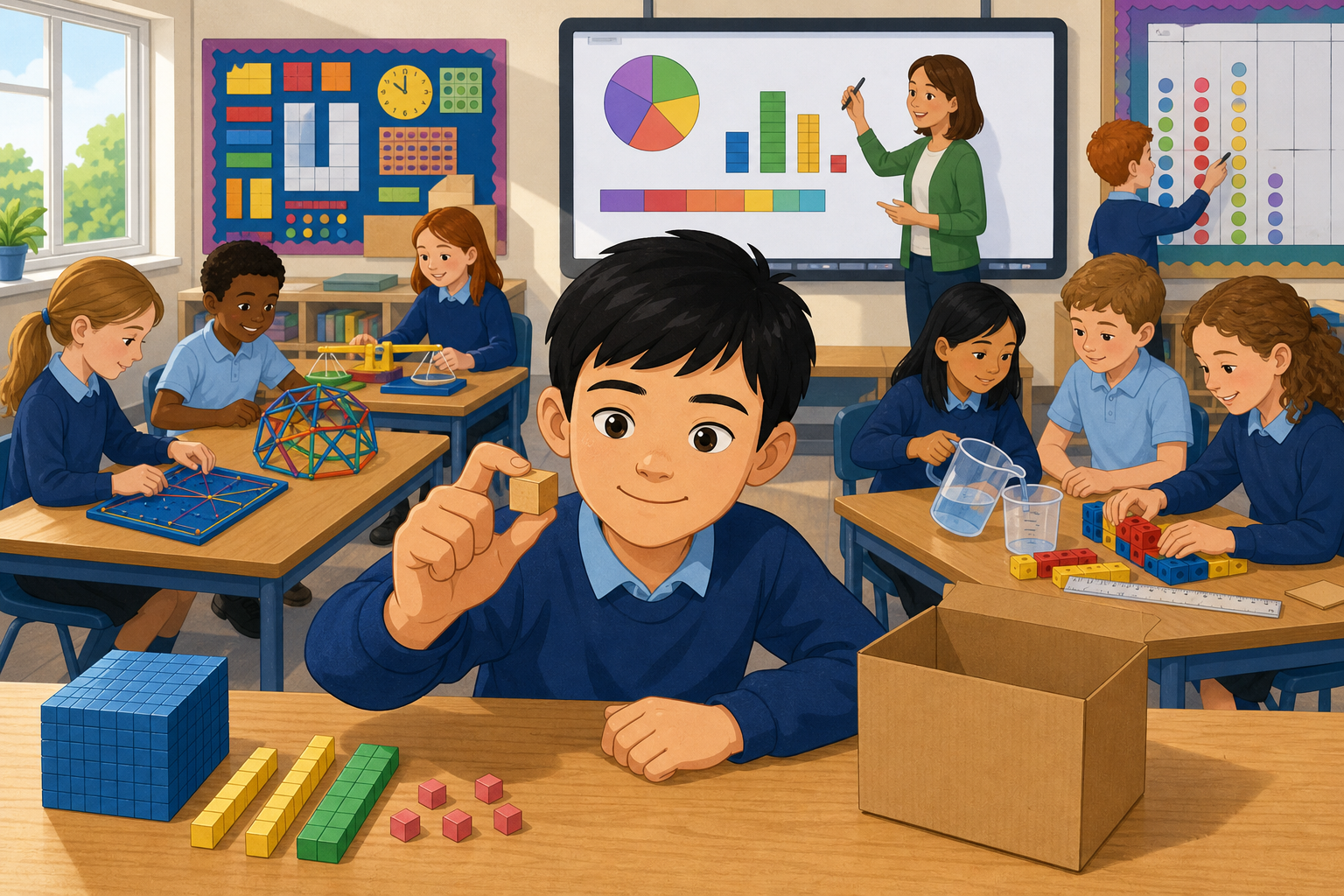
Here is one little cube, and here is a small cardboard box. Hands up: how many of these little cubes do you think it would take to fill the box right up to the top, with no gaps and none sticking out?
Have a guess before we work it out. Is it more than ten? More than twenty?
Show a real unit cube against a small box (a matchbox or a cube-tray works). Take three hands-up guesses, not open call-outs — you want a spread of estimates to compare against the answer later.
Do not reveal a number yet. The whole lesson answers how would we know for sure?
Watch each box fill with cubes, layer by layer. Count the bottom layer with me, then see what happens when another layer lands on top. Each cube is one cubic unit.
Play each fill one at a time. This layer idea is the make-or-break of the lesson.
First box, one layer: count the base aloud, a row of 3 then another row of 3, so six cubes in one layer.
Pause here. Take a prediction for a second layer before you reveal it.
Second layer: revoice a strong prediction, one layer is six so two layers is six and six more, twelve cubes. Name each cube as one cubic unit, so volume is 12 cubic units.
Point out we counted one layer and doubled, not one by one.
Third box, 2 by 2 by 2: base is 2 across and 2 deep, so four cubes per layer. Ask which is bigger, this or the last box, and why, before confirming two layers of four make eight, volume 8 cubic units.
Now we build some cuboids together, one at a time, and count the cubes each one holds. Each time, we find the bottom layer first, then say how many layers stack on top. One of you comes up to set the width, the depth and the height at the board, then reads the cube count out for us to check together — the rest of us agree aloud or put it right.
First, build 4 across, 3 deep and just 1 layer high. How many cubes in that one flat layer? Say it together.
Now keep the same layer and stack a second one on top: 4 across, 3 deep, 2 layers high. Predict the total before it appears, then read it out together.
Last, a cube that grows in every direction: 3 across, 3 deep, 3 layers high. Count the layers together as they stack.
This round is for talking it through together — no marking yet. Pupils take turns at the board and the class agrees or corrects out loud.
Insist on the two-step way of counting every time: how many in one layer? then how many layers? Do not let pupils count cube-by-cube once they have the layer idea.
Keep the pace to one build at a time: reveal, predict, confirm, then clear the board for the next build.
In your maths copy, sketch a cuboid built from cubes that is 2 cubes wide, 2 cubes deep and 3 cubes high. Then write how many unit cubes it holds in total.
Walk the room glancing at the sketches — check the base is 2 by 2 and there are three layers. This is whole-class copybook practice, not marking. Prompt anyone stuck: how many in one layer, and how many layers?
Now we work through some builds together and check each one. Each time, one of you builds it at the board, presses the Check button, and we all confirm it before we move on. The rest of us predict the answer aloud first, then thumbs-up to confirm when it checks out.
First: build a single flat layer of 8 cubes — that is 4 across, 1 layer high and 2 deep.
Now stack a second layer on that same base.
Next: a cuboid 3 across, 2 layers high and 3 deep.
Then: a cuboid 4 across, 2 layers high and 3 deep.
Last one is open: build any solid at all with exactly 12 cubes. There is more than one right answer, so let's see who finds a different way.
These are the practice questions — pupils check each answer. Pupils take turns at the board, press Check, and the class confirms before moving on. Keep the board work brisk rather than over-explaining.
The last target has more than one right answer (2 × 6 × 1, 3 × 2 × 2, and others all give 12). Use it for maths-talk: who made 12 a different way? The Check marks any correct cube count. Note the labels state each build in width, height, depth order to match the board steppers.
You're previewing this lesson. Get full access to this lesson and hundreds more — each one ready to teach, with interactive activities, printable resources and pupil progress tracking built in.