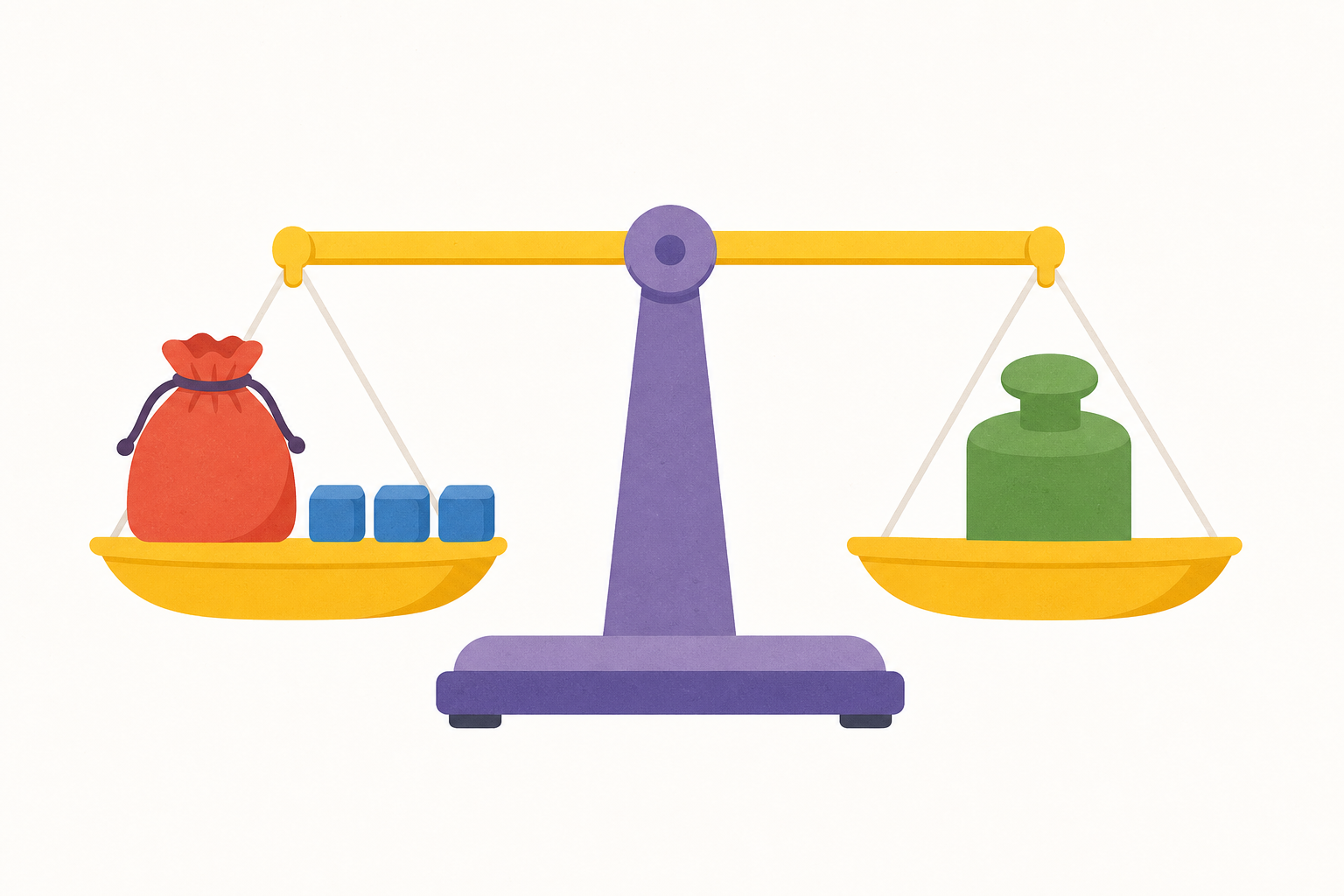
Here is a puzzle on a balance: a + 3 = 10. The letter a is hiding a number. Both pans have to weigh the same, so the beam stays level. What number do you think a is hiding?
Write the equation a + 3 = 10 on the board as pupils settle. Give five seconds of quiet think-time, then take three hands-up answers, not open call-outs. Do not confirm yet — hold the answer for the next step. Listen for whether pupils treat the letter as a real hidden number, not as decoration.
Watch these balanced sentences on the scales. In each one a letter is standing in for a missing number. See how the letter is just a name for the number that keeps both pans level.
In the next one the total is on the left — the balancing job is still the same.
In the last one the same letter appears twice. That means two of the same hidden number added together.
Say verbatim after each: the letter is only a name for the missing number.
Each time we say the value of the letter aloud. Then we read the whole sentence back with the number in place of the letter to check both sides match.
Let us find the value of the letter together. First we work e + 4 = 9 on the balance, sliding the letter block until the beam is level. Then we work three more the same way at the board: g − 3 = 8, then 7 + h = 16, then 13 = k + 5.
Talk this one through together — pupils take turns at the board and the class agrees or corrects out loud.
Work e + 4 = 9 on the balance tool first, sliding the letter block until the beam levels. Then work the other three at the board with the same balancing move. Say the value each time. Hold out for pupils to read the whole sentence back with the number in place of the letter — that is the check. For g − 3 = 8, watch for the pupil who slides to 5 (8 − 3); ask what number, take away 3, leaves 8? For 13 = k + 5, name that the total is on the left — the balancing job is unchanged. Values in order: 5, 11, 9, 8.
In your maths copy, find the value of the letter in each of these, then write the full sentence with the number in place of the letter:
Read each finished sentence back to yourself to check both sides match.
Walk the room glancing for whether pupils rewrite the sentence with the number swapped in — that rewrite is the check. No individual marking — this is whole-class copybook practice, not assessment. Answers: a = 7, n = 10, m = 7.
Now we work through these together at the board, sliding the letter block until both pans balance. First is a + 4 = 13. Then b + 4 = 18. Then c + 7 = 6 + 8. Last is d + d = 14.
The last two are the ones to slow down for. For c + 7 = 6 + 8, work out the right pan first — 6 + 8 = 14 — then find c to match it. For d + d = 14, the same letter appears twice, so it means two of the same hidden number added together — each d must be the same.
This is the practice round — pupils take turns at the board, check each answer, and the class confirms before moving on. Keep the board work brisk rather than over-explaining.
For c + 7 = 6 + 8, work out the right pan (14) first, then find c. For d + d = 14, both blocks are the same letter, so both must be 7. Values in order: a = 9, b = 14, c = 7, d = 7. Read each finished sentence back as the check.
You're previewing this lesson. Get full access to this lesson and hundreds more — each one ready to teach, with interactive activities, printable resources and pupil progress tracking built in.