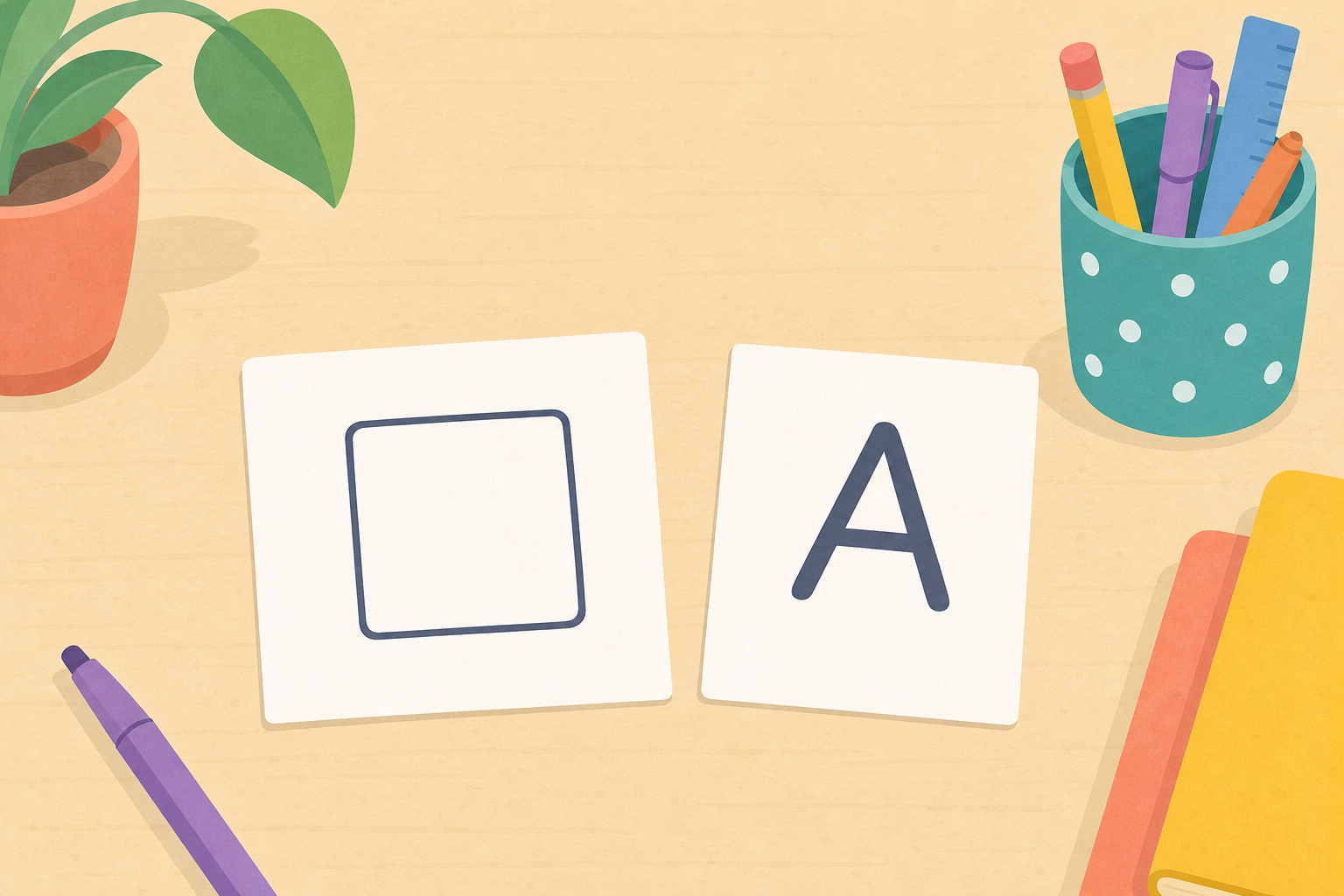
Here are two number sentences side by side:
□ + 3 = 9 and a + 3 = 9
One uses a box for the missing number. The other uses a letter. Is the missing number the same in both? Hands up: what do you think that missing number is?
Take three hands-up answers, not open call-outs. The point to draw out is that the box and the letter are two ways of writing the same hidden number — do not confirm the value yet, just get pupils noticing the two forms match.
Watch the balance beams. Each shows a number sentence with a letter for the unknown. Look for the value that levels the beam. The letter does the same job a box would do.
Now a fresh letter in a different sentence, b + 4 = 10.
The last one is different. Here the letter sits on its own on the left because the letter is the whole. On the right sit the two parts, 5 and 2. So d = 5 + 2. See if the same idea still works.
Let's work one out together on the balance. Our sentence is a + 4 = 9, written with a letter. We slide the letter until the beam hangs level. Then we say what the letter is standing in for. Remember: 9 is the whole and 4 is one part, so a has to be the other part.
Talk this one through together — pupils take turns at the board and the class agrees or corrects out loud.
Model the reasoning aloud: nine is the whole, four is one part, so a is the other part. Try a value, check the beam, adjust. Ask pupils to name the letter as a value ("a is five", not "it is five").
In your maths copy, copy this sentence and find a:
Write what a equals. Then rewrite the very same sentence with a box instead of the letter. To rewrite with a box, keep every number exactly the same and just swap the letter for an empty box, like this: □ + 5 = 11. This shows the box and the letter mean the same thing.
Walk the room glancing for two things: that a is written as 6, and that the box version reads □ + 5 = 11 with the same numbers. Remind anyone who is unsure that "rewrite with a box" means copy the sentence again but draw an empty box where the letter was. No individual marking — this is whole-class copybook practice, not assessment.
Now your turn on the balance. First we sort out one new kind of sentence together, then you slide and Check four of your own.
Look at this sentence: 12 = a + 5. The letter is on the right this time. 12 is the whole on the left. On the right, a is one part and 5 is the other part. The missing part is what makes both sides equal, so a is 7 because 7 + 5 = 12.
Now the four challenges. Slide the letter and press Check. First a straight add: b + 7 = 15. Then the letter on the right, just like we did: 16 = c + 9. Then the letter is the whole made from the two parts on the right: e = 3 + 6. Last, the letter is the whole again, but from different parts: f = 4 + 3.
Teach the letter-on-the-right form on the board before anyone touches the interactive. Work 12 = a + 5 together (no interactive for this demo).
Then the practice round, pupils take turns at the board, check each answer, class confirms. Keep it brisk.
Before each reveal, ask whether the letter is a part or the whole. The 16 = c + 9 one matches the worked example (c is 7). Whole-first sentences: e is 9 and f is 7. For your eye only, e = 3 + 6 is the take-away e − 6 = 3 written whole-first, keep that framing to yourself.
You're previewing this lesson. Get full access to this lesson and hundreds more — each one ready to teach, with interactive activities, printable resources and pupil progress tracking built in.