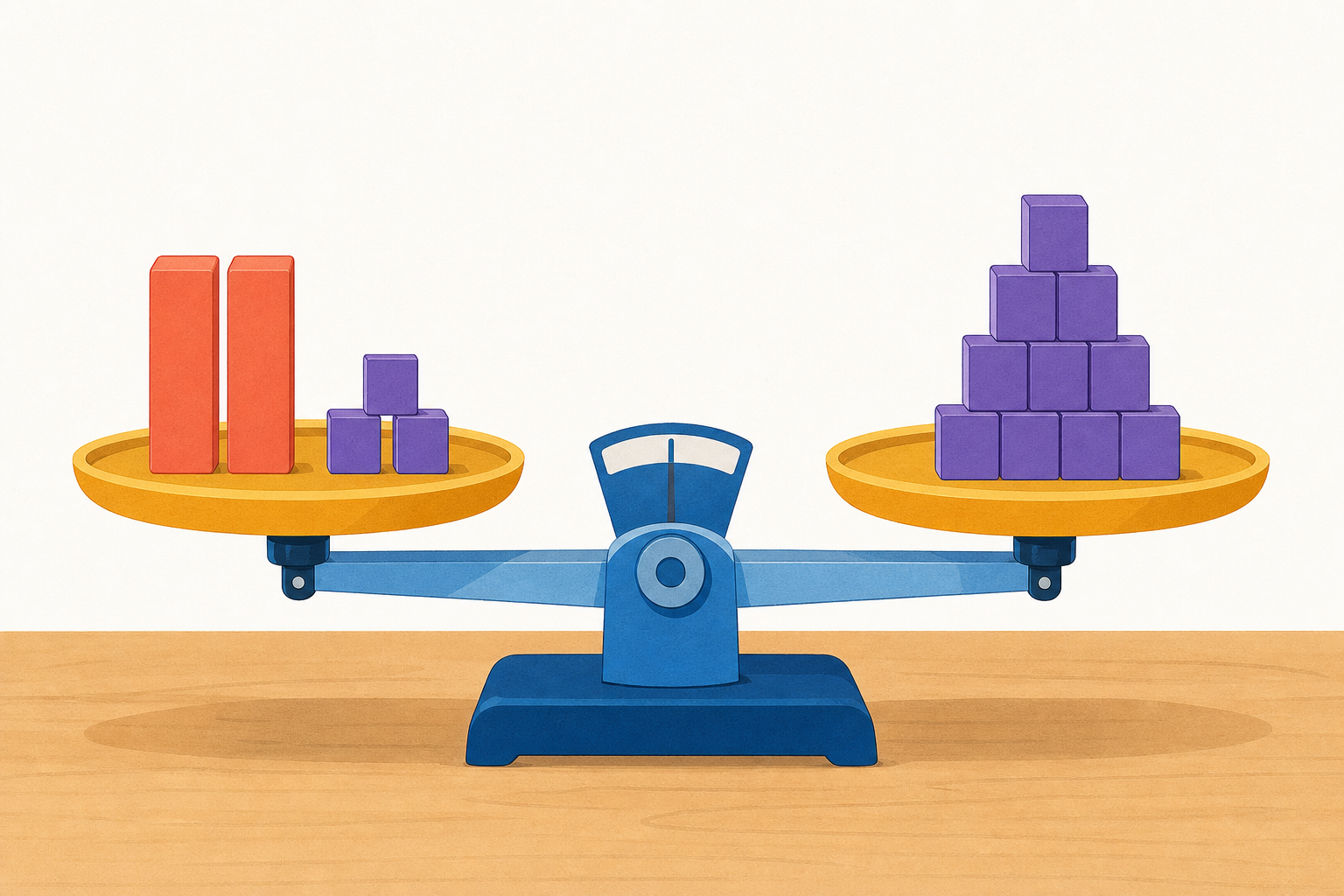
Here is a puzzle on the board: 2x + 3 = 11. We already know how to solve x + 5 = 12 in one move. This one has two things done to the x. Have a look: what is happening to the x here, and which thing would you undo first?
Take two or three hands-up answers, not open call-outs. Don't confirm which step comes first yet — that is the discovery of the lesson. Listen for a pupil who says 'take the 3 away first' and hold that thought for Watch and Notice.
Each beam below is already balanced. The x-block was multiplied first, then a number added or taken away on the same pan. To find x we peel those back in reverse: take off or add back that number, then split the multiplied blocks into equal shares. Watch as we work each beam, and notice which move comes first every time.
Work each one live on the beam; do not read the steps aloud like a script. For 2x + 3 = 11, take the three unit cubes off both pans first, then ask how many are in one x-block if two together match eight?
The order is the whole lesson. Hold out for pupils to notice the addition comes off before the multiplication is split — don't announce it. The third example (4x + 1 = 21) is the one to slow down on: the added number is small and easy to forget.
Let us solve 2x + 5 = 13 together on the beam. First take 5 off both pans, so 2x = 8. Now work out x by sharing 8 across the two x-blocks. Say your value for x out loud before anyone touches the slider. Then slide x to that value and watch the beam settle level to check we were right.
Talk this one through together — pupils take turns at the board and the class agrees or corrects out loud.
Take five off both pans (2x = 8) before anyone touches the slider. Ask the class to work out x by sharing, then slide only to confirm the beam balances — the slider checks the answer, it is not how we find it. Listen for anyone splitting before removing the number; revoice: so we tidy the pan first, then share the x-blocks.
If you have a physical beam to hand, you can repeat the same routine with 3x + 1 = 13 and then 5x − 3 = 12 (add 3 first for the subtraction case). The on-screen beam holds one equation, so treat these as optional extra turns, not part of the timing.
In your maths copy, solve each two-step equation by unwinding one operation at a time. Undo the addition or subtraction first, then the multiplication. Show every step.
Before you begin, we check one answer together so you know how. For 2x + 3 = 11, find x then put it back into the original equation and check that both sides match.
Now work these three the same way:
Write the original equation. Then write your working, doing the same to both sides. Then write the value of x. Check by putting your answer back into the first line, just as we did.
Board the check for 2x + 3 = 11 before pupils open copies: x = 4, so 2 × 4 + 3 = 8 + 3 = 11. Both sides equal, tick.
Walk the room glancing for the two lines of working and a written check, not just the final answer. This is whole-class copybook practice, not marking. Catch anyone who divides before subtracting, and anyone who skips the substitute-back line.
Answers: 2x + 3 = 11 gives x = 4; 3x − 2 = 7 gives x = 3; 4x + 1 = 21 gives x = 5. The printable Two-Step Equations Practice Sheet carries these three equations if you prefer pupils to work on paper.
Now we work through these equations together on the board, in order. First 2x + 3 = 11. Then 4x + 2 = 14. Then 3x − 1 = 8. Then 2x − 5 = 7.
Each one adds a wrinkle. The first two are straight adds. Then comes a subtraction on the pan. The last one gives the biggest answer to work back from. Work out x each time before we slide. Then slide to check and press Check.
This is the practice round — pupils take turns at the board, check each answer, and the class confirms before moving on. Keep the board work brisk rather than over-explaining.
Each pupil tidies the pan first (take off or add on), then works out x, then slides to check and presses Check. The order builds: 2x + 3 = 11 gives x = 4, 4x + 2 = 14 gives x = 3, 3x − 1 = 8 gives x = 3 (add 1 first), and 2x − 5 = 7 gives x = 6, the largest answer. If a slide lands on the wrong value, ask did we tidy the pan before splitting? rather than giving the answer.
You're previewing this lesson. Get full access to this lesson and hundreds more — each one ready to teach, with interactive activities, printable resources and pupil progress tracking built in.