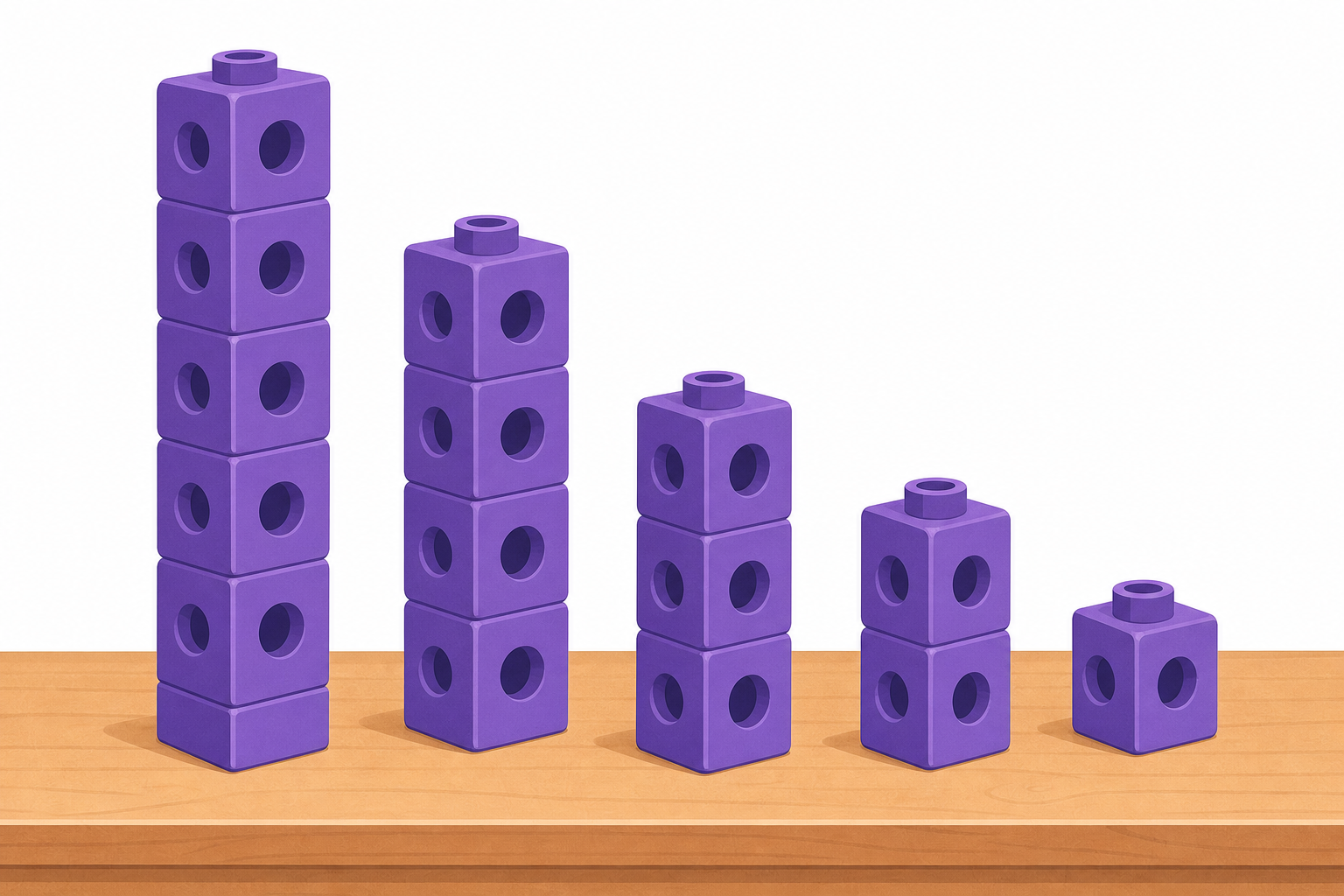
Here are five towers of cubes, and they are all different heights. Imagine we knocked them down and shared every cube out equally, so all five towers became the same height. Roughly how tall would each one be? Have a guess before we work it out.
Give five seconds of quiet think-time, then take three hands-up guesses, not open call-outs. Do not confirm or correct yet — the guessing is the hook, the levelling comes next. Listen for anyone who already lands near the middle height; you can revoice their reasoning in Watch and Notice.
We will level three sets of cube towers until each set sits at one equal height — that height is the mean. Watch how levelling the towers and adding-then-dividing land on the very same number. For the last two sets, predict the equal height in your head before it is revealed.
Set one 4, 6, 8: level them live so all three sit at 6, point to the mean on the overlay. Then show the two routes meet — total 4 + 6 + 8 = 18, shared into 3 gives 18 ÷ 3 = 6. Call the mean the fair-share height.
Set two 12, 9, 15, 4: take two predictions first, then reveal total 40, four values, 40 ÷ 4 = 10 — mean sits between the values, equal to none of them.
Set three 0, 3, 6: turn-and-name the equal height. Hold out for the empty tower still counting — divide by 3, not 2, giving 3. Common slip is ignoring the zero tower; revoice an empty tower is still a tower.
At your tables, level a fresh set of cube towers so they are all the same height, then check your answer against adding-and-dividing. Today's set is 5, 7, 3, 9 cubes. Level them together, count how many cubes are in each equal tower, then work out (5 + 7 + 3 + 9) ÷ 4 to see if it matches.
Pupils measure and level at their desks with their own cubes — circulate and catch alignment slips on the spot. The class reads aloud and you reconcile any disagreement as you circulate.
The total is 24 and there are 4 towers, so 24 ÷ 4 = 6 — every tower should end at 6 cubes. Watch for groups who stop levelling too early or who forget to count all four towers when dividing. Ask one group to show their levelled towers to the class and another to show the add-and-divide line, then confirm the two match.
In your maths copy, write out the lesson's data set. Show the total, then divide by the number of values, and underline the mean.
Walk the room glancing at the division line and the count of values — this is whole-class copybook practice, not marking. Check nobody divides by 3 instead of 4.
Two players scored a mean of 5 points across 2 games. What was their total? Multiply the mean by how many games: 5 × 2 = 10 points in total. That is the move you need for the last problem below.
Now we work through four mean problems together, each a step harder than the last:
Four mean problems in Irish contexts, rising from a plain three-value mean to a reversed missing-value stretch, after a short worked example of working backwards.
Ways to start:
Stretch:
This is the practice round — pupils take turns at the board, check each answer, and the class confirms before moving on. Keep the first three problems brisk to protect two or three minutes for the missing-value problem, which is the hardest.
Answers: rainfall (4 + 6 + 8) ÷ 3 = 6 mm; hurler (3 + 5 + 5 + 7) ÷ 4 = 5 points; savings (2 + 3 + 0 + 4 + 6) ÷ 5 = 3 (the €0 still counts as a value, so divide by 5); missing sweets: mean 8 × 3 = 24 total, minus 6 and 11 leaves 7. The missing-value one reverses the rule — multiply the mean by how many to get the total back, then subtract the known values, exactly like the worked example at the top. Ask the class to predict whether the third friend has more or fewer than 8 before revealing.
You're previewing this lesson. Get full access to this lesson and hundreds more — each one ready to teach, with interactive activities, printable resources and pupil progress tracking built in.