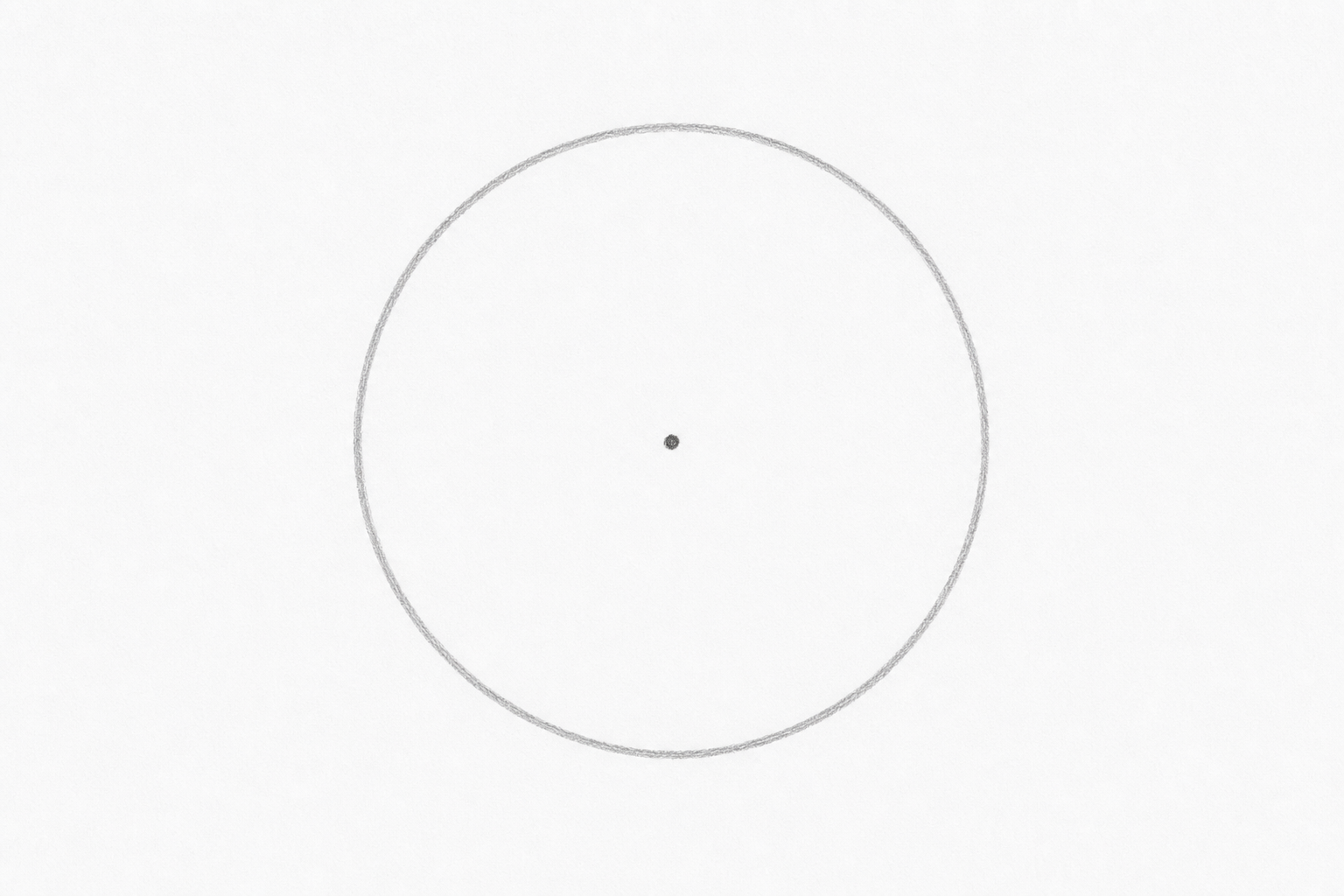
On the board is a circle drawn by going round the edge of a cup, with one dot marked in the very middle.
Look at the edge. Do you think every point on that round edge is the same distance away from the middle dot? Have a good look before you decide.
Give five seconds of quiet think-time, then take two or three hands-up answers. Don't settle the question yet, the model step proves it.
Look at the circle on the board. The middle point is the centre.
A straight line reaches from the centre out to the edge. That is the radius. Every radius of the circle is exactly the same length, wherever it points.
A line goes straight across the circle and through the centre. That is the diameter. Notice how the diameter is made of two radii put together, one radius on each side of the centre, so it is twice as long as one radius. (Radii means more than one radius.)
Point to each part as it appears and name it once, clearly. On the radius, hold out for the class to spot that every radius is exactly the same length, wherever it points.
On the diameter, the key move: it goes through the centre, and it is two radii long. Point out the two radii sitting end to end, one on each side of the centre, before you say the diameter is twice as long as one radius. Say radii aloud and remind the class it just means more than one radius. No circumference and no measuring today.
Now some of you come up to the board in turn to set each part, while the rest of the class watches and agrees or corrects out loud.
First one pupil shows the centre. Then another sets a radius. Then another draws a diameter across through the centre. Last, one more sets a second radius pointing a different way, and we all check it is the same length as the first.
Pupils take turns coming up to the board; the rest of the class judges each move aloud and corrects it if it is wrong.
Watch for the common slip: a line drawn edge-to-edge that misses the centre is not a diameter. Ask each time: does your line go through the middle dot? When a second radius is set, get the class to judge by eye that it matches the first in length.
Here is a quick way to find the centre. Watch the scrap circle of paper being folded in half, then in half again. Where the two folds cross is the centre.
Now in your maths copy, draw round a circular lid. Mark the centre with a dot in the middle. Then draw and label one radius and one diameter with your ruler.
Model the fold-in-half-twice trick on a spare scrap circle of paper so the class sees the folds crossing at the centre. Pupils do not cut or fold in this step; they trace the lid in their copies and place the centre dot by eye near the middle.
Walk the room and glance for two things: the centre dot really is near the middle, and the diameter line passes through that dot. This is whole-class copybook practice, not marking.
Now we work at the desks with real round things, sharing the objects around as you finish. Start with one round object and draw round it. Find and mark the centre with a dot. Draw one radius from the centre to the edge and label it. Draw one diameter straight across through the centre and label it. Then swap for another round object and do it again. Each time, say how you know your diameter passes through the centre.
This is the practice round with real objects at pupils' desks, shared and passed around; the class confirms the finished drawings aloud at the end. Keep the pass-on rhythm brisk.
The make-or-break is the centre: if the centre dot is off, the diameter won't cross it. Circulate and catch that on the spot, and remind pupils where the centre sat when you folded the scrap circle earlier if their dot is guessy. Revoice a strong answer: your diameter goes through the middle, so it splits the circle into two matching halves.
You're previewing this lesson. Get full access to this lesson and hundreds more — each one ready to teach, with interactive activities, printable resources and pupil progress tracking built in.