1 - Getting Started ~5 mins
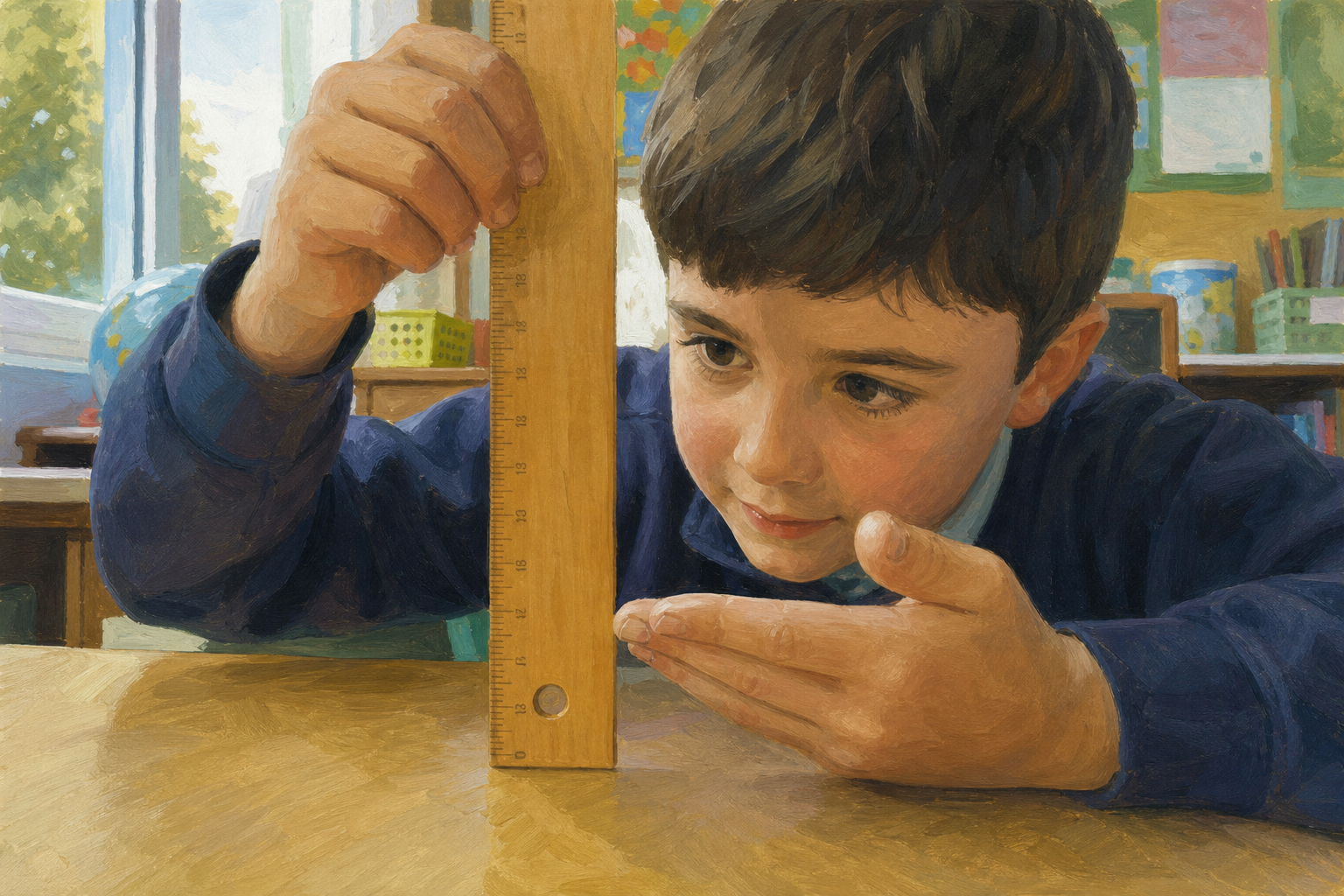 Watch the front carefully. A volunteer is about to catch a falling ruler between their fingers. Can they catch it before it falls far?
What do you think the brain and senses are doing in that tiny moment?
Hold a 30 cm ruler upright so the zero end hangs between a volunteer's open thumb and finger (about 2 cm apart). Drop it without a countdown. Let the class call out roughly where it was caught.
Keep this light: one surprising catch, then the question. Do not explain the fair-test plan or the key vocabulary yet. No rulers are distributed yet; this is a whole-class demo only.
Ask: Was that a slow, careful plan, or a fast reaction? Surface ideas that eyes, fingers and the brain work together.
2 - Your Brain and Senses ~8 mins
In that catch, the volunteer's eyes saw the ruler move. Their brain got the message and told their fingers to pinch. That quick response is a reaction.
How far the ruler fell before the catch is the reaction distance. A longer distance means a slower reaction.
 Thumbs up if you think the brain can react before we plan every step through. Thumbs sideways if you are not sure yet.
Board load (keep light): only reaction and reaction distance need to land on screen. Fold brain and senses into talk-back to the demo: the volunteer's eyes (sense) sent a message; the brain linked it to the pinch. Do not walk the full table cell by cell.
| Concept | Why it matters | Example |
|---|---|---|
| Brain — the organ that takes in messages from the senses and sends messages so the body can respond quickly | Every catch, dodge and spoken answer depends on the brain linking senses to action | Seeing a football come toward you and moving your hands to meet it |
| Senses — the ways the body gathers information: sight, hearing, touch, taste and smell | Without senses, the brain has nothing new to work with | Using only touch to name a hidden object in a feely bag |
| Reaction — how the body responds when the senses notice something; some reactions are so quick they feel automatic | Fast reactions help keep people safe in sport, traffic and everyday life | Pinching a falling ruler as soon as you see it move |
| Reaction distance — how many centimetres a falling ruler drops before you catch it; a longer distance means a slower reaction | It turns a hard-to-time moment into a measurement the class can compare fairly | Catching at 15 cm is faster than catching at 25 cm on the same ruler |
Use the table as a glance-back aid only if a pupil needs a word restated. Do not read every cell aloud.
Must-say script (protect this as the core of the 8 minutes; say it aloud once before groups plan):
I wonder whether I catch faster when my eyes are ready or when I am listening to someone talking. I predict the distracted catch will be slower, so the number on the ruler will be bigger. I test three ready catches and three distracted catches, same partner, same hand, same starting gap. I observed ready catches around 15–20 cm and distracted ones around 22–28 cm. I think distraction slows the reaction because the brain is busy with another message.
Optional asides only if the model finishes early: Misconception — the hand does not “just know”; the sense sends a message, the brain processes it, then the hand moves. Nature of STEM — people who study reaction time help design safer roads, clearer signs and better sports training (expand fully in the evidence talk).
End the step with the thumbs check on the board so every pupil has a clear move.
3 - What Will We Find Out? ~5 mins
We are going to investigate how quickly people react. Your group will help design the test, then you will measure in pairs.
Here are the two set-ups you can compare:
- Eyes ready versus distracted (the dropper asks a simple question at the exact moment of the drop)
- Writing hand (the hand you usually write with) versus your other hand
Choose one comparison. On your results table (Investigation Journal), write the comparison you chose, then write your prediction: which set-up will give the shorter catch distance, and why. Do this before any dropping starts.
Frame the theme: reaction time with a dropped ruler. Name both concrete set-ups on the IWB before groups choose. Groups plan together; they will later split into measuring pairs that all use the same group comparison and prediction.
Where the plan goes: every pupil uses the same place on the provided results table (Investigation Journal DataTable page) — the prediction/comparison lines at the top of the page, above the trials grid. Pupils write (1) which comparison they chose and (2) which set-up will be shorter and why. If a copybook substitute is in use, rule two short lines at the top of the table for the same two sentences.
Gloss “writing hand” if needed: the hand you usually write with (sometimes called the dominant hand). Gloss “condition” once as “set-up” if anyone still looks unsure.
Fair-test reminders the class already knows: same ruler, same drop height (zero between the fingers), same starting finger gap, same catcher for a set of trials, three trials each set-up, then use the middle value.
Key questions: What is the one thing we change? What do we measure? What must stay the same?
Anyone who prefers not to catch can be the dropper or the recorder. That is a full role in the investigation.
Differentiation: offer sentence starters for predictions: I think the catch distance will be longer when… because…
4 - Catch the Ruler ~18 mins
Your group splits into measuring pairs. Each pair needs one ruler and uses the comparison and prediction your group just wrote.
- One person drops the ruler; the catcher pinches it as soon as it moves.
- Read the centimetre mark at the top of the catcher's finger and write it on your results table.
- Do three trials for each set-up. Circle the middle value on the results table (for example, if you catch at 18 cm, 22 cm and 16 cm, the middle is 18 cm).
Finish line: both middle values circled on your results table. That is the main job.
Before pairs start
Model the drop once more slowly: zero end between open thumb and finger, no countdown, pinch to catch, read the mark at the upper edge of the finger. Remind them that a bigger number means a slower reaction.
Social unit: planning groups stay as the design unit; they now split into measuring pairs. Every pair in a group runs the same comparison and prediction the group wrote. Each pair keeps its own results table and will later call out its own two middle values to the class chart. There is no merge step back into one group middle.
Kit check: one ruler per measuring pair (not one per group of four). Split groups so every pair measuring has its own ruler.
One shared distraction method for the whole class: if a group chose ready versus distracted, the dropper asks one simple question (favourite colour, or 7 + 5) at the exact moment of the drop. Do not mix methods so every “Distracted” bar on the class chart means the same thing.
Reaction test (protect this block first: about 12–14 minutes)
- Pairs: dropper and catcher; swap roles after a full set only if both middle values are already circled.
- Set-up A and set-up B as the group chose (ready vs distracted with the shared question method, or writing hand vs other hand).
- Three trials each set-up is the standard; record all three on the results table; circle the middle value.
- If only two fair trials exist for a set-up: record both and use their average (add the two distances and divide by two). Write “avg of 2” beside that number so the class knows it is not a three-trial middle. Prefer three trials whenever you can. Never invent a “middle” of two values.
- Minimum viable finish: one fair summary value per set-up on the page (three-trial middle, or labelled average of two). Incomplete pairs still contribute to the class pool.
Optional feely-bag senses check (only if both middles are done and time remains: about 3–4 minutes)
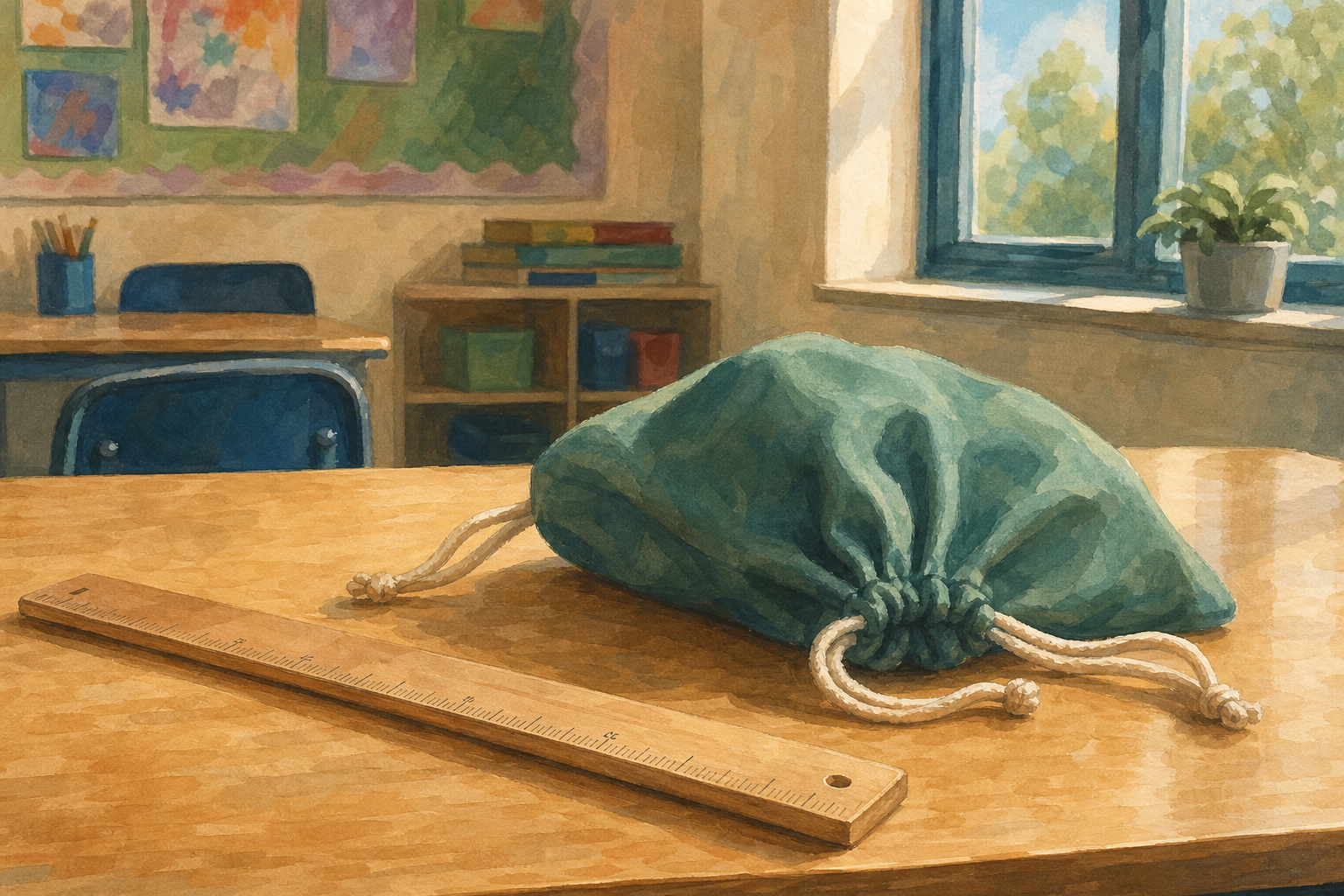
Not on the pupil finish path. One bag per group with 4–5 safe classroom objects (rubber, coin, cotton wool, pencil stub, smooth shell or large button). Catcher closes eyes or looks away; partner places one object in the bag. Name it by touch only. Brief talk: which sense is working hardest? If time is short, skip the bag; the reaction-distance data is the load-bearing evidence for later steps.
What to expect
Ready / writing-hand distances often sit roughly in the 15–30 cm band; distracted or other-hand trials are often several centimetres longer. Overlap and higher numbers are fine; that is real data.
Safety: no swinging or throwing rulers; nothing near eyes or ears; soft objects only in bags. Opt-out pupils drop or record.
Circulate and ask watchers: Do you think that drop was fair? What would you predict for the next trial?
5 - Notice What Changed ~7 mins
Look back at your trials. When was the catch hardest? Did the catch feel early or late? Did fingers start too wide between trials?
If you tested distraction: did the question make anyone miss or catch higher on the ruler?
If you tested hands: did the other hand feel slower or miss more often?
Share one careful observation with your group: something you saw or felt about your hand and eyes as you tried to catch, not just the number.
This is the observation beat: separate what we saw or felt from what we think it means. Lead with ruler-catch noticing for every pair.
Prompt pairs to notice concrete things that match their comparison:
- Was the catch early (anticipation) or late (miss or high number)?
- If distraction: did talking change the starting finger gap or cause a miss?
- If hands: did the other hand miss more often or feel slower?
- Did the catch feel planned or sudden? (Keep automaticity without saying the hand acts alone.)
- If you had time for the bag: which features (shape, texture, temperature) gave the brain the best clues? Gate this prompt; skip it if the bag was not used.
Push language such as I noticed… and I felt… before any conclusion talk.
Common slip: changing two things at once (different hand and talking). If that happened, name it honestly as something that made the test less fair.
6 - Pool Our Catch Distances ~10 mins
Call out your pair's middle catch distance for each set-up. We will add the numbers on the board, then look at the bar chart.
Which bar is tallest? Does a taller bar mean a faster reaction or a slower one?
How far did the ruler fall?
Drive the data-recorder on the IWB in explore mode. The pooling unit is the measuring pair, not the planning group. Each row is one pair's already-calculated middle catch distance (or labelled average of two) for one set-up (for example Eyes ready, Distracted, Writing hand, Other hand). Enter the summary values from paper only; do not re-run three trials or recalculate on the board.
Thirty rows hold a full class of pairs on one two-set-up comparison (about 12–15 pairs × 2 set-ups). If pairs chose different comparisons, pool one comparison first (ready versus distracted), then the other if time allows. Empty rows can stay blank.
Ask: Which bar is tallest? Does a taller bar mean faster or slower? (Taller = longer distance = slower reaction.)
Use classAverage to show a pooled class figure under the chart when enough pairs share the same set-ups.
Pupils also finish any missing numbers on their paper results table while you enter class values.
7 - What Does the Evidence Show? ~5 mins
Look at the chart and your table. Did the evidence match your prediction?
Talk together: what do these results suggest about how the brain uses messages from the senses? Where might quick reactions matter on Irish roads or in sport?
Display-only science talk. Revoice pupil ideas; do not type responses into the platform.
Draw out:
- Evidence over opinion: point at the bars or the middle values.
- Observation versus inference: longer distance is what we measured; “the brain was busier” is what we think it means.
- Unexpected results are still data: if distraction did not slow everyone, ask what else might have varied.
Nature of STEM weave (concrete hook): picture a GAA goalkeeper diving for a late shot, or a cyclist waiting at lights near the school gate — a longer reaction distance means less time to move. Researchers and safety teams study reaction time to improve sports training and to design clearer road layouts, signs and signals so drivers and pedestrians have enough time to respond. Keep it hopeful: careful measuring helps people make safer choices.
If a pair's test was unfair, celebrate that they spotted it; that is working scientifically.
8 - Closing Thoughts ~2 mins
Today we saw that the brain takes in messages from the senses and can react very quickly. We measured reaction distance, compared set-ups, and used evidence to talk about our results.
That same quick team-up is what a GAA goalkeeper needs for a late shot, and what helps you at the lights near school.
One thing to remember: a fair test changes one thing, measures one thing, and keeps the rest the same.
Quick oral recap with thumbs or short pair shares: Tell your partner one thing that slowed a reaction today.
Safe pack-away: collect rulers and feely bags; check small objects are all back in bags.
Optional homework (journal, not digital): ask an adult about one time a quick reaction mattered at work, in sport or while travelling, and note one sentence.
Unlock the full learning experience
You're previewing this lesson. Get full access to this lesson and hundreds more — each one ready to teach, with interactive activities, printable resources and pupil progress tracking built in.
This lesson is copyright of Coding Ireland 2017 - 2025. Unauthorised use, copying or distribution is not allowed.