1 - Getting Started ~4 mins
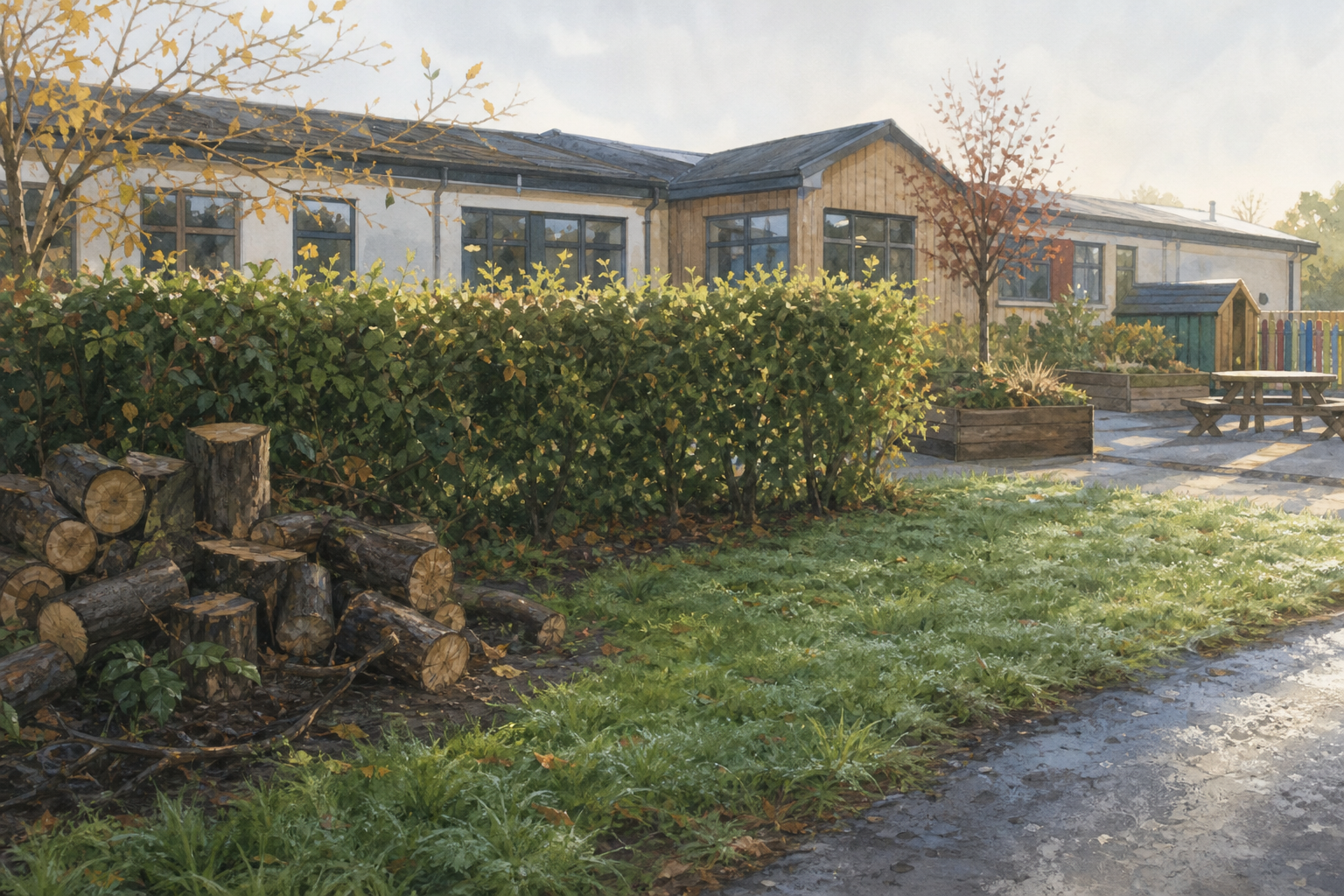 Imagine you are the first person ever to study the living things in our school grounds. Where would you start looking, and what would you write down first?
Today we begin a two-part project: we survey a real patch outside, just as ecologists (scientists who study living things outdoors) do before they act to protect a place.
Keep this beat light. Do not hand out kit or name the full method yet. Stand near the window or door so the grounds are in view if possible.
Ask: If we only looked once, near the door, would we know the whole school grounds? Draw out that a fair survey needs a chosen patch and a careful record.
Link forward: next lesson in this project we will build food chains from today's notes, so every careful observation matters.
2 - How We Survey a Habitat ~5 mins
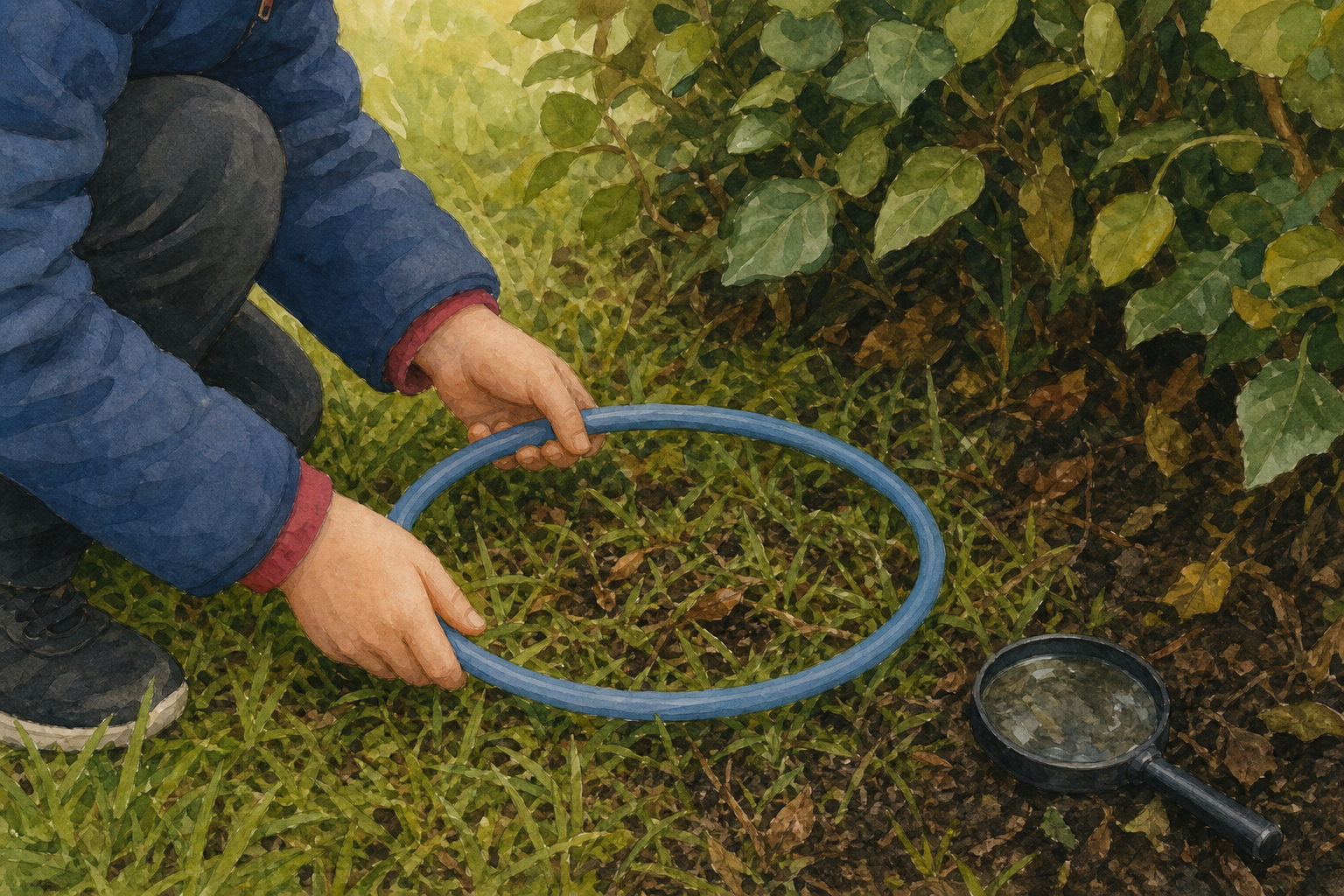 Today we need two words for our outdoor work.
Habitat is the place a living thing calls home and finds food, water and shelter. A damp log pile is a habitat for woodlice.
Quadrat is a hoop or string square that marks one fair patch so every group looks at the same size of ground.
We will take a careful look and record what we find. Why do scientists mark one small patch instead of wandering the whole field?
Project only the short board text (habitat and quadrat). Keep survey in plain language as "a careful look and record". Hold ecosystem for the sense-making step once groups have real finds and a chart to hang it on.
| Concept | Why it matters | Example |
|---|---|---|
| Habitat — the place where a living thing lives and finds food, water, shelter and the right conditions | If we know the habitat, we can guess what might live there and what it needs to stay healthy | A sunny grass square suits daisies; a damp log pile suits woodlice |
| Quadrat — a hoop or loop of string that marks the same size of ground for every group | It keeps the look fair: every group studies a patch of the same size | Drop the hoop gently, then only count what is inside the rim |
| Survey (plain language today) — a planned look that records living things and conditions, not just a quick glance | A survey gives evidence you can share and use later (we will use ours for food chains next time) | Irish ecologists survey a bog or hedgerow before any work begins on it |
Misconception to head off: children may think only big animals "count". Worms, woodlice, spiders, grass and moss are living things and belong on the record.
Nature of STEM: say briefly that this is how ecologists work in Ireland before protecting a habitat: look carefully, record evidence, then decide.
3 - What Might We Find? ~3 mins
Our class will survey one chosen patch of the school grounds. Talk with your group: what living things do you predict you will find, and will the patch feel damp or dry, sunny or shady?
Be ready to share one prediction and one reason.
Before you go out
Name the class patch clearly (for example the hedge edge, the grass square by the wall, or the log pile). Groups will use the same habitat type so results can be pooled.
Format: think–pair–share, then two or three quick group feeds (keep feedback short so outdoor time stays protected).
Non-negotiable before exit: leave at least one short class prediction list on the board (living things + damp/dry or sunny/shady guesses). That list is the inquiry hook you revisit after the survey. If the yard walk looks long, cut to one pair feed only, but still write the class list before you leave. If even that is squeezed, capture one whole-class prediction aloud at the door brief in Step 4 so the prediction-to-evidence arc still lands.
Prompts: What might live under a leaf? Would a daisy prefer sun or deep shade? Predictions are never wrong; they start the science.
Ask groups to whisper one thing they think a living thing in that patch might need (food, damp soil, shade, shelter).
If outdoor walk time looks long: take only one or two feedbacks here rather than four. Protect the class prediction list, the hoop look, the journal write-up and the interdependence talk later.
4 - Survey Our Patch ~23 mins
We are going outside to survey our chosen patch the way ecologists do. Each group has one job sequence:
- Place your quadrat gently on the agreed patch.
- Look only inside the hoop for plants and minibeasts (small animals like worms, woodlice and spiders). Use the ID cards to name what you find.
- On your outdoor tally sheet, mark every living thing inside the hoop.
- Finish your tally.
- Circle damp or dry, and sunny or shady.
- Write what two living things seem to need.
- Put every living thing gently back where you found it. Move slowly and lift leaves carefully.
Before the lesson
- Check weather and outdoor boundaries; brief a second adult if available.
- Print one set of the provided ID cards per group (full card texts below).
- Print one outdoor tally sheet per group (species marks, damp/dry, sunny/shady, two needs lines).
- Use plastic hoops, or loop string into a square about 50 cm on each side (about 2.5 m of string per loop, including knot allowance); one quadrat per group. Four rulers or sticks laid as a square also work.
- Clipboards ready with the outdoor tally sheet clipped on (not the full journal page outdoors).
Suggested outdoor split (about 23 minutes total)
- Walk-out, boundaries and door brief: about 4 minutes
- At the hoop (finds, tally, conditions, needs): about 13–14 minutes
- Return living things, walk-in and hand-washing: about 5–6 minutes
Priority if time runs tight: slow searching at the hoop is the point. If walk time is long, shorten prediction feedback indoors rather than the hoop look, but keep the class prediction list (or one door prediction). Protect the journal write-up and the interdependence talk after you return; when reclaiming minutes later, trim chat around the chart, not the data entry that builds it.
Wet-day / indoor alternative: pupils who should stay indoors can tally from photos you take of one quadrat, or act as indoor recorders for a paired outdoor group.
Brief both finds and conditions at the door (before exit)
Model once indoors or at the door so patch time is pure survey, not re-instruction. Budget walk-out, boundaries, return and hand-washing inside this outdoor block. If Step 3 was cut very short, speak one class prediction aloud here before you leave so the inquiry hook still exists.
- Walk to the agreed patch together.
- Each group places the quadrat flat without stamping the ground first.
- Spend the time looking only inside the quadrat: plants, minibeasts, signs of life (holes, webs, droppings) and leaf litter.
- Use ID cards to name finds; if unsure, draw it and write "unknown — looks like…".
- On the outdoor tally sheet, keep a running tally or name list of every living thing inside the hoop (this evidence feeds the class chart later).
- Before leaving the hoop, work the tally sheet in order: finish the tally; circle damp or dry and sunny or shady; write what two living things seem to need.
- Return living things gently; no collecting jars to keep.
- Return to class and wash hands.
Prompts at the patch: Put a finger near the soil (gloved) — damp or dry? Can you see your shadow clearly here? Why might a woodlouse choose the underside of a log?
Look-fors: groups link at least one living thing to a condition (for example snails and damp; daisies and light). Accurate tallies, not mental notes alone. Check that every group has circled conditions and written two needs before packing up.
Safety: mind nettles and brambles; no tasting; wash hands on return. Pupils who should stay indoors can tally from photos you take of one quadrat, or act as indoor recorders for a paired outdoor group.
ID cards (print as provided — full texts)
Card 1 — Earthworm: Long, soft body with rings, no legs. Often pink or brown. Lives in damp soil. Loosens soil and eats dead plant bits.
Card 2 — Woodlouse: Small grey armour plates, seven pairs of tiny legs. Rolls or runs when touched. Needs damp, dark places under logs and stones.
Card 3 — Spider: Eight legs, body in two parts. May sit on a web or hide in grass. Hunts or traps small insects.
Card 4 — Snail: Soft body with a coiled shell. Leaves a shiny trail. Likes damp plants and feeds on leaves.
Card 5 — Ant: Six legs, clear head–middle–end body. Often in busy trails on soil. Lives in groups and carries food home.
Card 6 — Beetle: Hard wing cases meeting in a straight line down the back, six legs. May be black, green or brown. Hunts or scavenges on the ground.
Card 7 — Daisy: Low plant with a yellow centre and white petals. Often on short sunny grass. Needs light to flower.
Card 8 — Grass: Long narrow green leaves from the ground. Covers much of the field. Provides food and shelter for many small animals.
Card 9 — Clover: Leaves usually in threes, sometimes small round flower heads. Common in lawns. Insects visit the flowers.
Card 10 — Moss: Soft green cushions on damp soil, path edges or the base of walls. Holds water and shelters tiny creatures.
If a group finds a bird sign (feather) or a larger visitor, note it as "seen near the patch" rather than inside the quadrat, so the method stays fair.
Outdoor tally sheet (print as provided — layout)
One A5 or half-A4 strip per group, clipped to the clipboard outdoors:
- Living things inside the hoop — blank lines or simple tally boxes for names/marks
- Conditions — circle one: damp / dry; circle one: sunny / shady
- What two living things seem to need — two short lines
Transfer these notes into the Investigation Journal back in class. Do not take the full journal page onto damp grass.
5 - Record in the Investigation Journal ~8 mins
Back inside, open today's Investigation Journal page. Use these headings:
- What we found (list or tally from your outdoor tally sheet)
- Conditions (damp or dry, sunny or shady)
- What two living things seem to need
- One question we still have
Write from your outdoor notes so every group is ready to share counts.
Hands washed before pencils. This write-up is in-lesson and required before pooling tallies; do not set it as homework. Optional extras only (quadrat sketch, an extra question) may go home later.
One InvestigationLog page per pupil (or pair if you preferred shared clipboards outdoors and individual write-up now). Transfer outdoor tally sheet marks and condition notes into the journal headings above.
Remind them these notes stay safe for the next lesson in this project, when groups will build food chains from the survey.
Support: sentence starters on the board — We found… The ground felt… I think the … needs … because…
Extension: sketch the quadrat layout showing where the main finds sat (sunny edge vs under leaf litter).
Unlock the full learning experience
You're previewing this lesson. Get full access to this lesson and hundreds more — each one ready to teach, with interactive activities, printable resources and pupil progress tracking built in.
This lesson is copyright of Coding Ireland 2017 - 2025. Unauthorised use, copying or distribution is not allowed.