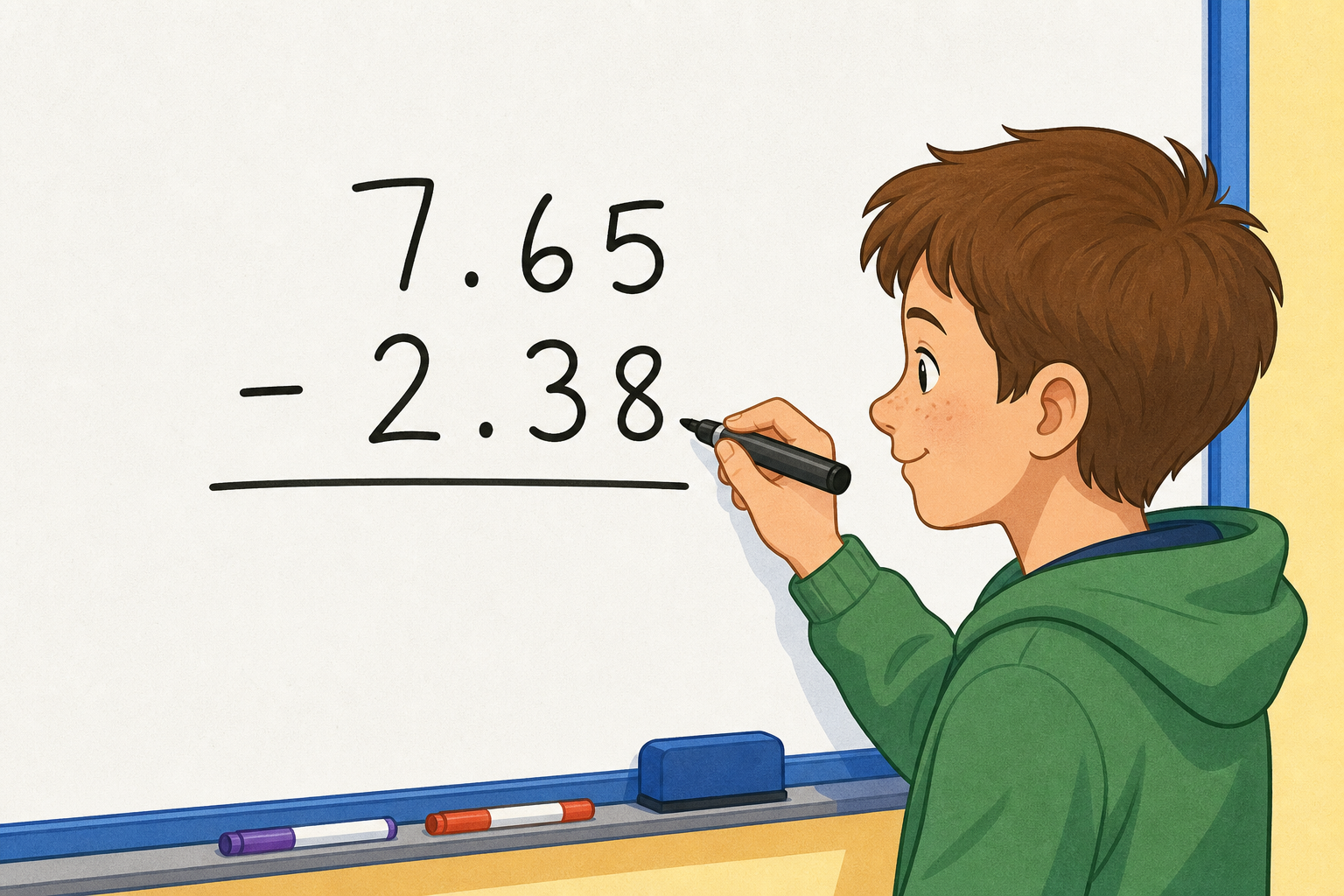
Look hard at where the decimal points sit and where each digit lands. You already know one rule that keeps everything in order when we work with decimals. Does that same rule seem to be holding here?
Here is a subtraction laid out ready to work: 4.5 − 1.75. Is this layout right, or is something wrong with it?
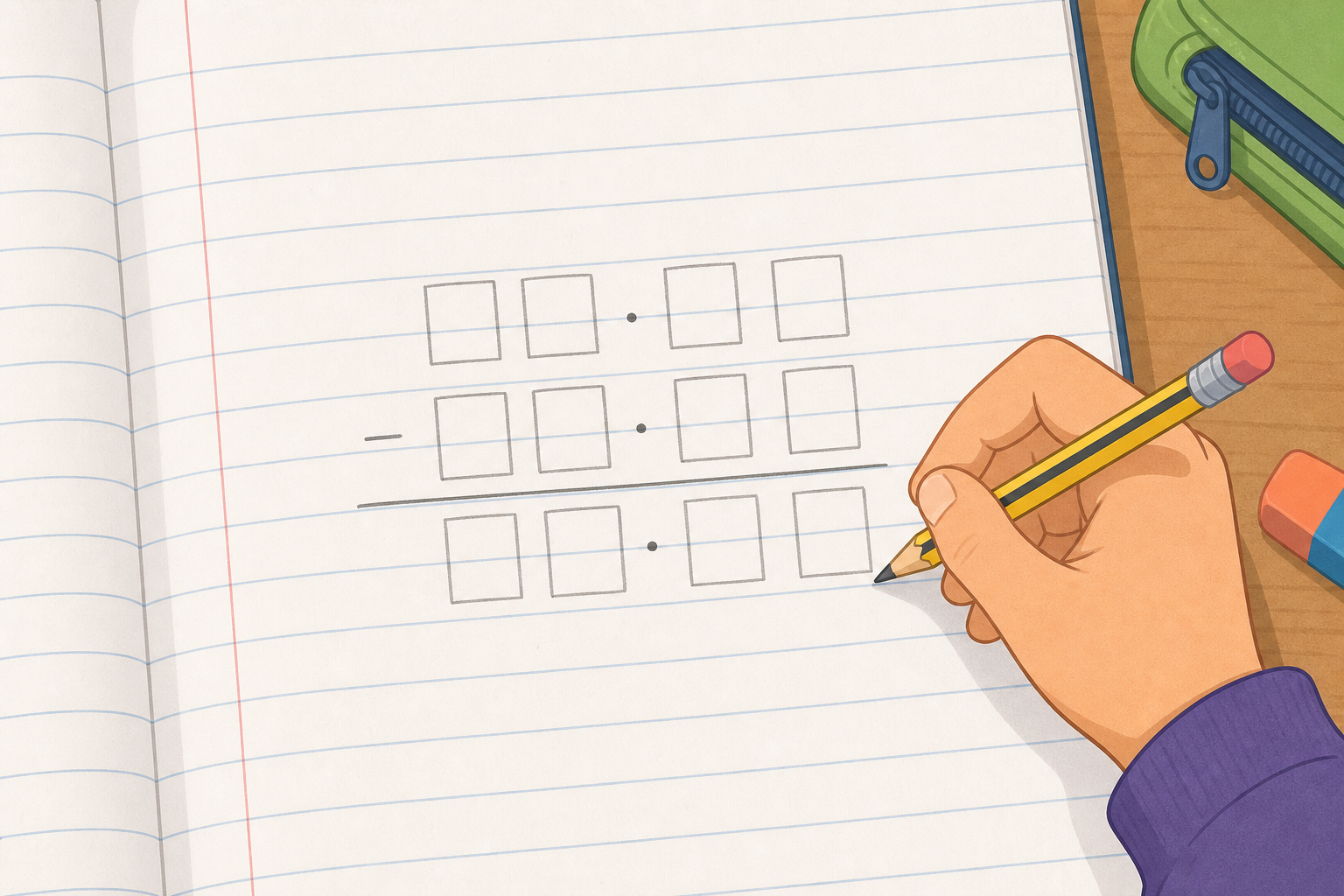
Set up the board first: display 4.5 − 1.75 with the digits deliberately right-aligned so the 5 of 4.5 sits directly under the 5 of 1.75 — the decimal points must NOT line up in a single column. This misalignment is the whole point of the question, so do not point-align it.
Take three hands-up answers, not open call-outs. You are fishing for the points aren't lined up — but don't confirm it yet; the model step reveals it.
The interactive shows three decimal subtractions lined up in columns. Notice how a missing digit is filled with a zero, and how each trade is the same one you already know, just further right.
Work each one right to left. Big idea: regrouping a tenth into ten hundredths is the same trade as regrouping a ten into ten ones.
4.5 - 1.75 = 2.75. Make 4.5 into 4.50 so the hundredths column has a partner. Hundredths cannot take 5, so break one tenth into ten hundredths. Point to that trade.
0.6 - 0.27 = 0.33. Make 0.6 into 0.60. Before revealing, ask how many tenths are left on top; take two hands, then check. Six tenths give one away leaving five; hundredths become 10 minus 7.
1.00 - 0.85 = 0.15. The cascade: no hundredths, no tenths to take from, so the trade travels along the row of zeros. Link to taking one from a whole hundred, one place further right. Watch each 0 become part of the answer.
Let's work this one together on the board, lining the decimal points up first: 3.8 − 1.45. Notice that 3.8 has no hundredths written, so we make it 3.80 to give the hundredths column a partner before we subtract.
This round is for talking it through together — pupils take turns at the board and the class agrees or corrects out loud.
Have a pupil first write the trailing zero so both numbers have the same number of decimal places (3.8 → 3.80). Then step the algorithm column by column from the right, class calling out each borrow before it lands.
Watch for the common slip: pupils who right-align the digits instead of the points. Catch it at the write-up stage, before any subtracting. Revoice the 0 hundredths can't lose 5, so one tenth becomes ten hundredths as the regroup lands.
In your maths copy, set up each of these decimal subtractions vertically, with the decimal points lined up in one straight column. Write in any trailing zeros you need so both numbers have the same number of decimal places.
Then work each one column by column and circle every regroup you make.
Walk the room glancing at whether the points line up and whether trailing zeros were added — this is whole-class copybook practice, not marking. No individual correcting; note who right-aligns digits so you can address it in the next round.
Line the points up first every time, and predict where the trade will have to travel before we check:
Today we work through these together on the board, each one a step harder than the last.
These are the practice questions — pupils take turns at the board, check each answer, and the class confirms before moving on. Keep the board work brisk rather than over-explaining.
The practice set rises in difficulty: 4.6 − 2.35 (one regroup), 3.0 − 1.48 (whole-number minuend, add two zeros), 7.25 − 3.9 (trailing zero on the subtrahend side), 10.0 − 4.55 (the big cascade from a whole ten).
Use the ✓ as part of the narration — yes, that's it. On a miss, ask did the points line up? did we add every trailing zero? before anything else.
You're previewing this lesson. Get full access to this lesson and hundreds more — each one ready to teach, with interactive activities, printable resources and pupil progress tracking built in.