1 - Getting Started ~4 mins
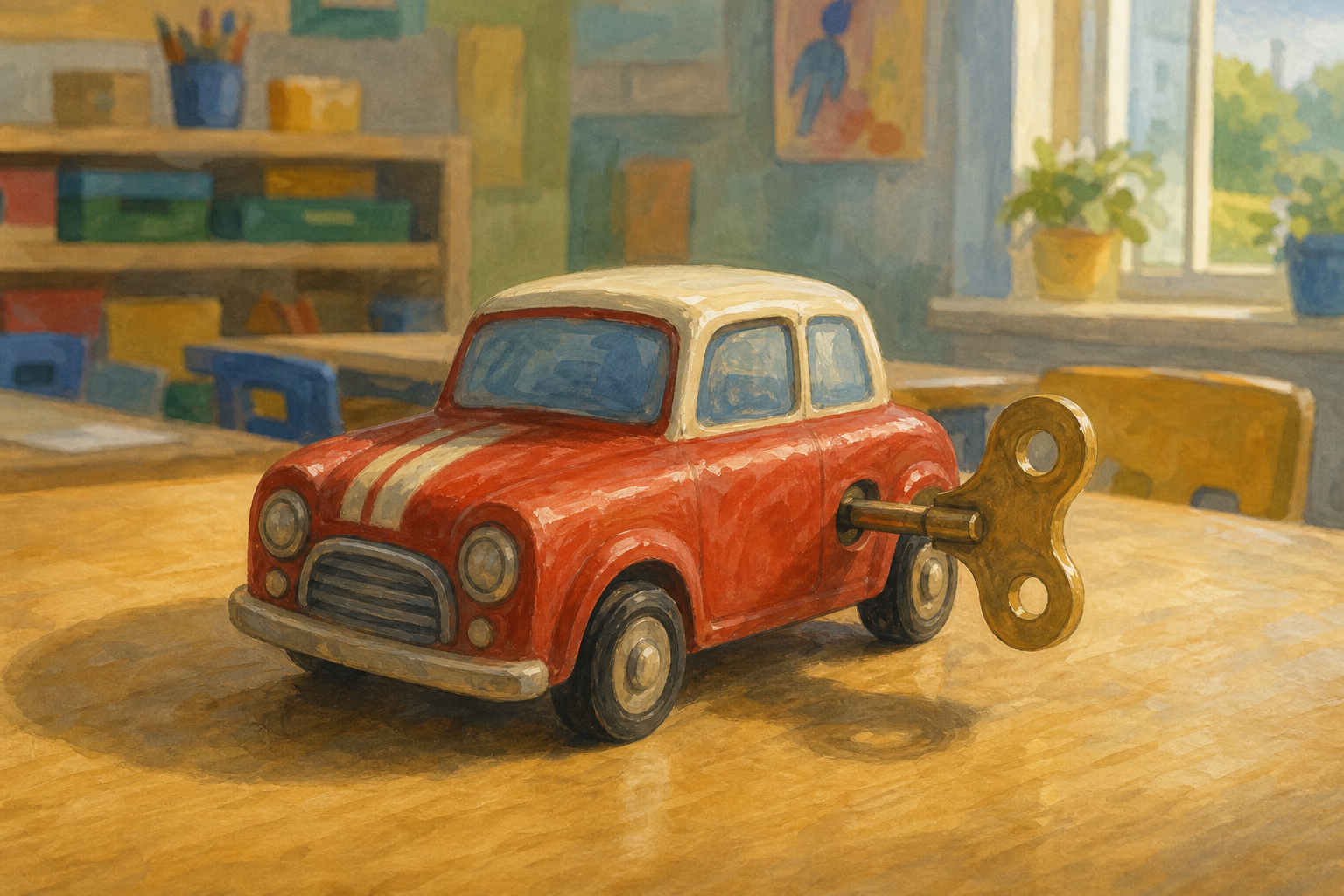 Watch this wound-up toy. It sits still, then suddenly it moves. Where was the energy hiding while it waited? Today we will build our own stored-energy device, follow the energy as it changes form, and test what happens when we store more of it.
Show a simple wind-up toy, a pull-back car, or (if you have none) the pre-built demo cotton-reel car with a few winds, held still then released. Keep the hook light: one surprising moment and the question. Do not hand out build kits yet.
Key question: Where was the energy while nothing seemed to be happening?
Surface prior ideas quickly: batteries, food, a stretched elastic, water held behind a dam. Frame these as things a 4th-class pupil already knows can hold energy ready for later.
2 - Energy That Waits ~6 mins
Two words for today. Stored energy: energy held ready to use later. Output: what the device does when that energy is released, such as how far a car travels.
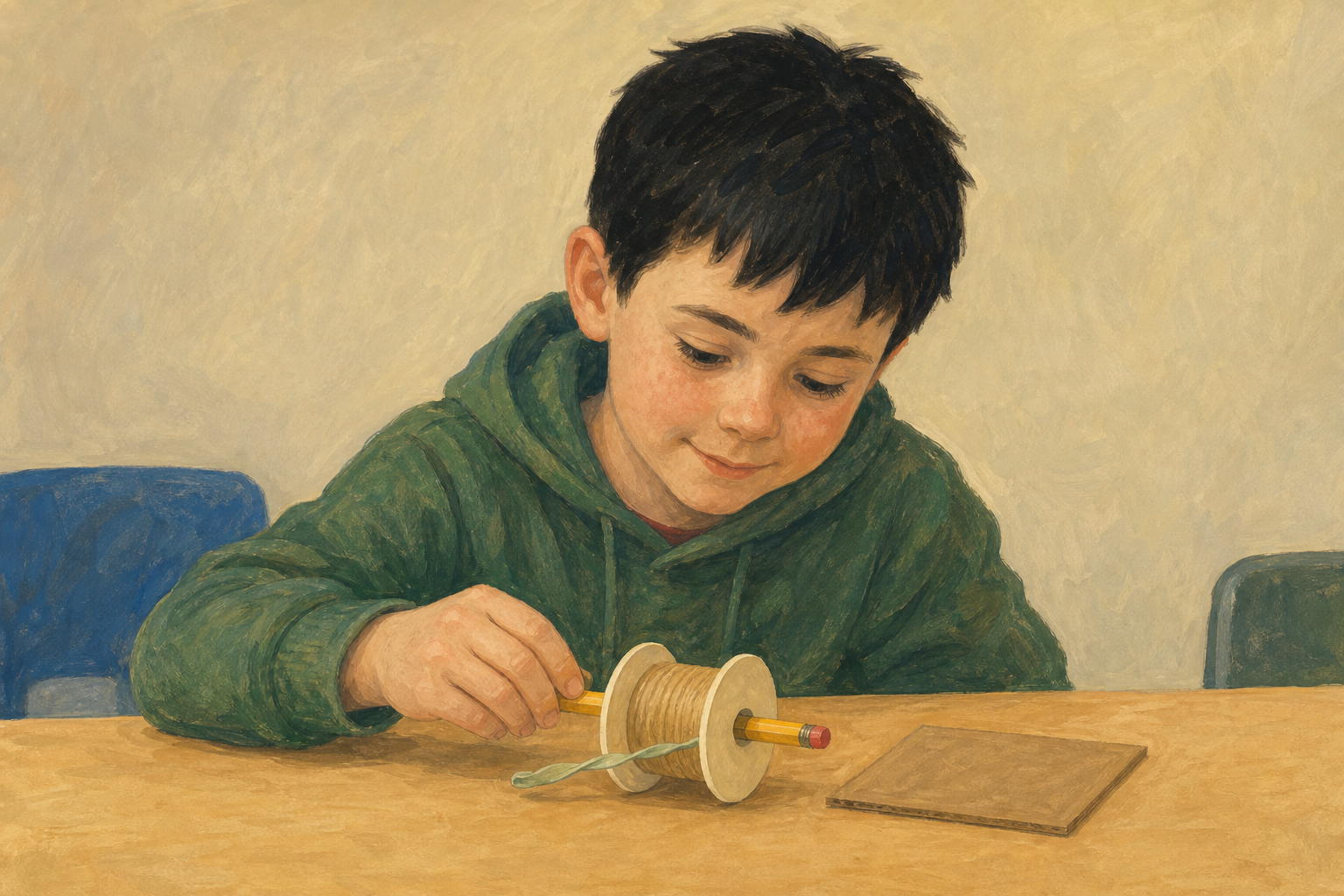 Watch the cotton-reel car on the desk. First we wind the elastic once, release from the start line, and mark where it stops.
Now, before we try again: if we wind the elastic more times from the same start line, will the car travel further, the same distance, or less far? Show me with your hands: further, the same, or less far?
| Concept | Why it matters | Example |
|---|---|---|
| Stored energy — energy held ready to be used later | Lots of useful devices wait with energy inside them until we need them: toys, clocks, batteries, dams | A wound elastic band on a cotton-reel car holds energy until you put the car down and let go |
| Output — what the device does when the energy is released | We judge a stored-energy device by its output: distance, time spinning, or how much it lifts | More winds of the elastic usually make the car travel further along the floor |
Hold energy transformation until the chain activity in step 6, when the cards make the idea concrete. Do not put all three terms on the board here.
Live demo sequence (use the pre-built demo car):
- Wind once, release from a marked start line, mark the stop with a scrap of paper. Do not run the high-wind trial yet.
- Hands-up prediction now, after the first run and before the second: will more winds take it further, the same, or less far? Give a clear beat for every hand.
- Wind several more times from the same line, release, and mark the new stop.
- Then voice the short model in true order once: I wonder whether more winds make it go further. I predict more winds store more energy so it goes further. I test one wind then more winds from the same start. I observed more winds carried it clearly further. I think more stored energy gave a bigger movement output.
Misconception (one line only): if a child says energy is "used up and gone", revoice: energy changes form; a little becomes sound and heat, so the car stops, but it has not vanished.
Leave Nature of STEM links for the closing discussion in step 8 so this six-minute slot stays demo, genuine prediction, second run, and one clean model.
3 - Build a Stored-energy Device ~16 mins
In your group, build one elastic-band car from the tray. The elastic is already threaded through the reel. Follow the steps on the board:
- Catch one end of the band on the short stick across the reel end (the little stick that holds the band still).
- Fix the long pencil (the part the band winds around) with the small card circle or tape so the band does not slip off.
- Wind the long pencil a few turns so energy is stored in the twisted band.
- Set the car on the floor, let go, and check it moves on its own.
Your car must store energy first, then release it to move. Fix any slips before we investigate.
Before the lesson
- Pre-build and check one working demo elastic-band cotton-reel car so the step 2 model runs in the short slot.
- Pre-thread an elastic band through each group's cotton reel and set a short stick, long pencil, card circle and tape ready on the tray (partial assembly saves build time).
- Clear a short floor run (about 1–2 m of smooth floor or corridor strip) for cars.
- Optional IWB support: flash a simple labelled tray photo or sketch naming short stick, long pencil, small card circle, and elastic so pupils match words to parts before they build.
Elastic-band car (quick build from pre-threaded reel)
One end of the band catches on a short pencil or matchstick across the reel end; the other end winds around a longer pencil with a scrap of tape or a small card circle so it grips. Wind the long pencil to twist the band, set the reel on the floor, and release.
Success look-fors: the device only moves after energy is stored in the wound band; groups can point to where the energy was waiting. Support groups whose elastic slips by adding a tape tab or thicker card circle. Fast finishers decorate nothing extra; they practise one careful wind and a clean release instead.
Safety: aim cars and flying elastic ends away from faces; do not overstretch bands until they snap.
Timing note: fourteen minutes of free first-time builds often overruns. Partial pre-assembly (band threaded, card circle ready) is what makes sixteen minutes realistic for a working store-and-release car before the investigation.
4 - Test More Stored Energy ~12 mins
We will investigate this question: does more stored energy change how far the car travels?
We share one floor run. Two groups test at a time while the rest of the class watches and helps judge the fair test. Stay seated until your group is called.
When it is your group's turn on the run:
- Predict first: say aloud what you think will happen with more winds, and why, before the first run.
- Run a low-energy trial (a small number of winds). Mark how far it goes with a scrap of paper or by counting floor tiles.
- Run a high-energy trial (more winds) from the same start line. Let go the same way each time. Mark how far it goes.
- Compare the two marks, then clear the run for the next pair of groups.
While you watch: predict with the testing groups (will more winds take it further?), and help check the fair test: same car, same floor, same start line, same way of letting go?
Groups design the detail within your theme: they choose how many winds (e.g. 2 vs 5). They must keep the same device, same floor, and same start point. "More stored energy" means more winds or a tighter twist of the elastic only, not a different way of letting go.
Classroom traffic plan (shared floor run): Use one shared run of about 1–2 m (smooth floor or corridor strip). Call two groups at a time to the run while the rest stay seated facing the run. Keep each round tight (about 2–3 minutes): testing groups predict aloud, run low winds, mark stop, run high winds, mark stop, clear the run. Seated groups stay in the fair test by answering your questions: Do you think more winds will make it go much further? What must they keep the same? Was that release the same both times? Rotate until every group has tested. If space allows a second parallel strip, run two pairs at once with the same watch-and-question pattern for the rest. With six to eight groups, three or four rounds fit a twelve-minute slot when each round stays tight.
Fair-test reminders to voice: change only how much energy is stored; measure one output (distance in floor tiles, book-lengths, or paper marks); repeat if a run is spoiled by a bump or a slipped band.
What to expect: more winds usually give a larger output. If results are messy, check for elastic slip, uneven floor, or different ways of letting go. A car that loops or skids still counts; mark the furthest point along the run.
Safety: clear feet from the run; never fire cars at people; stop if an elastic looks frayed.
5 - Notice What Changed ~2 mins
Look and listen carefully as you compare your two trials. What was different about the movement? Was it faster, further, louder, or longer? Tell your group one thing you noticed that you did not predict. This is talk only; you will draw the chain on your journal page next.
Keep this as a short, sharp oral observation beat before the energy-chain interactive. No diagram or journal marks are required in this step; recording comes on the DrawingRecord page in step 7. Circulate and push past "it went more" toward precise notices: it left the line faster, the reel hummed, it stopped sooner than we thought after many winds.
Prompts: Which trial sounded different? Did anything get warm (elastic, hands)? Did extra energy ever make the device less steady or tip?
Common surprise: too many winds can make a car spin on the spot or flip if grip is poor. That is useful data about how the energy is released, not a failed build.
Unlock the full learning experience
You're previewing this lesson. Get full access to this lesson and hundreds more — each one ready to teach, with interactive activities, printable resources and pupil progress tracking built in.
This lesson is copyright of Coding Ireland 2017 - 2025. Unauthorised use, copying or distribution is not allowed.