1 - Getting Started ~5 mins
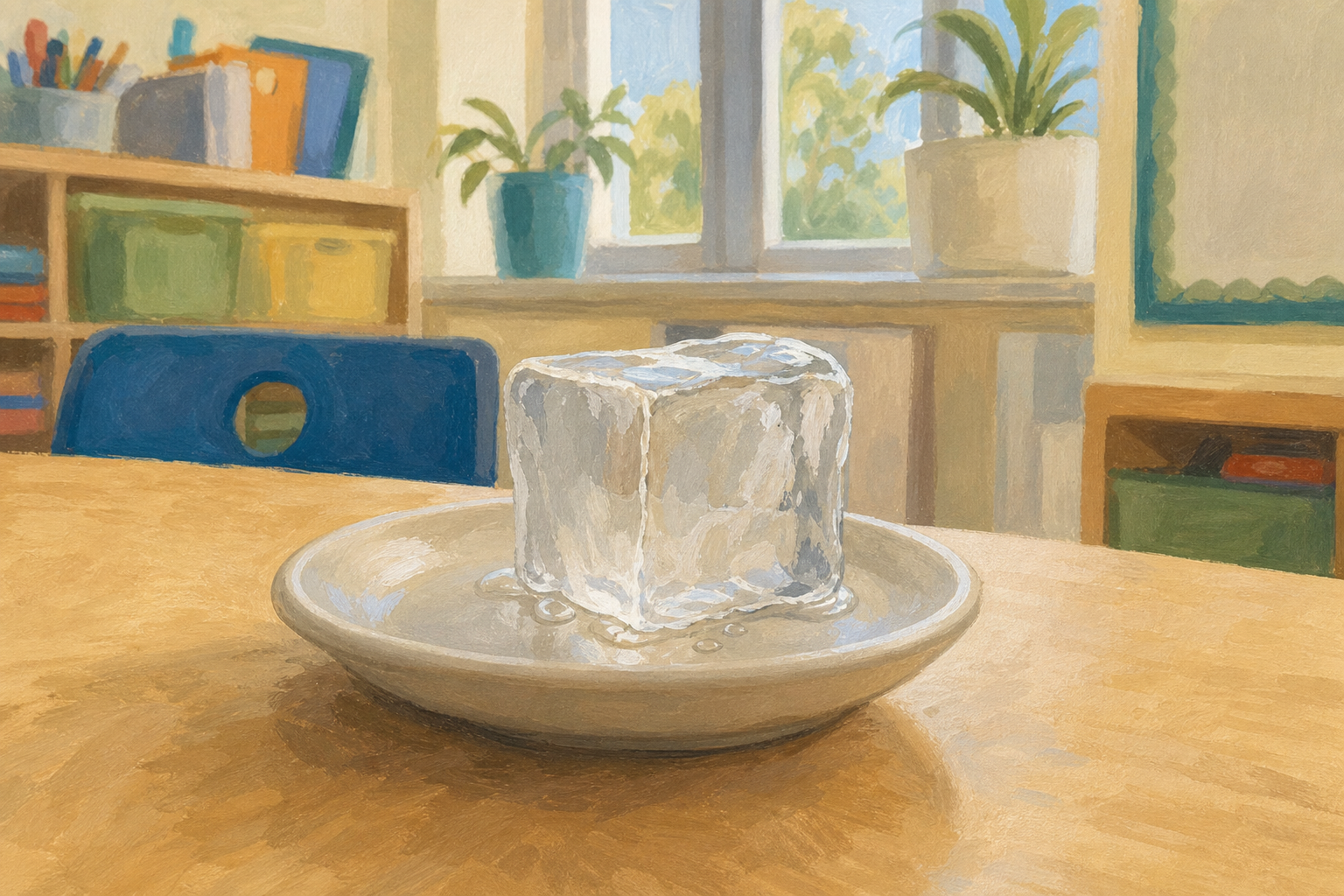 Look at this ice cube. It is hard and cold and keeps its shape. In a few minutes we will watch what heating and cooling do to water. Will it stay a solid, become a liquid, or turn into something you can barely see?
Hold up one ice cube (or a clear bag of ice) so the whole class can see it. Keep the hook light: one object and one curiosity question. Do not run the demo yet, but have the tray nearby ready for the next steps.
Key question: What do you already notice about ice that is different from the water in the sink?
Quick hands-up guesses only. Do not correct or teach the three states here.
2 - Solid, Liquid and Gas ~5 mins
Today’s words: solid: keeps its own shape. liquid: flows and takes the shape of its container. gas: spreads out to fill the space, and we often cannot see it. Which state is our ice cube in right now?
Project only the short board text with the three state words. Hold changing state and condensation until after the demo, when pupils have something real to attach them to. Use the full table below yourself when you explain and when you circle back after the demo.
| Concept | Why it matters | Example |
|---|---|---|
| Solid — a material that keeps its own shape; its particles stay in a fixed pattern and only wobble | Solids are the materials we build with and hold in our hands without a cup | An ice cube, a stone, or a wooden block keeps its shape on the desk |
| Liquid — a material that flows and takes the shape of its container; its particles slide past each other | We pour, store and drink liquids every day, so we need to know how they behave | Water in a jug fills the bottom and matches the jug’s shape |
| Gas — a material that spreads out to fill the whole space; its particles race freely. True water vapour is invisible | Air and water vapour are gases we live with even when we cannot see them | Invisible water vapour leaves a kettle; the white mist is tiny liquid drops in cooler air |
| Changing state — heating or cooling moves a material between solid, liquid and gas without making a new substance | Cooking, freezing food and Irish weather all depend on materials changing state | Ice melts to water when warmed; water freezes back to ice when cooled |
| Condensation — a gas cools and turns into liquid on a cold surface | This is how bathroom mirrors mist up and how vapour becomes water again | Tiny drops form on a cold metal lid held above warm steam |
Misconception to head off: children often say steam or clouds are “air” or that ice “disappears” when it melts. Keep saying: it is still water; only the state has changed. Particles are the same water particles moving differently.
Steam accuracy: the white plume above a kettle is tiny liquid droplets already condensing in cooler air. True water vapour (the gas) is invisible. Do not point at the white cloud and call it gas.
3 - What Do You Predict? ~5 mins
Look at the tray at the front: ice, a jug of warm water, the kettle the teacher will use, and a cold lid from the fridge. We are going to warm ice and hold the cold lid in the steam path. Talk with your partner: what do you think will happen to the ice when it is warmed? What do you think you will see on the cold lid? Write one short prediction on your Investigation Journal page, then be ready to share with the class.
Before partners talk, briefly hold up or point to each item on the tray (ice, jug, kettle, cold lid) so “cold lid” and “steam” are things pupils can point at. Do not run the demo yet.
Hand out the PredictObserveRecord Investigation Journal page now. Pupils write one short prediction in the predict section only (paper only; nothing typed into the platform). Observations come later, straight after the demo.
Whole-class think–pair–share. Predictions are never wrong; they start the science.
Look-fors:
- Children use the words solid, liquid or gas (even roughly)
- Someone predicts melting or water appearing
- Someone wonders about the cold lid getting wet or misty
Collect two or three spoken predictions on the board in the children’s own words. Do not reveal the condensation result yet.
If a child says ice “disappears”, revoice: You think we might not see the ice any more. Let’s watch carefully what is left.
4 - Watching Water Change State ~12 mins
Watch the teacher’s tray carefully. First we look at ice. Then we look at warm water. Then the teacher uses the kettle and holds the cold lid in the steam path. Where do you think the water will go next: stay ice, become liquid, or leave as a gas you can barely see?
Before the lesson
Set a demo tray at the front: ice cubes from the same tray, a jug of warm (hand-safe) water, a kettle the teacher only will use, a cold metal lid or clean mirror from the fridge or freezer, and clear space so pupils stay well back from the kettle.
Modelled investigation (keep this tight)
Say the beats briefly, not as a long monologue:
I wonder: can the same water be a solid, a liquid and a gas if I heat and cool it?
I predict: (point back to two board predictions)
I test: (1) show ice; one child names hard and keeps its shape; (2) pour warm water into a clear cup; (3) boil the kettle yourself with pupils well back; (4) hold the cold lid in the steam path and wait for beads.
I observed / I think: ice kept its shape then softened; water flowed; some water left as a gas we mostly cannot see; clear drops formed on the cold lid when the gas cooled. It was still water each time. We call moving between solid, liquid and gas changing state. Drops forming when a gas cools on a cold surface is condensation.
Steam: get the science right
Do not point at the white plume and call it gas. Say: Some water left the kettle as a gas we mostly cannot see. The white mist is tiny liquid drops forming in cooler air. The invisible vapour is the gas; the white cloud is already tiny liquid. The cold lid then shows more liquid forming as that gas cools: condensation.
Contingency pace
If condensation is weak: chill the lid longer next time, or immediately breathe gently on a cold mirror as backup so the class still sees liquid form from a gas. Do not spend the whole slot waiting on a dry lid.
Keep the kettle and steam as a teacher-only demo. Warm water for the jug is hand-safe only. Pause between beats so children can name the state they just saw.
Safety: pupils stay well back from the kettle and steam. Never let children pour boiling water or hold the kettle.
5 - Record What We Saw ~10 mins
On your Investigation Journal page, record each stage we watched. For ice, liquid water, steam and the cold lid, answer: What did you see? Solid, liquid or gas? Heating or cooling? Tick or note whether your earlier prediction matched what happened.
What are the particles doing?
Pupils already have the PredictObserveRecord page from the prediction step. They now complete the observe section on paper only; nothing is typed into the platform. Capture what they saw before the particle model, so observations stay tied to the real demo.
Suggested table rows on the page: ice on the tray; water in the cup; steam from the kettle; drops on the cold lid. Columns match the board prompts: What did you see? · Solid, liquid or gas? · Heating or cooling?
Circulate and prompt with: Is steam a solid, a liquid or a gas? What made the drops appear on the lid? If needed, revoice steam carefully: invisible vapour is the gas; white mist is tiny liquid drops.
Differentiation: some pupils may draw the four stages and label solid / liquid / gas with a word bank on the board. Confident writers add one sentence: “It was still water because…”
What good looks like: ice named as solid, cup water as liquid, steam/vapour as gas (with white mist understood as tiny liquid if discussed), lid drops as liquid from cooling a gas (condensation). Predictions from earlier ticked or noted beside the observations.
Unlock the full learning experience
You're previewing this lesson. Get full access to this lesson and hundreds more — each one ready to teach, with interactive activities, printable resources and pupil progress tracking built in.
This lesson is copyright of Coding Ireland 2017 - 2025. Unauthorised use, copying or distribution is not allowed.