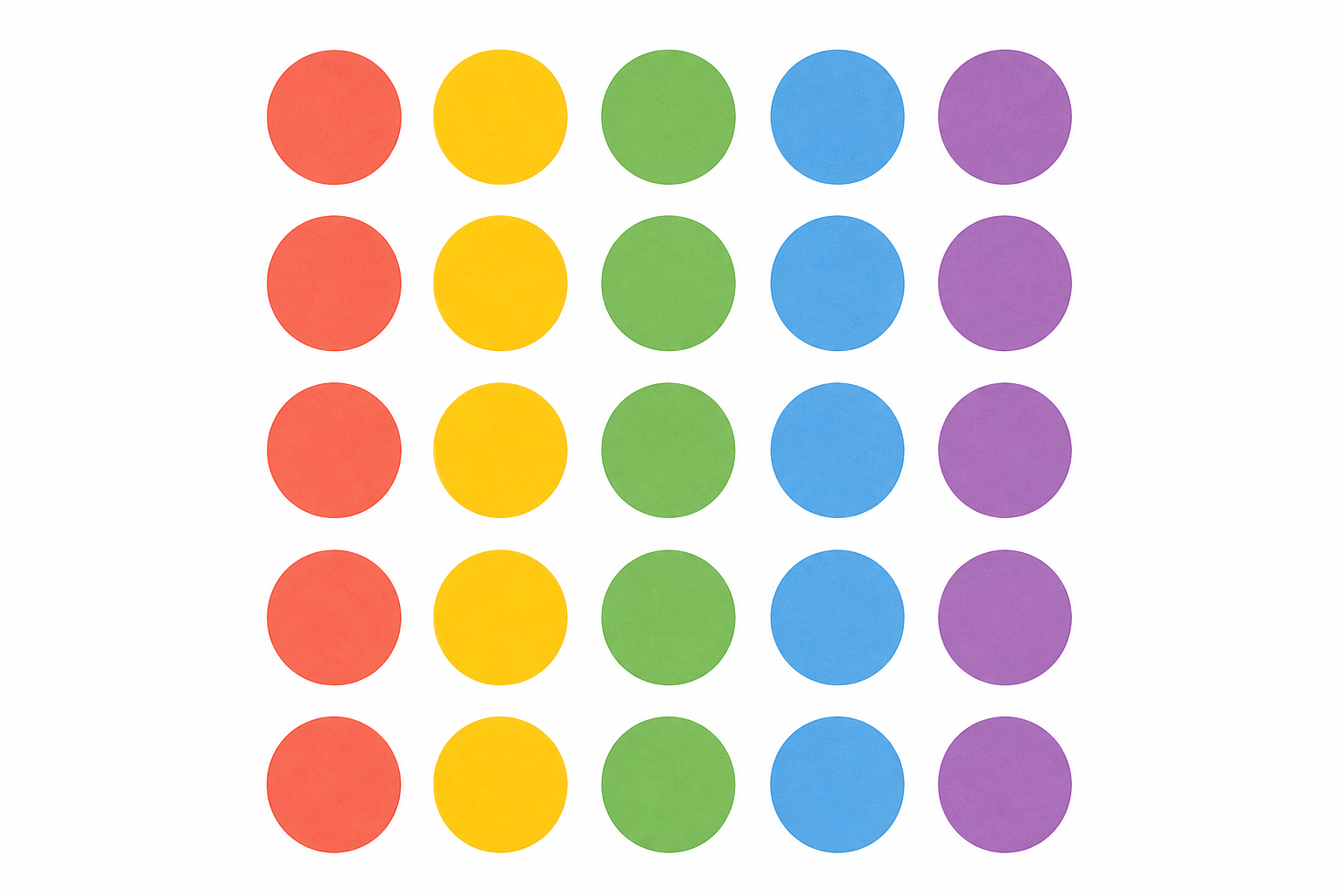
Look at this square of dots on the board. Count how many dots there are along one side, then count the whole square. What do you notice — how does the number along one side connect to the total we counted?
We call the total a square number because it fills a perfect square exactly. Today we will build a few of them and hunt for the pattern hiding between them.
Display a 5×5 dot array as pupils settle. Take three hands-up answers to "how many dots along one side?" and "how many altogether?" before revealing that 5 × 5 = 25.
Give five seconds of quiet think-time before any hands go up.
Each square is built as an area model: dots along the bottom, dots up the side. When I ask you to predict, think it quietly and put your thumb up when you are ready. Watch what gets added each time the side grows by one.
Prediction moments are think-only: thumbs up, then take a couple of hands.
4 squared: four along, four up, sixteen. Stress both factors are the same, that is what makes a square number.
5 squared: ask "how many more than sixteen?" before revealing 25 (nine more).
6 squared is the key one, thirty-six. On the model point to the new bottom row of six, the new side column of five, and the shared corner, so they see we add 6 + 5 = 11, not twelve.
Land it: gaps are 9 then 11, rising by 2 each time, the odd numbers.
Now we build together on the board: 7², then 8², then 9². One pupil drives the board while the rest of the class predicts each total aloud from the side length before it is built. Watch the gaps climb between each pair.
This round is a whole-class board build — one pupil at a time drives the area model while the class predicts aloud and agrees or corrects together.
For each square, the pupil at the board sets both factors equal and reads the total; the class predicts before the build reveals it. After 8² and 9², ask the class for the gap between each pair (15, then 17) and confirm they are the next odd numbers after 13.
In your maths copy, write each square number two ways — as 'squared' and as its product. For example: 6 squared = 6 × 6 = 36.
Then list the first ten square numbers in a row, and underneath write the odd-number gap you notice between each one.
Walk the room glancing at the layout and the gaps between the squares — this is whole-class copybook practice, not marking.
For a less confident pupil, sit them beside a partner so they can take turns reading each square aloud and check the gaps together. A printable square-numbers reference card (first ten squares written both ways, 6² and 6 × 6 = 36) helps pupils check their own work.
Now we work through fresh squares together, each one a step bigger: build 10², then 11², then 12², then 13². One pupil drives each build while the class predicts.
Optional think-about-it: can you find two square numbers that add together to make another square number? Here is a way in — try combining a 9-square and a 16-square and count the total.
These are the practice questions — one pupil at a time drives the board build while the class predicts and confirms before moving on. Keep the board work brisk rather than over-explaining. If a pupil gives a clear gap explanation, revoice it for the whole class rather than pairing pupils up mid-step.
For the optional stretch, guide toward 9 + 16 = 25 (that is 3² + 4² = 5²). Let a pupil test their own pair on the board before you confirm it.
You're previewing this lesson. Get full access to this lesson and hundreds more — each one ready to teach, with interactive activities, printable resources and pupil progress tracking built in.