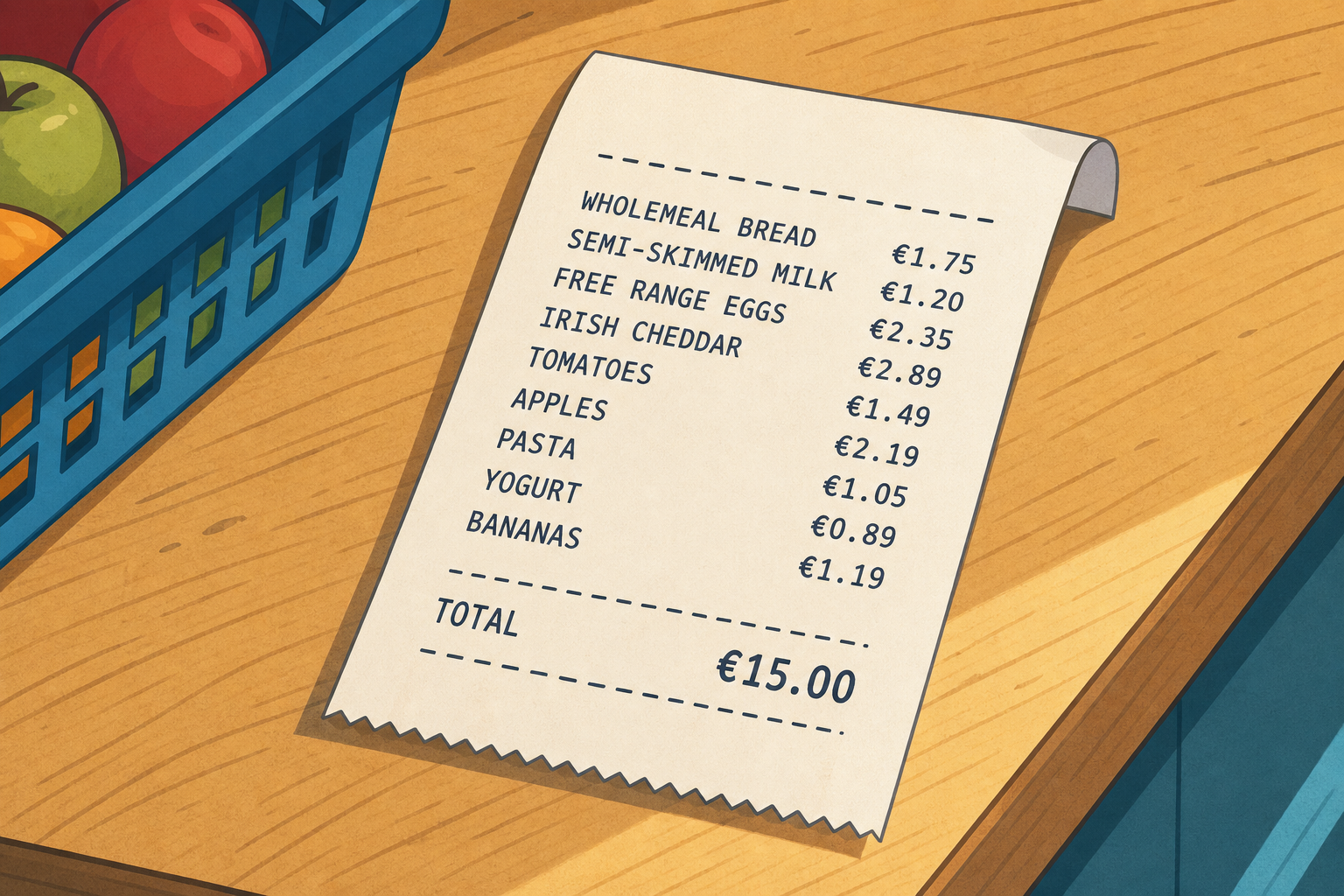
Look at this shopping receipt. The total at the bottom says €38.95. You hand over two €20 notes. Roughly how much change should you get back? Would rounding the total to €40 be close enough to check the change is right, before you count every cent?
Display the receipt and take three hands-up answers, not open call-outs. You are not after the exact change yet, only the idea that about €40 is enough to sanity-check. Give five seconds of quiet think-time before hands go up.
Watch four estimates worked one at a time: a sum, a division, a crowd of people and a multiplication. For each one, notice what gets rounded and to which place, then check the exact answer looks sensible next to the estimate.
487 + 312: round each to the nearest hundred first, that is the whole trick. 487 to 500, 312 to 300, so 500 + 300 = 800; exact is 799, sits right beside it. Watch pupils who round 487 to 400.
6,180 divided by 3: round to something friendly, 6,000, so 6,000 divided by 3 = 2,000. Ask 'a little more or a little less than 2,000?' and pause before revealing. A little more, because 6,180 is a little more than 6,000.
23,742: the key one. Sensible place changes with the size of the number. Rounds to 24,000; contrast the silly 23,740 nobody counts a crowd to the nearest ten.
198 times 4: 198 is almost 200, so 200 times 4 = 800. The estimate is a safety net: if someone got 80, the 800 shouts that a slip has crept in.
Now we try the estimation jar. Before anyone counts, look at the jar of counters and estimate how many are inside. We'll gather a few estimates, then reveal the true count and see how close we got. Ask yourself: was your guess a sensible rough number, and how far off was it from the real total?
This round is for talking it through together — take hands-up estimates before the reveal, and the class agrees or challenges each guess out loud.
Reveal the jar and collect three or four estimates before showing the count. When the true total appears, ask 'whose estimate landed closest, and why was it a sensible guess?' Draw out that a rough estimate near the real number is exactly what we practise in the receipt and division work — you do not need the exact count to know roughly how full the jar is.
In your maths copy, write each problem, then your rounded estimate, then the exact answer. For the third item the exact answer is the number itself. Underneath each one, note in a single line how close your estimate came.
Walk the room glancing at whether the estimate is written before the exact answer — that order is the habit we are building. This is whole-class copybook practice, not marking.
Today we work through three real Irish-context estimation tasks together, then a stretch. In your copy work each one: round to a sensible place, write the estimate, then find the exact answer and compare.
Round to a sensible place to estimate, then calculate exactly, across three Irish-context division tasks.
Ways to start:
Stretch:
These are the practice questions — pupils take turns at the board, check each answer, and the class confirms before moving on. Keep the board work brisk rather than over-explaining.
For task 1, round 1,180 to 1,200 (÷ 6 = 200) as the estimate; exact is 196 remainder 4. For task 2, round 47,300 to 47,000 (÷ 4 = 11,750); exact is 11,825. For task 3, round 2,985 to 3,000 (÷ 5 = 600); exact is 597. Draw the class to notice all three estimates land very close — that closeness is what makes them trustworthy to plan with. Save the stretch for the maths-talk.
You're previewing this lesson. Get full access to this lesson and hundreds more — each one ready to teach, with interactive activities, printable resources and pupil progress tracking built in.