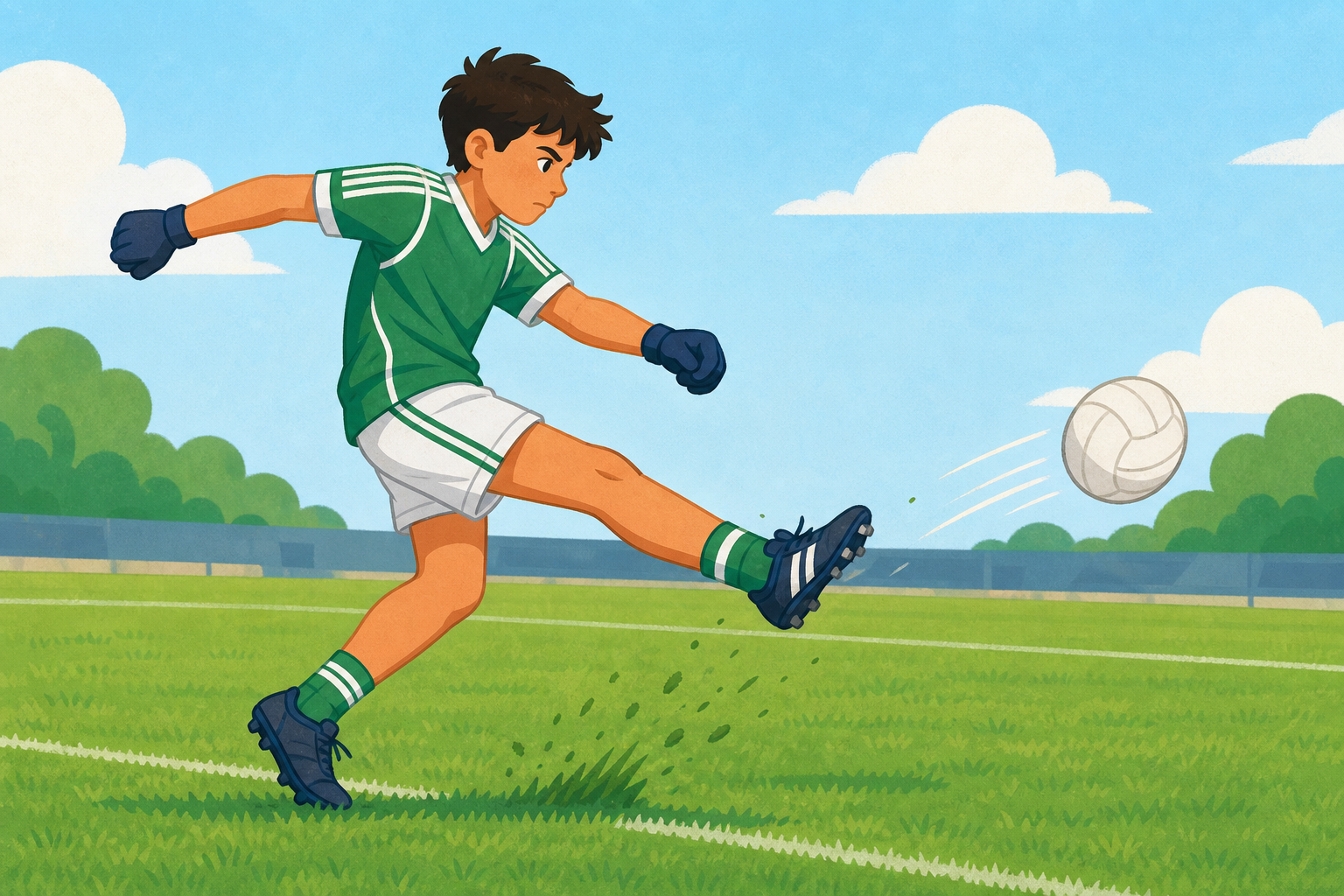
A GAA player's kick travelled 4.7 metres. The match report only wants whole metres. Is that a 4 metre kick or a 5 metre kick? Hands up: which one, and how did you decide?
Take three hands-up answers, not open call-outs. Give five seconds of quiet think-time first. Do not confirm the answer yet, that lands in Watch and Notice. Listen for anyone who says 'it's closer to 5' and hold that phrasing for later.
Each number line zooms in on the two values our number sits between. Watch where the marker lands, and decide which end it is closer to. Look out for the deciding digit each time.
4.7 to nearest whole: between 4 and 5, well past halfway, rounds to 5. Establish the deciding digit is the very next digit after the place we are rounding to; here the 7 sends it up.
0.34 to nearest tenth: between 0.3 and 0.4, only just past 0.3, rounds down to 0.3. Head off the reflex that the 4 out front makes it 4-something; deciding digit is the second place, and 4 is under 5.
1.275 to nearest hundredth: between 1.27 and 1.28, exactly halfway. Deciding digit is the thousandths 5. State the rule: when the deciding digit is exactly 5, we round up, so 1.275 to 1.28.
4.5 to nearest whole: exactly on the halfway mark, not closer to either. Pause here. Ask the class to predict before you name it. This is where the round-half-up rule breaks the tie, so 4.5 to 5.
At each marker ask for a prediction before revealing the rounded value.
Let's round some numbers together on the board. On screen you can see 0.62 sitting on a line from 0.6 to 0.7. Which candidate is it nearer to, 0.6 or 0.7? Say why, then we agree the rounded value together. After that I will change the line to 9 to 10 for 9.5, and then to 1.3 to 1.4 for 1.34, and we round each one the same way.
This round is for talking it through together — pupils take turns at the board and the class agrees or corrects out loud.
The board shows one number line at a time. Start with the configured 0.62 on 0.6 to 0.7. When the class has agreed the answer, reset the range for the next number: for 9.5 use 9 to 10; for 1.34 use 1.3 to 1.4. Each time, name the deciding digit aloud with the class before deciding. The 9.5 case is the exact-half moment — revoice a strong answer as 'exactly halfway, and the rule says round up, so 10'.
In your maths copy, sketch a short number line for each rounding example and mark both candidate numbers, one at each end. Put a dot where the decimal sits, then circle the candidate it rounds to.
Walk the room glancing at whether pupils have written both candidates at the ends before dotting the number — this is whole-class copybook practice, not marking. Watch for the round-half-up case (9.5) being left uncircled because it looks stuck in the middle.
Rounding up can fill the tenths completely and carry into the ones, so the answer may jump past every mark on the tenths line. Look out for that twist on the last challenge.
Here's today's challenge, and each one adds a little twist: round 0.62 to the nearest tenth, then 1.275 to the nearest hundredth, then 9.5 to the nearest whole, and finally 9.95 to the nearest tenth.
This is the Class Challenge round — the whole class works each problem, pupils take turns at the board, and everyone confirms the answer before moving on. Keep the board work brisk rather than over-explaining.
You're previewing this lesson. Get full access to this lesson and hundreds more — each one ready to teach, with interactive activities, printable resources and pupil progress tracking built in.