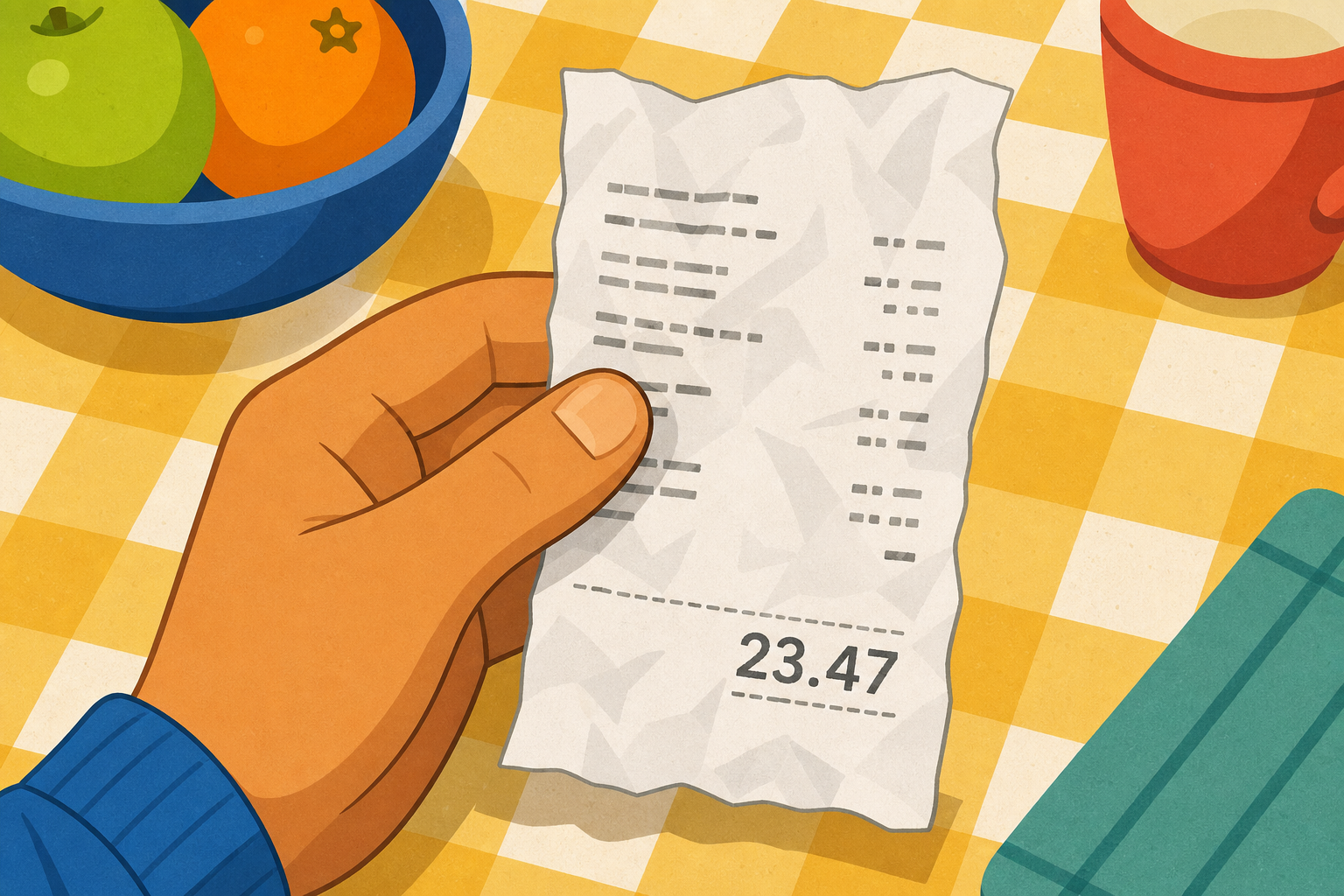
Here is a number that turns up on a receipt all the time: 4.7.
If someone asked you to round it to the nearest whole number, would you say 4 or 5? Hands up when you have decided, and be ready to say how you know.
Give five seconds of quiet think-time before any hands go up. Take three hands-up answers, not open call-outs. Don't confirm right or wrong yet — the number line in the next step settles it. Listen for whether pupils are reasoning from position ("it's closer to 5") or just guessing.
The number line shows a number caught between two whole numbers or two decimals. Watch where the marker sits compared to the halfway point. Which end is it closer to?
4.7: candidates 4 and 5. Point to both ends first, then the marker. Ask which it's closer to. Past halfway (4.5), so rounds to 5. Establish the two-candidates idea here.
0.34: candidates 0.3 and 0.4, halfway 0.35. The round-down case. Deciding digit after tenths is 4, and 4 is less than 5, so stays at 0.3.
1.275: candidates 1.27 and 1.28. Marker sits exactly on halfway. The boundary case. Don't move on until they can say the rule back: lands on the halfway line, round up, so 1.28. This is the trap in the challenge.
Now we round some together on one number line, zooming to each number in turn. We start with 3.2 to the nearest whole (which whole is it closer to?), then 0.68 to the nearest tenth (the deciding digit is 8, so watch what happens), and finally 0.95 to the nearest tenth.
This round is for talking it through together — pupils take turns at the board and the class agrees or corrects out loud. For each number, retype the board range so the line straddles the two candidates, then have a pupil name the two candidates and say the deciding digit that settled it.
Revoice a strong answer: 'so because the digit after the tenths was 8, and 8 is bigger than 5, we jumped up to 0.7.' If the class is quick, voice one more comparison aloud without re-ranging: 2.451 to the nearest hundredth holds at 2.45 because the deciding digit is 1.
Save 0.95 for last — it is the key one. Rounding 0.9-something up to the nearest tenth gives 1.0, which crosses into a whole number. Pause here and ask the class to predict before the reveal: 'what tenth is just above 0.9?' Watch for pupils who write 0.10 instead of 1.0.
In your maths copy, sketch a short number line for each rounding example. Mark both candidate numbers on it — the tidy number below and the tidy number above. Then circle the winner: the candidate your decimal is closer to.
Do this for each of these:
Walk the room and glance for two things: both candidates written at the ends of the line, and the marker sitting sensibly between them. This is whole-class copybook practice, not marking — no individual corrections, just a quiet nudge if a candidate pair is wrong.
Today we work through these on the board, one at a time: round 0.628 to the nearest tenth, then 9.5 to the nearest whole, then 1.275 to the nearest hundredth, and finally 9.96 to the nearest tenth. Say the deciding digit aloud each time before we check.
These are the practice questions — pupils take turns at the board, check each answer, and the class confirms before moving on. Keep the board work brisk rather than over-explaining.
For each target, the pupil drags the marker to the rounded value and presses Check. The last one, 9.96 → 10.0, is the ceiling: rounding a 9.9-something up to the nearest tenth crosses into a new whole. Ask the class to predict where it lands before the pupil checks. Watch for pupils who try to write 9.10.
You're previewing this lesson. Get full access to this lesson and hundreds more — each one ready to teach, with interactive activities, printable resources and pupil progress tracking built in.