1 - Getting Started ~5 mins
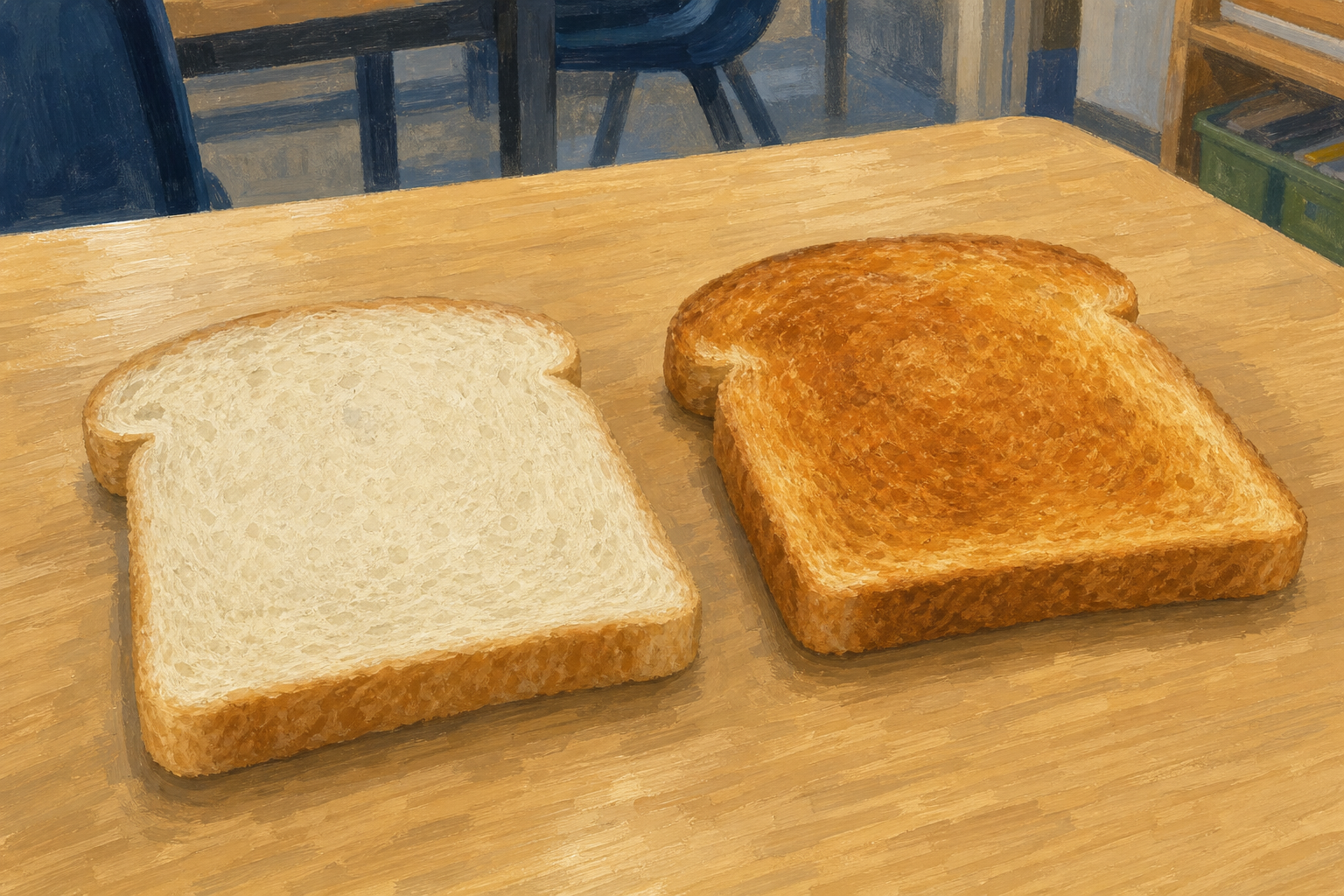 Look at this piece of soft bread and this slice of toast. Could you turn the toast back into soft bread? Why or why not?
Today we will test four real changes and decide which ones we can undo, and which ones make something new.
Hold up one slice of fresh bread and one slice of toast (toast made just before the lesson if you can). Do not explain the answer yet. Take three or four quick hands-up guesses and one reason from each side. Keep it light: curiosity only, no materials handed out yet.
Before the lesson: print the Investigation Journal SortingGrid page (one per pupil); set six station trays as two copies of each station type (see materials and rotation model); make the toast for the hook and keep a second slice ready for the teacher demo; chill plates in a fridge so chocolate can harden again in station time; prepare and label at least two overnight pre-dried salt samples ("salt came back") so every Station B tray has one; leave spare dark paper for live drops.
Allergy note: check the class list for chocolate, gluten and other food allergies before you open any food materials.
2 - Changes We Can Undo, and Changes We Cannot ~6 mins
 Today’s two big words:
Reversible — a change you can undo and get the same material back.
Irreversible — a change that makes something new and cannot be undone.
When ice melts into water and then freezes again, is that reversible or irreversible?
Project only the short board text. Hold back the word evidence until the prediction and recording steps, when pupils need it. Use the table below for your own reference while you teach.
| Concept | Why it matters | Example |
|---|---|---|
| Reversible change — a change that can be undone so you get the same material back again | Helps us reuse materials and understand melting, freezing and dissolving in daily life | Chocolate softens with gentle warmth, then hardens again on a cool plate |
| Irreversible change — a change that makes something new and cannot be undone | Cooks and makers rely on these changes: bread becomes toast, batter becomes cake | Toasting bread; baking soda fizzing with vinegar and releasing a new gas |
| Evidence — what you observed that supports your decision | Scientists sort changes by what they saw, not by a guess | “We saw bubbles and heard fizzing, and we could not get the powder and vinegar back” |
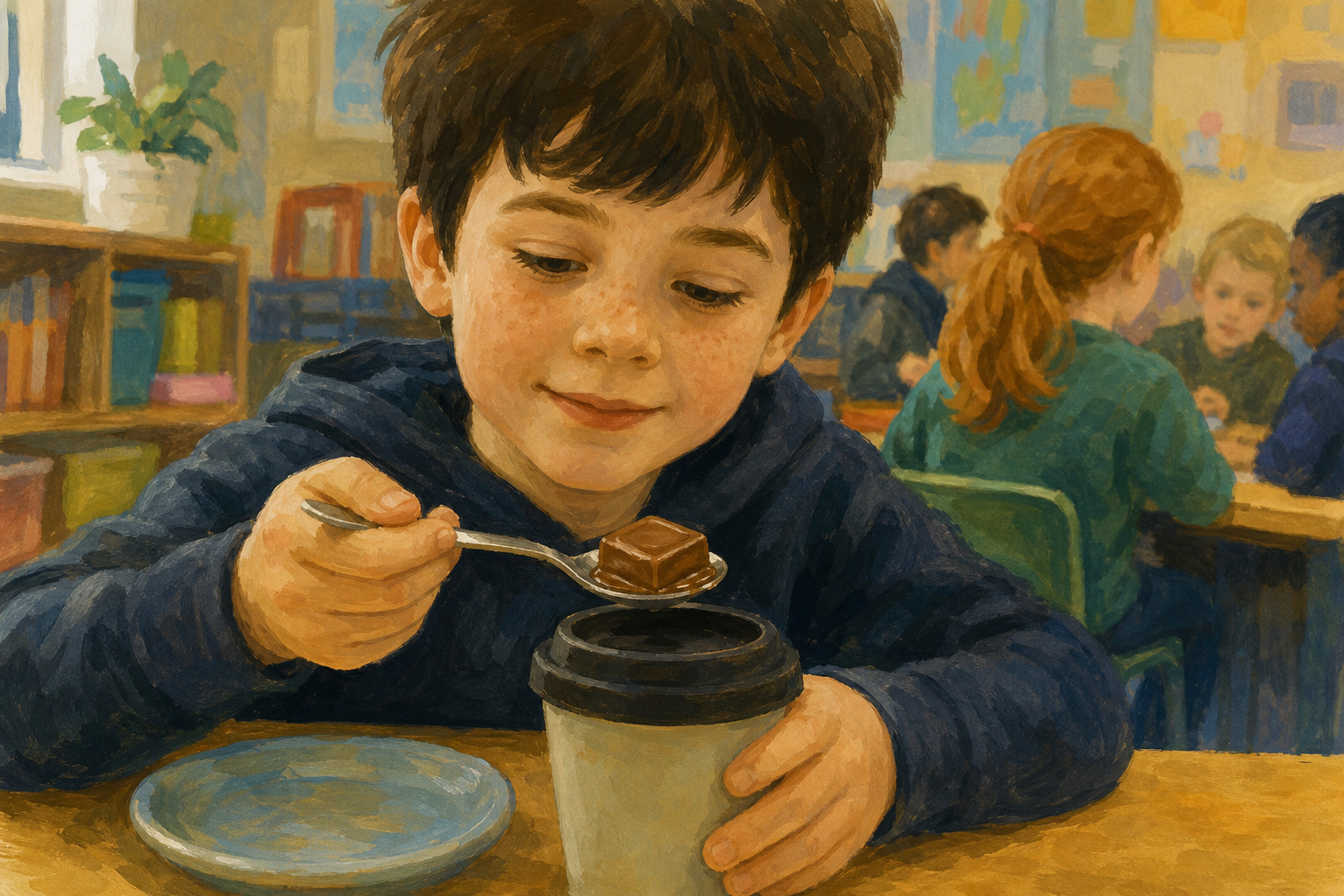
Worked example (model the full cycle once before stations): Hold a small square of plain chocolate on a clean spoon or spatula (not a pupil palm). Say: I wonder whether warming this chocolate is a change we can undo. I predict it will soften with gentle warmth, and if I cool it, it will go hard again. Rest it briefly on the lid of a cup of warm (hand-safe) water you control until it softens. Show the soft chocolate. Then place it on a pre-chilled plate. I observed it went soft when warm and firmer when cool. I think melting chocolate is reversible, because we got solid chocolate back. Point out that the material is still chocolate, even if the shape looks different.
Misconception to head off: children may say a change is irreversible just because it looks messy or takes time (salt drying). Reversible means the same material can come back, not that it happens instantly. Another common mix-up: “the vinegar disappeared so it is gone forever.” Guide them to look for a new substance (gas, toast crust) versus the same substance in a new form.
Nature of STEM angle: cooks and makers in Ireland have long used irreversible changes on purpose, from soda bread rising with baking soda to toasting and baking. The change is the point of the recipe.
3 - What Do You Think Will Happen? ~5 mins
We will test four changes: melting chocolate then cooling it, dissolving salt then letting the water dry, mixing baking soda with vinegar, and toasting bread.
With your group, predict for each one: can we undo it, or does it make something new? Be ready to share one prediction and why. Think what you will look for — that will be your evidence.
Delivery
Keep this as talk only. No kit on desks yet. Use think-pair-share: one minute silent think, one minute pair talk, then take two or three group predictions on the board as simple yes/no columns headed Can undo / Makes something new.
Introduce evidence here in plain words: evidence is what you see, hear or feel that helps you decide. You will write evidence on the SortingGrid after the stations.
Key questions:
- What would count as getting the same material back?
- If you see bubbles or smell something new, what might that tell you?
- Does a change that is slow still count as reversible?
Differentiation: offer sentence stems aloud: I think … is reversible because … / I think … is irreversible because …. Confident groups can also say what evidence they will look for at the station.
Predictions are never wrong. They are the start of the science.
4 - Station Investigations ~18 mins
Your group will visit the change stations. At each one, carry out the change carefully, watch closely, and talk about whether you think you can undo it.
Station A: melt a small piece of chocolate on a warm lid, then cool it on a chilled plate. Station B: dissolve salt in water, start drying a drop, and compare with the labelled “salt came back” sample. Station C: mix baking soda with vinegar. Then watch the toast demo together.
No tasting. Keep vinegar mixes away from eyes and faces.
Before groups start
Run the toast demo as a short whole-class moment (about 3 minutes) at the start of this step. Pupils stay seated well back. Drop one slice into the toaster (or use a toaster oven you control). Ask: What do you predict will happen to the bread? When it pops, show the brown toast beside a fresh slice. Say: I observed the bread went brown, dry and crisp. I cannot turn it back into soft bread. I think toasting is irreversible because a new material formed.
Class rotation model (about 24–28 pupils)
Form 6 groups of 4 (adjust group size for your class; keep groups of 3–5). Set up two copies of each station (A1/A2, B1/B2, C1/C2) so all six groups work at the same time — no idle queue.
- Minutes 0–3: whole-class toast demo (seated).
- Minutes 3–8: first station visit (~5 minutes hands-on).
- Minutes 8–13: rotate each group to a different station type (A→B, B→C, C→A on each pair of trays).
- Minutes 13–18: third visit so every group has done A, B and C once (~5 minutes), then 1–2 minutes wipe trays and leave stations ready. Hands washed later after recording if needed; full pack-away sits at the end of the lesson after the plenary talk.
With two copies of each station, transitions stay short. One adult eye stays on both Station C trays. Wipe spills at once. If you have fewer than 18 pupils, run one copy of each station and three groups, same three-visit carousel.
Station set-up (write these cards exactly as station labels)
Station A: Chocolate melt and cool — Using the clean spoon or spatula only (not hands), place one small plain chocolate piece on the lid of the teacher-prepared cup of warm (hand-safe) water until it softens. Move the soft chocolate onto a chilled plate. Watch for 1–2 minutes. Talk: did solid chocolate come back? Same material or new?
Station B: Salt dissolve and dry — Stir half a teaspoon of salt into a small cup of water until it disappears. Place one drop of the salty water on dark paper. This live drop is only the start of drying. Compare it with the labelled dish “salt came back” (pre-dried overnight): the water left, the salt remained. Talk: can salt come back, even if it is slow?
Station C: Baking soda and vinegar — Put one teaspoon of baking soda in a clear cup on a tray. Add one tablespoon of vinegar. Watch and listen. Do not lean over the cup. Talk: can you get the powder and vinegar back as they were?
What to expect
- A: chocolate softens with gentle warmth and firms again on the chilled plate (reversible).
- B: salt “disappears” in water; the pre-dried sample shows salt crystals returned (reversible; live drop may still be wet).
- C: strong fizz, bubbles, cooler feel sometimes; gas escapes; mixture left is not the original powder and vinegar (irreversible).
- Toast: brown, crisp, cannot undo (irreversible).
Key questions while you circulate: What is still the same material? What is new? What is your evidence?
Safety: teacher-only toaster; warm water only, never hot, poured by the teacher before stations; chocolate handled with clean spoons/spatulas, not palms; no tasting; vinegar away from eyes; stand clear of toast steam.
End of step: groups leave trays wiped. Do not run the full sink pack-away yet — that waits until after the cooks-and-makers talk so the third objective keeps its slot.
5 - Record What We Observed ~8 mins
Open your Investigation Journal SortingGrid page. For each of the four changes, fill the four columns: the change, what you observed, reversible or irreversible, and your evidence.
Use evidence: what you saw, heard or felt. Keep “what we saw” separate from “what we think it means”.
Why a hand melts chocolate
This is the paper recording beat, placed straight after stations so chocolate, salt, fizz and toast are still fresh. One SortingGrid page per pupil (or one shared per pair if you prefer joint records).
The provided SortingGrid page uses exactly these four columns:
- change
- what we observed
- reversible or irreversible
- evidence
Board rows to guide the class:
- Chocolate melt then cool
- Salt dissolve then dry
- Baking soda with vinegar
- Toasting bread
Circulate and push for evidence words: softened, hardened, crystals, fizz, bubbles, brown and crisp, cannot undo.
If salt drops are still wet: pupils record “live drop still wet / compared with labelled salt-came-back sample” and use the pre-dried sample as the completed reverse.
Look-fors: every pupil has all four changes noted; at least one evidence phrase per row; toast and fizz marked irreversible; chocolate and salt marked reversible.
Unlock the full learning experience
You're previewing this lesson. Get full access to this lesson and hundreds more — each one ready to teach, with interactive activities, printable resources and pupil progress tracking built in.
This lesson is copyright of Coding Ireland 2017 - 2025. Unauthorised use, copying or distribution is not allowed.