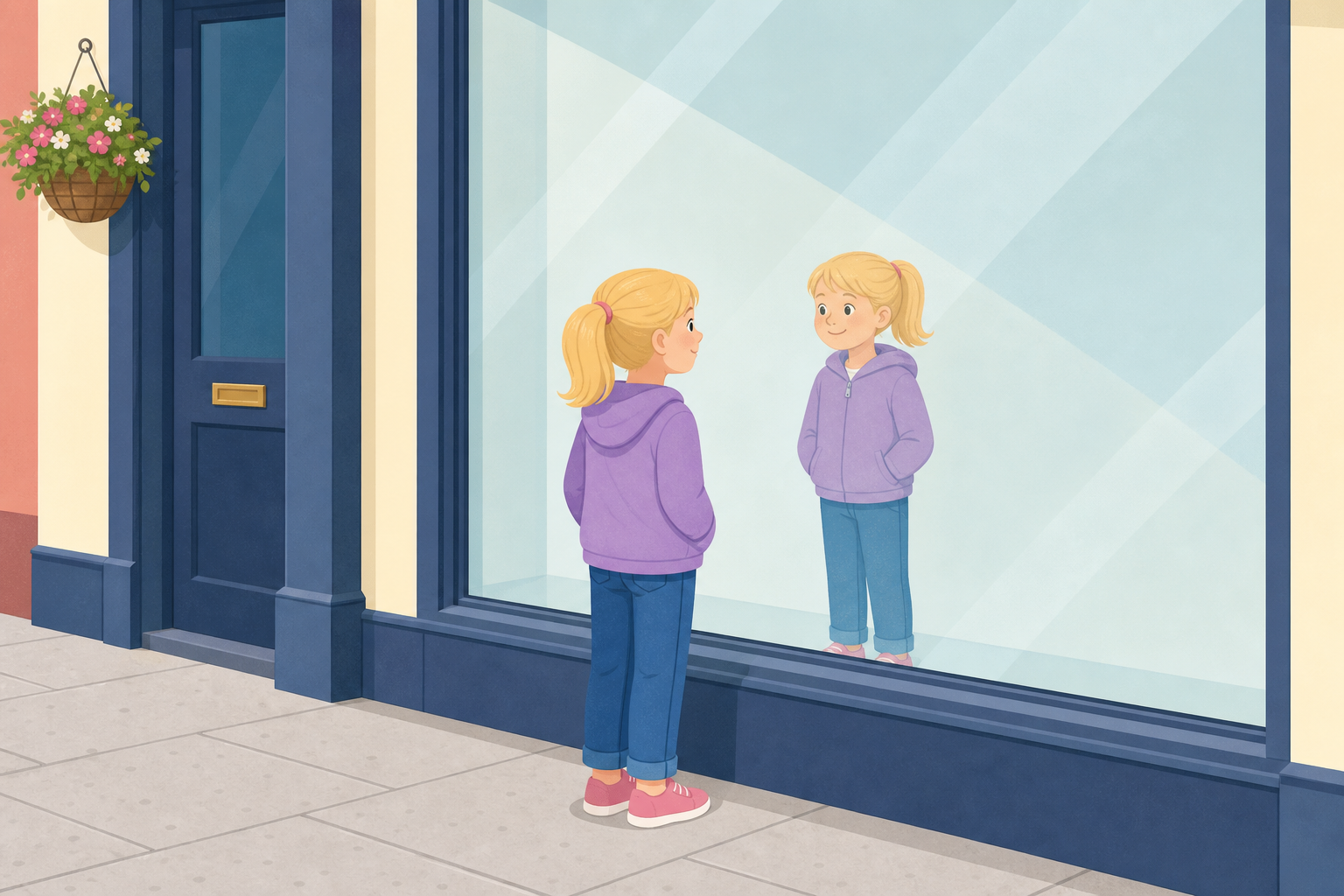
Look at your own reflection in a shop window. Your right hand looks like the reflection's left hand, but you are exactly the same distance in front of the glass as your reflection seems to be behind it.
A shape works the same way when we flip it across a line on the co-ordinate plane. What do you think happens to a point's co-ordinates when we flip it across the up-and-down line through the middle?
Fold a shape drawn on paper along a line and hold it up so pupils see the two halves match. Take two or three hands-up predictions about the co-ordinates, then move on. Do not confirm the rule yet.
The new shape we get after a flip is called the image. It is the same size as the first shape but faces the opposite way.
First we look at a triangle flipped in the y-axis. Notice a corner before the flip and its image after. Look at where each corner lands, and how far each corner sits from the mirror line on each side.
Now we look at a different shape, an L-shape, flipped in the x-axis. Notice it before the flip and its image after. Be ready to say which co-ordinate changed and which stayed the same.
Y-axis example: write one corner on the board, e.g. (2, 3), and its image (−2, 3). Same height, same distance across, opposite side. Draw out that only the x-co-ordinate flipped sign.
X-axis example: this is the x-axis mirror. Ask which co-ordinate flips this time? before you confirm it is the y-co-ordinate, so the mirror is the x-axis. Watch for pupils who expect both to change — only one flips for an axis reflection.
In your maths copy, draw a small shape on the right of the y-axis and draw the y-axis as your mirror line. Then draw its reflection on the left. Write the co-ordinates of one corner and the co-ordinates of its image underneath, so the sign change on the x-co-ordinate is clear.
Walk the room, glance for the mirror line drawn straight down and the two matching corners equal distances from it — no individual marking, this is whole-class copybook practice.
Now we plot a reflection together on the board. We will name each image co-ordinate as it lands:
Talk this one through together — pupils take turns at the board and the class agrees or corrects out loud.
Do the y-axis reflection of the whole triangle first, asking the class to predict each image co-ordinate before the pupil plots it. Then switch to the second prompt: reflect the single corner (3, 2) in the x-axis so pupils see the y-co-ordinate flip while the x stays the same. Reconcile any disagreement by measuring distance from the axis on both sides. Naming the mirror axis each time stops pupils losing track of which co-ordinate flips.
Now we work through the challenge questions together. Each round asks you to plot a reflected image. As you plot each one, say out loud which axis is the mirror and which co-ordinate flips its sign. On the last round no axis is named: look at the starting point, work out for yourself which axis must be the mirror, say it aloud, then plot the image to check you were right.
This is the practice round — pupils take turns at the board, check each answer, and the class confirms before moving on. Keep the board work brisk rather than over-explaining.
On the final round the label does not name the axis. Ask the class to compare the starting point (6, −4) with its image (−6, −4): the x-co-ordinate flipped and the y stayed, so the mirror must be the y-axis. Have them say the axis aloud before they plot, then let Check confirm it. This is where they practise reading the mirror axis from which co-ordinate changed. Watch for pupils flipping both co-ordinates; head that off by pointing back at Watch and Notice.
You're previewing this lesson. Get full access to this lesson and hundreds more — each one ready to teach, with interactive activities, printable resources and pupil progress tracking built in.