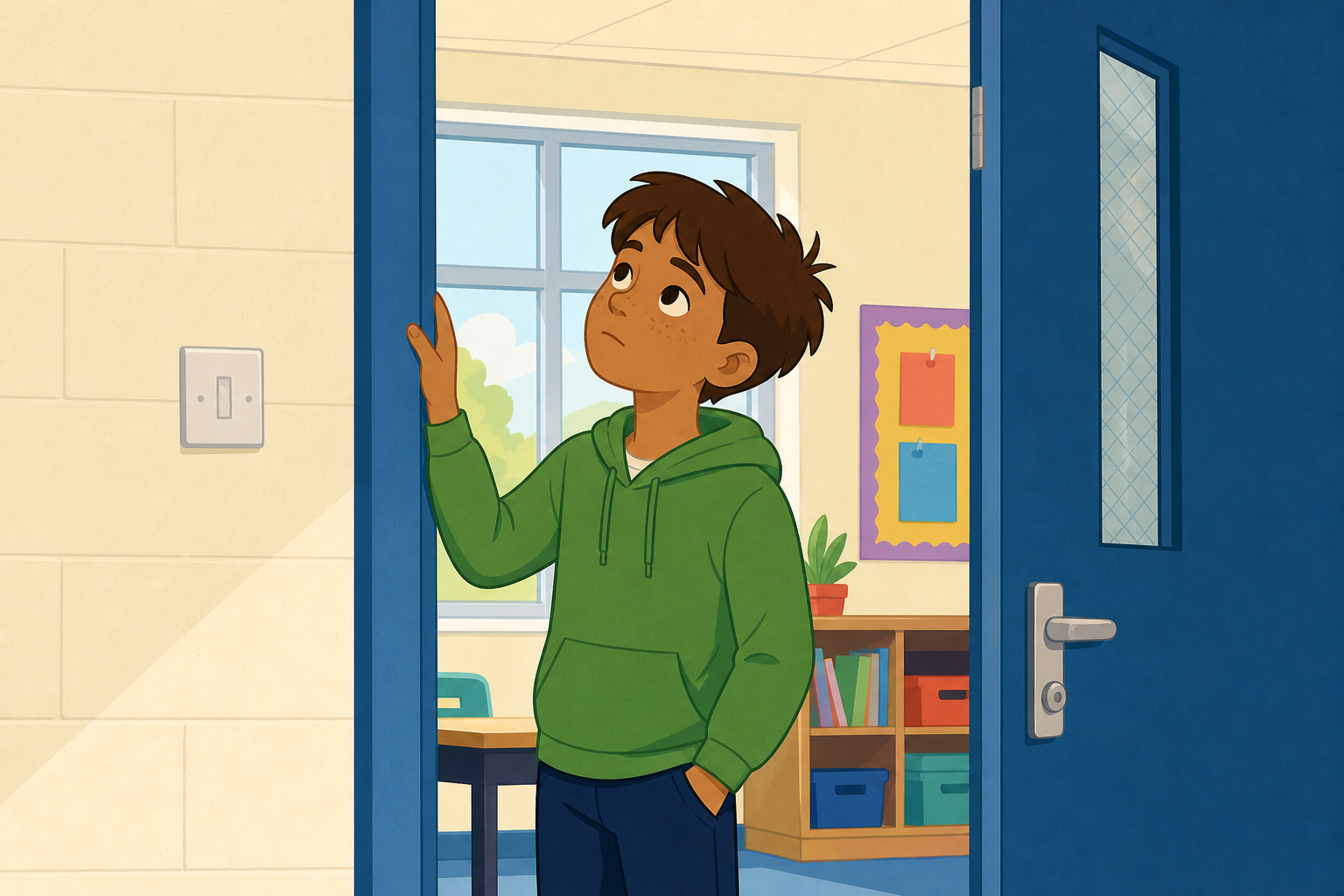
Here is a question with no wrong answer yet: roughly how tall is our classroom door? Don't measure it, don't count anything, just picture it and give a number in metres.
Now the harder one: what things about ourselves and our room get measured to a decimal, not a whole number? Your height, your shoe, a bottle of water, your lunchbox on a scale. Where do the decimals hide?
Take three hands-up estimates for the door height, then move on — don't reveal a true value, this is a warm-up for estimating, not a test. Give five seconds of quiet think-time before the second question so quieter pupils can find an example.
The interactive shows a length reading on a ruler. Look at where the edge sits between the whole marks and decide what decimal it shows. Your teacher will then show a mass reading on the scale and a capacity reading in the jug.
Have the real tape, scale and jug to hand, set to the readings below.
Pencil, 14.5 cm: edge sits between the 14 and 15 marks, halfway across the mm divisions. Point: that in-between position is why we need a decimal at all.
Register, 0.42 kg: needle sits below the 1, so whole-number part is zero. The leading zero catches pupils out. Say zero whole kilograms, forty-two hundredths. Note it is also 420 g, and they will later judge which unit reads more clearly.
Water bottle, 0.5 l: level halfway between 0 and 1 litre, half a litre. Ask for an estimate first, nearer a quarter, a half, or nearly full, then reveal and check.
Let's read one length together on the ruler before you head to your stations. First we estimate: is this object nearer 5 cm or nearer 15 cm? Say your guess out loud. Then we drag the cursor to where the object's edge stops and read it as a decimal centimetre. Watch closely whether the edge lands on a whole mark or between two marks — that is where the decimal comes from. Estimate before you read.
This round is for talking a single length reading through together — invite a pupil to the board to drag the cursor, ask the class to read it, then confirm.
Keep insisting on an estimate first — is it nearer 5 cm or 15 cm? — so estimation stays the skill, not just reading. The mass and capacity readings come next with the real instruments in the Class Challenge, so keep this beat to the length reading only.
In your maths copy, set up a survey with two columns headed estimate and actual. For each thing you measure, write your estimate first, then the real decimal reading beside it. Beside every number, write the unit (cm, m, kg, g, l or ml).
Walk the room glancing for the two columns and a unit beside every number — this is whole-class copybook practice, not marking. Nudge any pupil who forgets to write the estimate before the actual.
In your group, measure three real things around the room and record each as a decimal in your copy: one length (a desk, a book, the door width), one mass (a lunchbox, a pencil case, a stack of books), one capacity (a bottle, a cup, a jug of water). Estimate before you measure each one. Choose the unit that gives the clearest decimal.
What do three things around our classroom measure, to a decimal?
Collect:
Show it as: each group reads two of their three readings aloud for the class to confirm
These are the practice questions — real objects and instruments circulate around the room (or sit at stations) and pupils measure each one with their group's tools. Keep the pass-on rhythm brisk; the class confirms a couple of readings aloud at the end.
Hand each group a metre tape, a scale, and a jug (or run three stations if kit is short). Collect one length, one mass and one capacity from each group. Prompt the unit choice out loud: would you write the door width in metres or centimetres — which reads more clearly? Watch for pupils who write a mass under 1 kg without the leading zero.
You're previewing this lesson. Get full access to this lesson and hundreds more — each one ready to teach, with interactive activities, printable resources and pupil progress tracking built in.