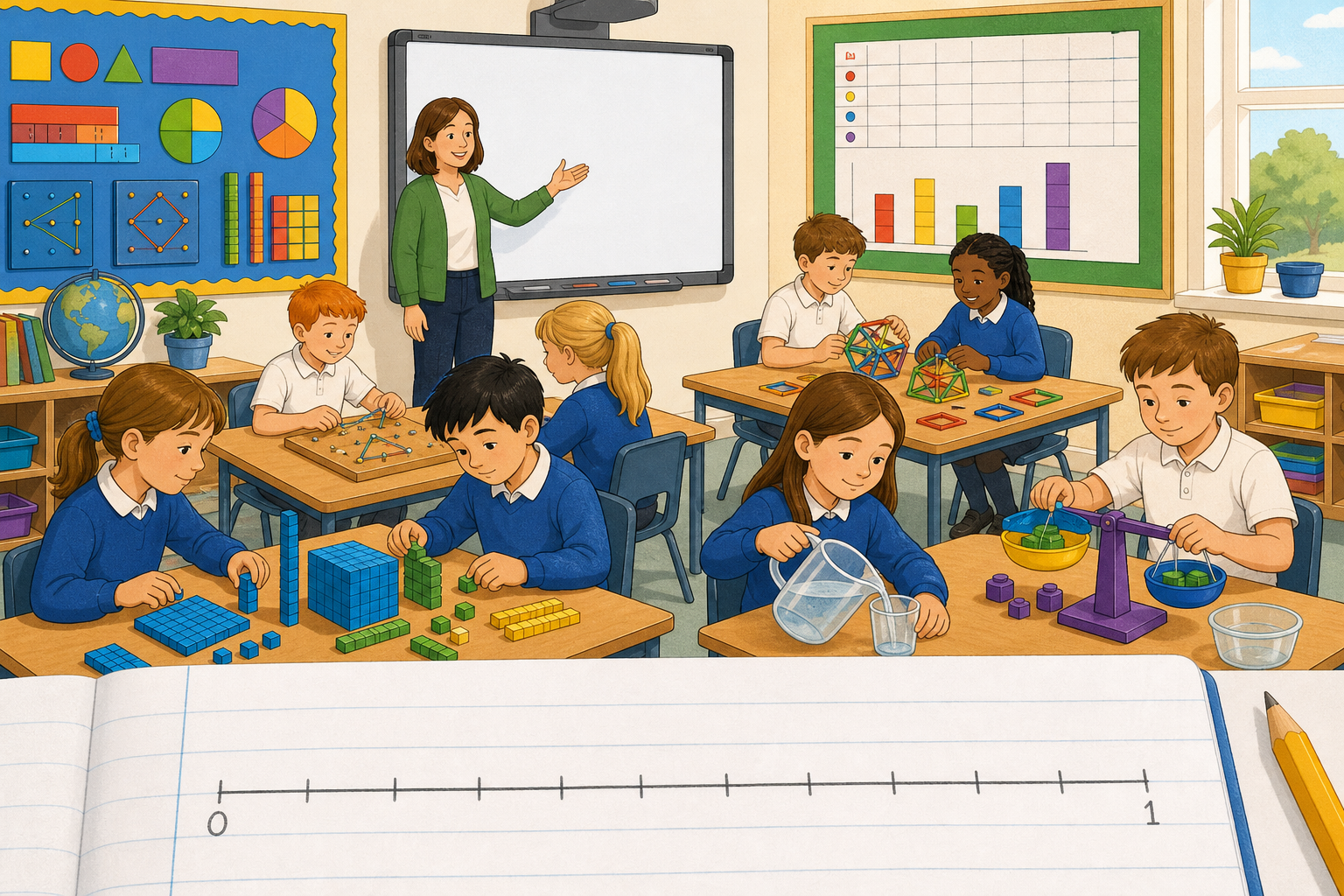
Here is a number line that runs from 0 to 1, and someone has split it into ten equal steps. Look closely at the very first little step after 0.
What decimal do you think sits right there, on that first step? Hands up when you have a number in your head.
Display the 0-to-1 line split into ten equal steps as pupils settle. Give five seconds of quiet think-time before any hands go up, then take two or three answers.
You are listening for 0.1 (one tenth). If a pupil says "one" or "a tenth", revoice it as "one tenth, and we write that as 0.1". You already know one tenth is 0.1, so lean on that to bring tenths onto today's number line.
The interactive shows a marker on a number line split into ten equal tenth-steps. Look at where each marker is and count the steps along with us. Later the line runs to 2, so notice where we start counting from.
0.1 — point to the marker, count one step from 0: one tenth, 0.1.
0.5 — count the visible steps with the class: one to five. Five tenths lands exactly halfway; link to one half from earlier fraction work. This is the key one.
0.8 — count on to eight tenths, 0.8. Stress it is two short of 1, not eight short, to head off miscounting from the wrong end.
1.3 — line now runs 0 to 2, marker past 1. The new move: go to the whole number 1 and make that the new start rather than counting all the way from 0.
Counting on from 1. Point right at 1, count three tenth-steps to reach 1.3. Draw out that the whole is already counted, so only the three tenths remain.
Count the steps aloud with the class every time so counting-on becomes the habit.
Now we work through these tenths together on the number line, in this order: 0.2, then 0.7, then 0.4, and finally 1.5. One of you comes up to move the marker each time. Everyone else counts the equal tenth-steps out loud with us, so we all find the answer together before we check where it lands.
This round is for talking it through together. One pupil comes up to drag the marker; the rest of the class counts the tenth-steps aloud with you and agrees or corrects.
For each value, call one pupil up to drag the marker. Before they release it, ask the whole class to count and predict the step number. Work the values in this order so the round builds: 0.2 (two steps), 0.7 (seven steps, near 1), 0.4 (four steps), then 1.5 on the 0-to-2 line where counting must start from the whole number 1.
To keep the watching class with the round between turns, revoice the last pupil's count aloud ("so Aoife counted seven steps for 0.7"), and for 1.5 do a quick turn-and-name: ask the class to name the whole number they start counting from before the pupil drags. Watch for pupils counting from the wrong end for 0.7 — remind them to start every count at the whole number on the left.
In your maths copy, draw a number line from 0 to 1 and split it into ten equal steps. Then label these three tenths in their correct places:
Count the equal steps carefully from 0 each time before you write the label.
Walk the room glancing at whether the ten steps are roughly equal and whether 0.5 lands near the middle — this is whole-class copybook practice, not marking. A ruler helps keep the steps even.
Now we place these tenths on the line, in order: 0.3, then 0.6, then 0.9, and finally 1.2. The last one is past the whole number 1, so we count the steps starting from 1.
One pupil comes up to move the marker and press Check each time. Everyone else predicts and counts the tenth-steps together first, then we all watch the check to see if we were right.
These are the practice questions — one pupil at a time comes to the board, moves the marker and presses Check, while the class predicts and counts the steps aloud together. The class confirms before moving on. Keep the board work brisk rather than over-explaining.
The order builds: 0.3 and 0.6 stay under 1, 0.9 sits just short of the whole number, and 1.2 is the key one where the count must restart from 1. Have the class count the step number for each before the pupil presses Check.
You're previewing this lesson. Get full access to this lesson and hundreds more — each one ready to teach, with interactive activities, printable resources and pupil progress tracking built in.