Here are three things that might happen today or tomorrow:
Which one is sure to happen? Which one can never happen? And which one sits somewhere in between?
Take three hands-up answers, not open call-outs. Give five seconds of quiet think-time first.
Listen for pupils reaching for words like sure, never and maybe without a scale to hang them on. That gap is exactly what the next step supplies.
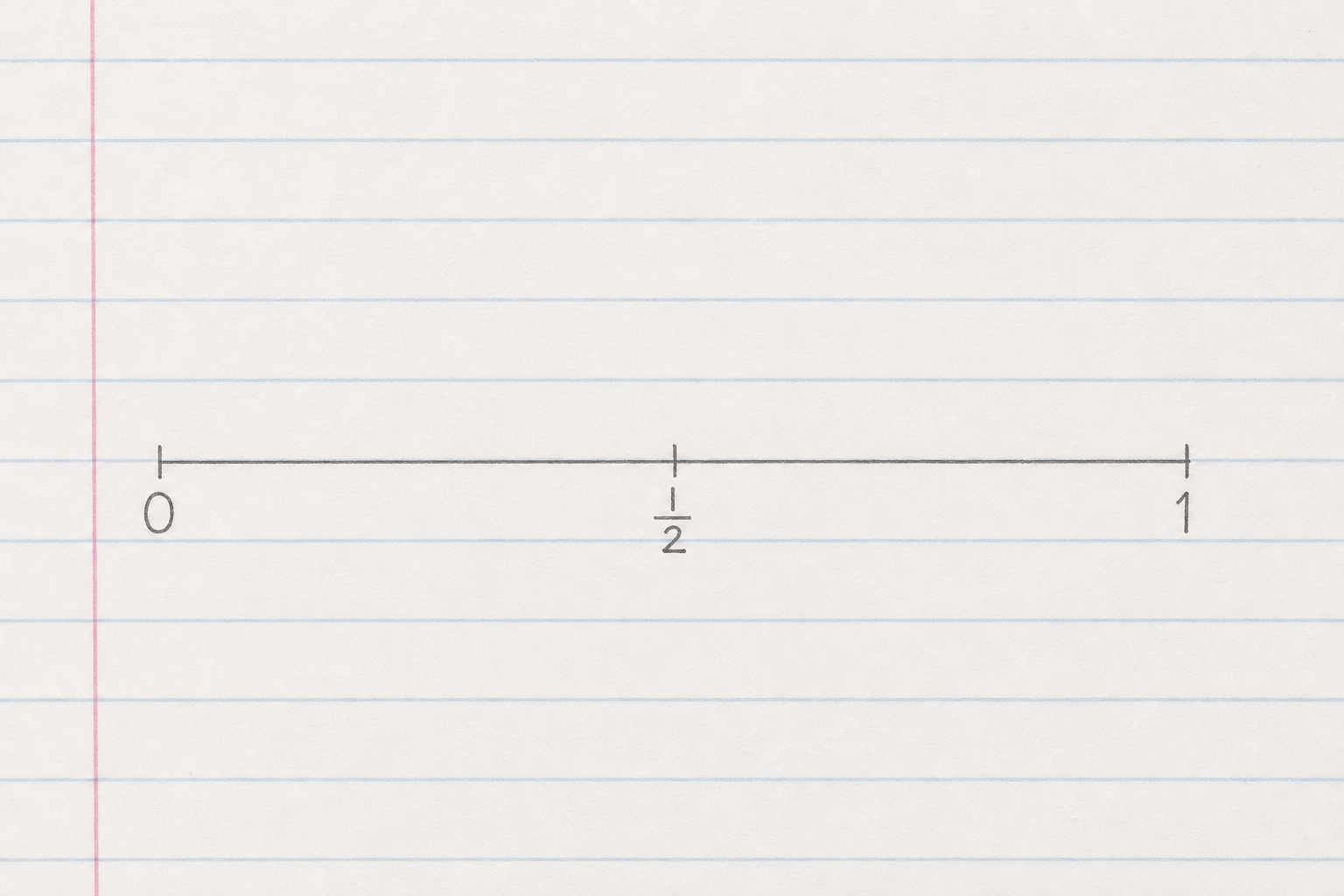
Every chance in the world sits on one line, from 0 at the left (it can never happen) to 1 at the right (it must always happen). The middle, 0.5, is an even chance, just as likely to happen as not.
Here is how to place an event on the scale and match its chance word. Follow this worked example: you roll an even number on an ordinary six-sided die.
A coin landing heads sits on the same spot as the even-number roll. Why do you think both events land at 0.5?
Point at each end first: 0 means never, 1 means must. Do not let the class read the middle as "halfway to certain", it is halfway between never and must.
Work the even-number die example on the board in order: six outcomes → three even (2, 4, 6) → half → marker at 0.5 → word even chance. Place the marker yourself so pupils see the full path once before they try.
On the coin question, hold out for the reason both land on 0.5: one of two sides is heads, three of six faces are even, so each is as likely as not. Revoice a pupil's answer rather than supplying it: so it is the same chance shown two different ways.
Slip to watch: calling 0.5 "likely" because it "might happen". Push back to even chance, equal chance either way.
Today we place these events on the chance scale together. For each one, say where you think it belongs and give a reason before the marker moves:
Talk this one through together — rename the single marker for each event in turn, and let pupils take turns at the board while the class agrees or corrects out loud.
Intended placements (keep these off the board): a Monday following a Sunday is certain; the next car being red is down near unlikely; the next baby being a girl is right at even chance; growing taller this year is up near likely.
Push every placement back to a reason, not a feeling: why nearer certain than even? The girl/boy birth is the anti-pitfall — hold out for even chance, and head off "but I know more boys". Watch for pupils crowding markers past the 1 end; there is no room beyond certain.
In your maths copy, sketch a chance scale — a line marked 0 at the left, 0.5 in the middle and 1 at the right. Then place each of these events on it and label each one with a chance word (impossible, unlikely, even chance, likely, certain):
Walk the room glancing at where markers land and whether the chance word matches the position — no marking, this is whole-class copybook practice.
Today we place four trickier events on the scale, and each one is harder to judge than the last. Say where each belongs and why:
This is the practice round — pupils take turns at the board, check each answer, and the class confirms before moving on. Keep the board work brisk rather than over-explaining.
The card (one heart in four suits, near a quarter) and the spinner (one of three colours, about a third of the way) have a clean fair split, so the class can reason them exactly — reason the fraction first, then accept the nearest reachable tick, since the line ticks in tenths. The drawing pin has no fair split, that is the point; the interactive accepts a wide band around 0.55 (about 0.35 to 0.75), so treat any placement in that band as fine and press for a reason rather than one exact spot. On the stretch, insist the chance word matches the placement, not the other way round.
You're previewing this lesson. Get full access to this lesson and hundreds more — each one ready to teach, with interactive activities, printable resources and pupil progress tracking built in.