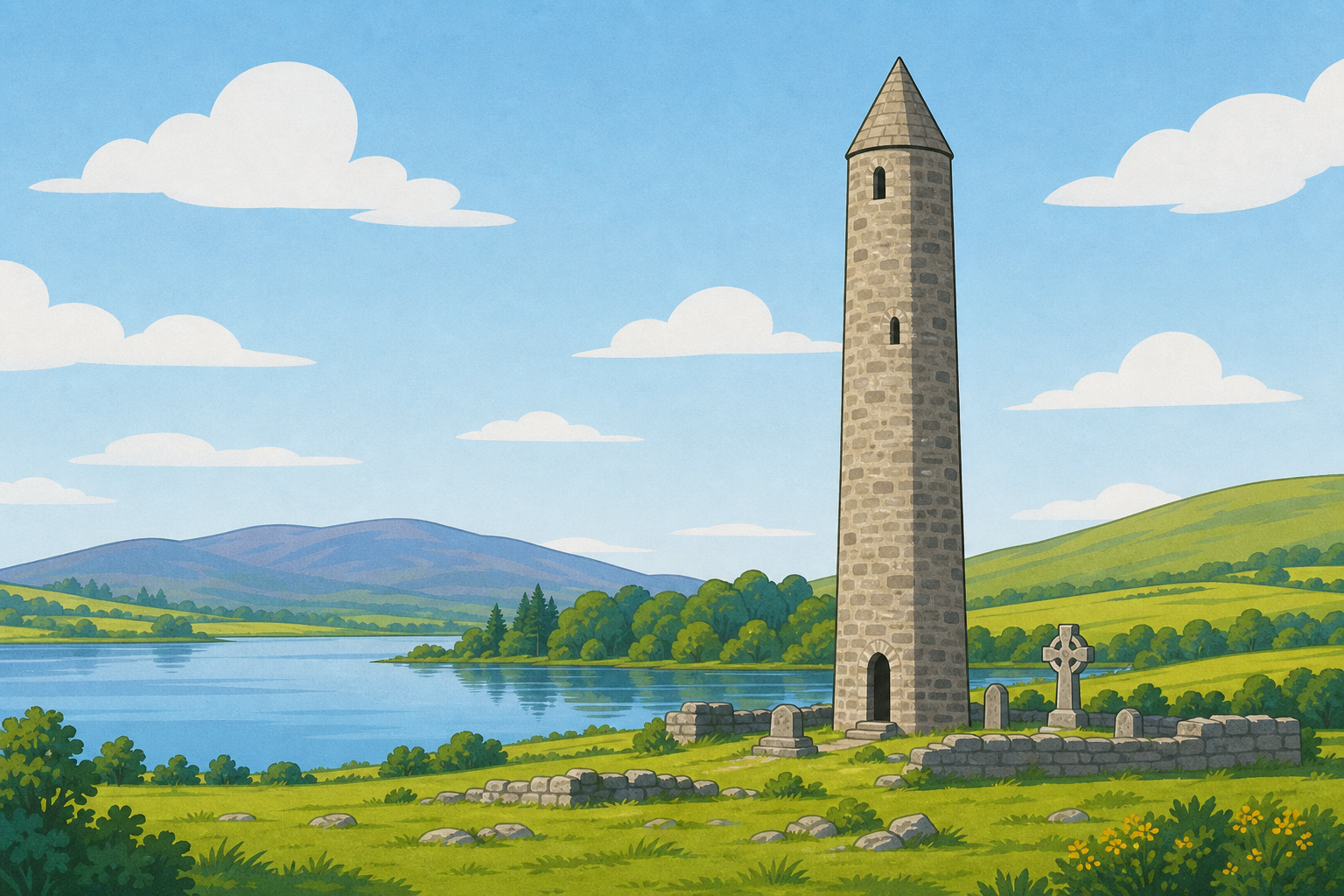
Two trips are on the table for our class: Glendalough, with its lakes and old round tower in Wicklow, or Newgrange, the ancient tomb in Meath.
We have a budget of €175 for each pupil, a school day from 09:00 to 14:40, and 28 pupils going.
One of these trips fits our day and our budget more easily than the other. Which one do you think it is? And what do we need to work out before we can be sure?
Take three hands-up answers to which fits better and three to what we need to work out. Do not settle the argument yet.
Steer the second list toward the three things the lesson works: cost per pupil, how long each way, and how long on-site. Write those three headings on the board as pupils name them.
All costs and times in this lesson are example figures chosen for the maths, so they may differ from current visitor prices and opening times.
Here are the two trips side by side. Look at how each cost and each time lines up against the other.
Now the same two trips as costs. These cards show that the bus is one price for the whole class, but entry and lunch are a price for each pupil.
Before the next card lands, predict which trip costs each pupil more, and by how much.
First card is the times. Point at the two travel-each-way rows and ask which trip spends more of the day on the road. Note the margins for yourself: Glendalough's 5 h total means a 09:00 depart returns at 14:00, a comfortable 40 minutes before the 14:40 finish; Newgrange's 3 h 40 m returns at 12:40, with plenty of the day to spare.
Second card is the raw costs. The move to draw out is that the bus is a fixed cost (one price for the class) while entry and lunch scale with pupil numbers. Hold out for a pupil to say the bus is shared. Work the bus share aloud here: €280 shared between 28 pupils is €280 ÷ 28 = €10 each, so pupils see the division method before the finished €10 appears on the next card.
Third card lands the per-pupil totals — €22 and €26.50. The class has just predicted which is dearer; reveal and check against their prediction. Both are far under €175, so name that the money will not be the deciding factor. All figures are example costs for this activity.
Today we work through two things together on the board: what each pupil pays, and how long the day is.
We will put the two trips into a budget chart so we can see each cost on its own row. For Glendalough we enter the bus share €10, entry €7 and lunch €5. For Newgrange we enter the bus share €12.50, entry €9 and lunch €5. The chart shows each cost as its own row, the running total, and how much of the €175 is left over for extras.
Once both totals are up, we will look back at the times: Glendalough spends 2 h 30 m of the day travelling, Newgrange only 1 h 40 m. So which limit really decides between them, the money or the day?
Talk this one through together — pupils take turns at the board and the class agrees or corrects out loud.
Set the budget cap to €175. Enter the three Glendalough rows first (€10, €7, €5) and read off the total €22 with €153 remaining — the chart shows nearly all the budget still free. Then clear and enter the three Newgrange rows (€12.50, €9, €5) for €26.50, €148.50 remaining.
The teaching point: both trips leave a huge amount of the budget unspent, so the €175 cap is not the constraint that decides — the day length is. Close by asking the day-length question and revoicing a pupil who spots that Glendalough eats 2 h 30 m of the day travelling versus Newgrange's 1 h 40 m.
In your maths copy, write the trip you would choose at the top. Then write each cost on its own line with the per-pupil amount beside it:
Total the three at the bottom and circle your per-pupil total.
Before the last line, we work one journey-time example together on the board so everyone sees the method. For Glendalough the pieces are travel out 1 h 15 m, on-site 2 h 30 m, and travel back 1 h 15 m. We add those three to get the total journey time, then check a 09:00 start: does the return land before 14:40?
On the very last line of your copy, write your own total journey time the same way (travel out and back plus time on-site) so you can check the trip fits the school day.
Costs first: walk the room glancing that the bus figure is the shared amount, not the whole €280 or €350 — this is the slip to catch.
Then teach the time method once, on the board, before they write their own. Write the three Glendalough pieces in a column:
1 h 15 m out
2 h 30 m on-site
1 h 15 m back
Add minutes first (15 + 30 + 15 = 60 m = 1 h), then hours (1 + 2 + 1 + the extra 1 = 5 h). Total journey time = 5 h.
Check the day: depart 09:00, add 5 h → return 14:00, which is 40 minutes before 14:40, so it fits. Name the method: out + on-site + back, then add on to 09:00.
Second slip to watch on their last line: forgetting to count travel both ways (only writing one journey). No individual marking; whole-class copybook practice.
Today we plan one trip's cost for each pupil, adding it up bit by bit and staying under €175. We enter each amount at the board and check the running total.
We build four plans in turn:
After the tool confirms each total, we say aloud whether it still comes in under €175.
This is the practice round — pupils take turns at the board, check each answer, and the class confirms before moving on. Keep the board work brisk rather than over-explaining.
Each challenge builds a per-pupil total. The last one is the one to linger on: even with a €10 tour added, Newgrange's total is €36.50, still miles under €175 — the point that lands is that our real limit today is time, not money. The tool checks the total; the class answers the under-budget question aloud.
You're previewing this lesson. Get full access to this lesson and hundreds more — each one ready to teach, with interactive activities, printable resources and pupil progress tracking built in.