1 - Getting Started ~5 mins
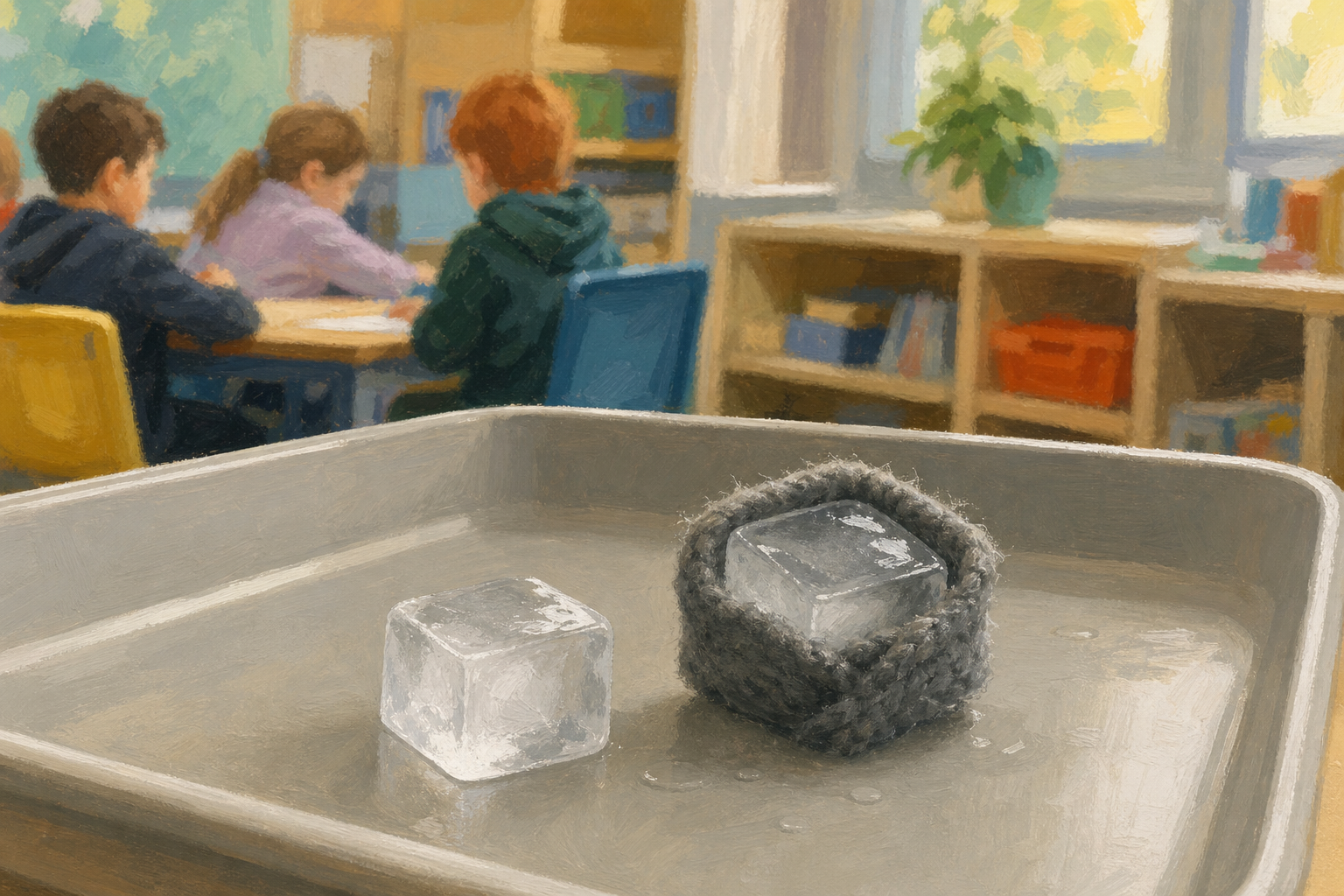 Look at this: one ice cube snug in a woolly wrap, and one sitting bare. Which do you think will melt first? More importantly, how could your group test a heating or cooling question of its own, and keep that test fair?
Have one bare ice cube and one loosely wrapped in a scrap of wool or a sock ready on a tray to show, nothing more. Do not lay out the full kit or name the variables yet.
Take three or four quick ideas from the class. Accept every suggestion as the start of the science. The point of the hook is curiosity and the idea that each group will own its question.
Nature of STEM: scientists often start from a simple everyday puzzle, then design a careful way to find out.
2 - Our Question and Prediction ~7 mins
First job: agree in your group whether you will keep an ice cube frozen as long as you can, or keep a cup of water warm as long as you can.
Next: look at today's materials on the board. Ice path: wool, foil, paper or bubble wrap. Warm-water path: plastic, metal or paper cups. We set the kit out later.
Then write your question using a shape like these, swapping in your materials:
- Ice path: Which wrapping keeps an ice cube frozen longest?
- Warm-water path: Which cup keeps water warm longest?
Write your group's question on the FairTestPlanner page. Say what you think will win, and why.
Set the theme only. Do not assign each group a question. Reveal on the IWB in three beats so groups have one job at a time: (1) pick ice or warm-water path; (2) show material choices (wool, foil, paper, bubble wrap / plastic, metal, paper cups) and one model question shape; (3) write the question and say the prediction. Still do not lay out full stations yet.
Priority in this slot: path chosen and one clear testable question on the FairTestPlanner page. A short "because" can be spoken while you circulate if writing time runs short.
Two paths groups may choose
- Ice path: Which wrapping keeps an ice cube frozen longest?
- Warm-water path: Which cup keeps water warm longest?
Predictions are never wrong. Push gently for a because: thickness, trapped air, or how quickly heat can pass through the material, not "it makes things hot or cold".
Misconception to listen for: "Wool keeps us warm, so it will melt the ice faster." Gently reframe: a wrap slows heat moving in or out; it does not make heat.
Look-fors: groups name one thing they will compare; a reason linked to a material property; quieter pupils given a turn to voice the prediction.
If a group wants a third heating or cooling idea within the theme and kit, allow it if it can stay fair with the materials on the table.
3 - Plan Our Fair Test ~12 mins
Before we touch the ice or water, we lock in a fair plan so we can trust the result.
On the board you will see three boxes:
- Change — the one thing we swap
- Measure — the result we read
- Keep the same — everything else that must match
That is a fair test. We will sort cards into those boxes for both paths (ice wrapping and warm-water cups). Be ready to suggest where each card goes.
After both board sorts, finish only your own three lines on the FairTestPlanner for the path your group chose.
Plan a heating or cooling fair test
Key concepts
| Concept | Why it matters | Example |
|---|---|---|
| Fair test — a comparison where only one thing is different on purpose | If two things change at once, you cannot tell which one caused the result | Same-size ice cubes, same spot on the table; only the wrapping differs |
| What we change — the single thing the group swaps between trials | This is the heart of your open question | Wool wrap versus foil versus paper |
| What we measure — the reading or rank you will compare after a set wait | Without a clear measure, groups argue opinions instead of evidence | How melted the ice looks after 8 minutes, or how warm the water still feels after the same wait |
| What we keep the same — every other condition held identical | Sameness is what makes the answer trustworthy | Amount of water, start warmth, cup size and shape, timing method, and who judges by hand |
Interactive on the IWB (two full challenges)
Do not project or read out the target placements. Drive the fair-test planner in challenge mode so the class decides. Run the ice challenge first with the class calling placements while you drag; check shows right or not yet. Then run the warm-water challenge the same way so both paths are modelled on the board before any group writing.
Ice target (teacher only): Change → the wrapping; Measure → how melted after the same wait; Keep the same → size of ice cube, place in the room, how cold the ice was at the start.
Warm-water target (teacher only): Change → the cup material; Measure → how warm after the same wait; Keep the same → amount of water, how warm the water was at the start, place in the room, same size and shape of cup.
Speak the card labels in plain words as you drag (for example "how cold the ice was at the start" not just "starting chill"). Then send groups to complete only their own three planner lines for the path they chose.
Pacing: if either board sort runs long, finish one full path cleanly, then a quicker second-path check with the class calling only the trickiest cards. Still protect time for every group to write their three FairTestPlanner lines before the trial — group writing is non-negotiable even if the second board pass is shortened.
Worked model (say aloud, do not project as a script)
I wonder which wrapping keeps ice frozen longest. I predict wool will win because fluffy wraps trap air so heat reaches the ice more slowly. I might be wrong, and that is why we measure. I will change only the wrapping. I will measure how melted each cube looks after the same 8-minute wait. I will keep the cube size, how cold the ice was at the start, and the place in the room the same. After the first trial I will only write the ranks or readings. I will not decide the winner until we have repeated next time.
Warm-water version: change only the cup material; measure how warm the water still feels after the same wait; keep amount of water, how warm it was at the start, place, same size and shape of cup, and the same judge.
Group planning
Each group finishes its own FairTestPlanner page: what they change, what they measure, what they keep the same. Circulating, challenge vague plans ("we will see which is better") into a named measure. For warm-water groups, check they have named same size and shape of cup (materials are identical cups of different materials).
Misconceptions to head off:
- Children often change two things (different cups and different amounts of water). One change only.
- "Wool keeps us warm, so it will melt the ice faster." Reframe: wrapping slows heat moving in or out; it does not make heat. Push "because" language toward thickness, trapped air, or how quickly heat can pass, not "it makes things hot or cold".
Low-kit measure (must finish in the trial slot): no thermometer and no full-melt wait. Agree one class watch window before groups start (for example 8 minutes). Ice path: at the end of the wait, rank each cube still solid / edges soft / half melted / mostly water, or note which has the most meltwater. Warm-water path: same pupil, same finger, ranks warm / cooler / cold after the fixed wait. Every group must leave with a Trial 1 reading today.
4 - Run Our First Trial ~18 mins
This is the exciting bit: will your prediction hold after about eight minutes? Set up the test your group planned. Change only the one thing on your plan. Agree the same watch time as the class.
When the timer ends, write each Trial 1 rank straight onto your DataTable: how melted the ice looks, or how warm the water still feels. Today is trial one only. We repeat next time so one odd result cannot fool us.
Before groups start
Bring ice from the cooler bag or freezer only now so cubes are still fully frozen and matched. Prefer small identical cubes (bottle-cap size) so differences show within the wait. Agree one class watch window out loud (8 minutes works well).
Pour window then shared timer (non-negotiable start): ice-path groups set out wrappings and place cubes first. In one short pour window, you pour hand-warm water (never hot) for every warm-water group. When every warm-water group has water and ice groups are ready, start the one class timer together. Do not start the watch while you are still pouring.
Wipe spills as you go.
During the wait
Fold every group into short whole-class questions while the timer runs — no parallel desk task for watchers. Ask: What do you notice so far? Is anything looking different already? Which sameness on your plan are you watching carefully? Groups that finish early after the timer can sketch what they will keep identical on the repeat, or whisper one thing that might have made today's trial unfair.
When the timer ends (recording moment)
- Ranks go straight onto the DataTable Trial 1 column now — not saved for the next step.
- Check each group changed only one thing.
- Ice path: rank or describe every cube (still solid / edges soft / half melted / mostly water) or note which left the most meltwater. Do not wait for full melt.
- Warm-water path: the same pupil must be the judge for every cup in that group. You can say: "Fingers are a rough tool, so the same person checks every cup the same way; that is why we rank and why we repeat."
What to expect
Wool or bubble wrap often slows melting more than paper; bare ice melts fastest. Metal cups often lose warmth faster than thicker plastic or a wrapped cup. Results vary with room temperature. That is fine; the comparison inside one group still teaches fair testing.
If nothing seems different: wrappings may be too alike, or cubes too large. Suggest adding a bare control beside a well-wrapped cube next trial, or using smaller bottle-cap ice.
Safety: warm water is teacher-poured only; keep floors dry; no tasting of ice that has been handled.
5 - Record Our Readings ~7 mins
Check your DataTable: is every Trial 1 rank already written from the end of the timer? Look at the board example: one row shows a reading such as wool | half melted.
Keep what we saw or ranked in the Trial 1 column. Cross out any claim words like "so wool is best" — those wait until after the repeats. Leave space for the repeats next time.
This step is a check and tidy-up, not a second full write from blank. Trial 1 ranks should already be on the DataTable from the end of the timer in the previous step. Confirm every material or cup has a rank; model one board row only if a group is stuck (material or cup name | trial 1 reading | blank columns for later repeats). Example reading only: wool | half melted or metal cup | cooler.
Then show a crossed-out or separate later box with a claim such as "so wool is best" and say that claim waits until after repeats.
Stress the split between observation and interpretation: "half melted after 8 minutes" is a reading; "so wool is best" is a claim for after repeats. For warm-water groups, revoice if needed: fingers are a rough tool, so the same judge and ranks matter, and that is why we repeat.
Investigation Journal pages in use: FairTestPlanner (already started) and DataTable. Collect or store journals so each group keeps its plan and first results for Part 2 of this project.
Differentiation: some pupils dictate ranks to a partner; others add a tiny sketch of the set-up beside the table.
Unlock the full learning experience
You're previewing this lesson. Get full access to this lesson and hundreds more — each one ready to teach, with interactive activities, printable resources and pupil progress tracking built in.
This lesson is copyright of Coding Ireland 2017 - 2025. Unauthorised use, copying or distribution is not allowed.