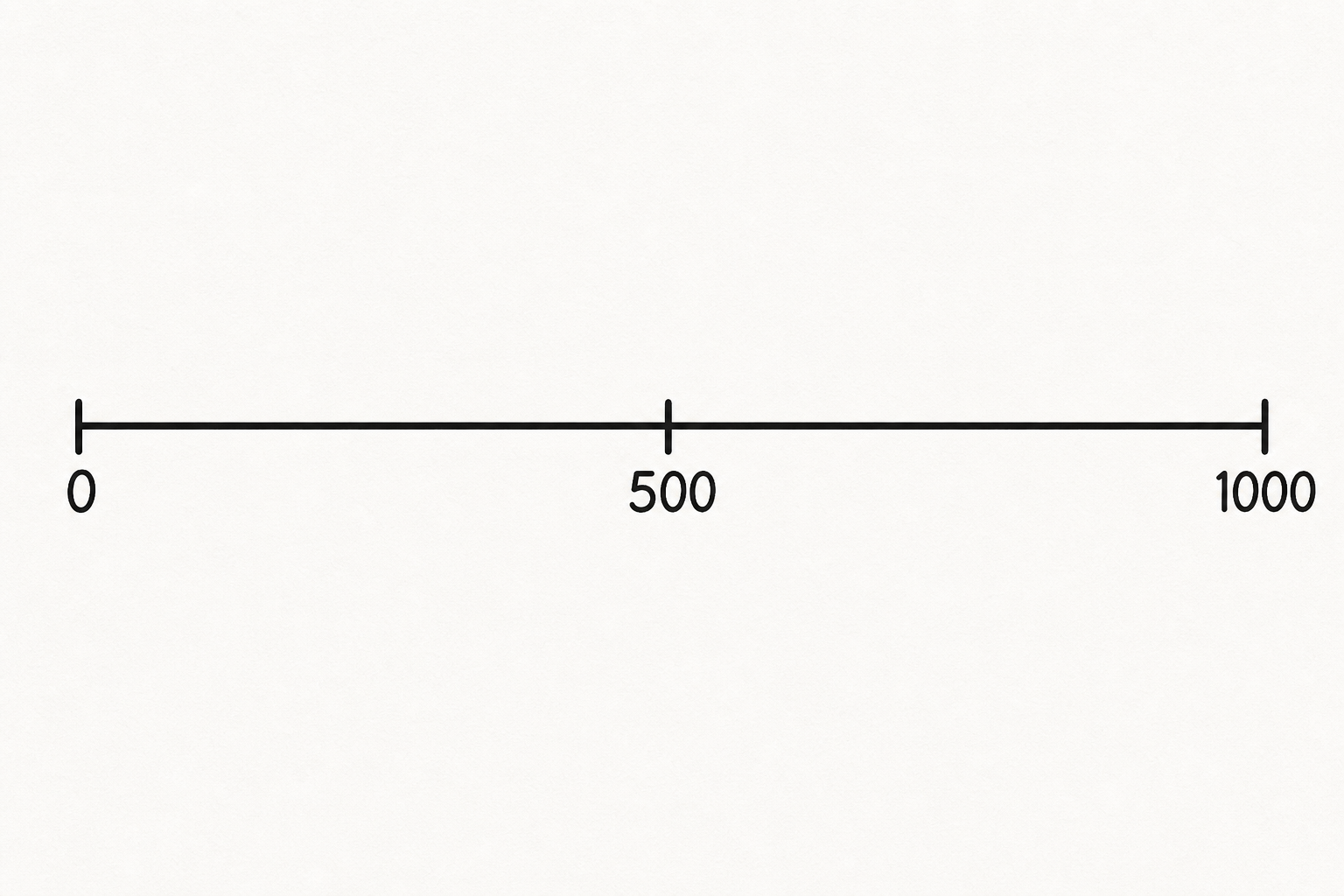
Here is a number line for a sponsored walk. The start is 0 metres and the far end is 1,000 metres. Only three marks are on it: 0 at the start, 500 in the middle, and 1,000 at the finish.
Roughly where would 750 metres go, past the middle towards the finish?
Display the 0 to 1,000 line with only 0, 500 and 1,000 marked. Give five seconds of quiet think-time before any hands go up, then take three hands-up answers, not open call-outs. You are only surfacing the instinct that 750 is 'past the middle, most of the way to the end'; don't confirm an exact spot yet.
Three number lines appear one at a time, each with a marker resting on it. Look at where each marker sits and think about which mark you already know that helps you judge its place. A landmark is a mark we know, like the middle, that we use to place other numbers.
500 on 0 to 1,000: marker at 500, right in the middle. Ask what the middle is here, take two hands. Press that halfway along means halfway between the two end numbers.
Before revealing 2,500 on 0 to 5,000: ask what half of 5,000 is, so the middle links to a calculation. Marker lands at 2,500, the middle again.
Prediction: five seconds quiet, then two or three hands. On a line up to 9,000, will a number near the middle be bigger or smaller than 2,500? (bigger, since middle of 9,000 is 4,500.)
7,000 on 0 to 9,000: marker at 7,000, not near the middle. It is 1,000 past 6,000 and 1,000 short of 8,000, exactly between the two nearest thousands. This gives nearest thousands as a second landmark beyond halfway.
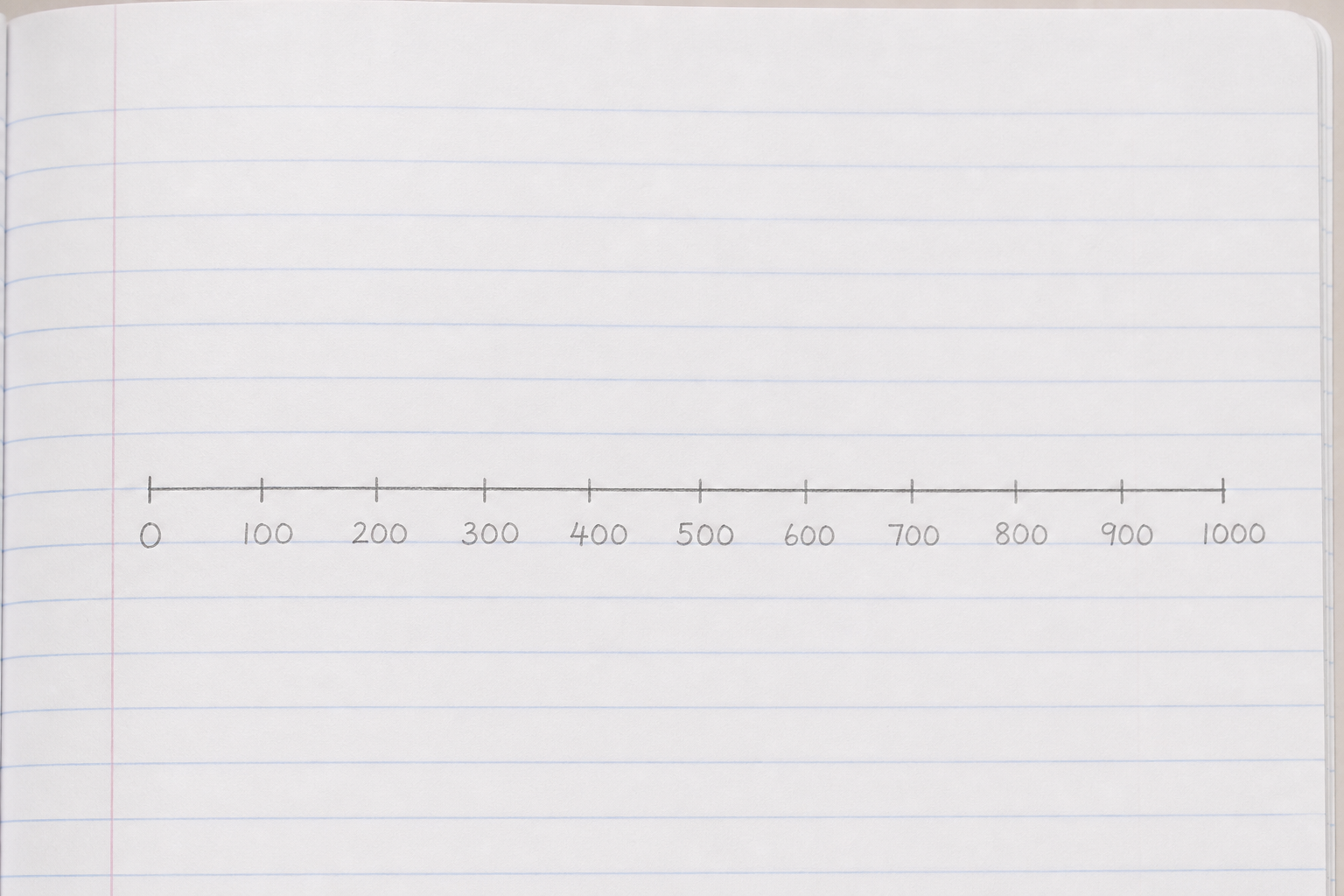
In your maths copy, draw a number line from 0 to 1,000 and mark it in hundreds: 0, 100, 200, all the way to 1,000.
Then mark these three numbers in roughly the right place on your line:
For each one, whisper to yourself which landmark helped you decide where it goes.
Walk the room glancing for even spacing of the hundred marks and whether 250, 640 and 880 land near the right positions — no marking, this is whole-class copybook practice. Watch for lines where the hundreds are unevenly spaced, which throws every estimate off.
Today we place four numbers together on the same line, which runs from 0 to 1,000. Each time, we say which landmark we used before we drop the marker. We start with 300, then 750, then 480, and finally 920. Each one leans on a landmark, so predict where the marker will land before we check it.
This round is for talking it through together; pupils take turns at the board and the class agrees or corrects out loud. All four numbers sit on the one 0 to 1,000 line, so the interactive does not need rescaling.
Set the interactive to explore mode. Call a number, a pupil drags the marker, then before anyone checks, ask the class 'which landmark did you lean on?'
Now we work through four placements together, all on one line that runs from 0 to 6,000, marked every thousand: 1,500, then 3,000, then 4,400, and finally 2,950. The last one is sneaky, so we say which landmark settled it before we check.
These are the practice questions; pupils take turns at the board, check each answer, and the class confirms before moving on. Keep the board work brisk rather than over-explaining. All four numbers sit on the one 0 to 6,000 line.
On each target, ask the pupil to name the landmark aloud before pressing Check.
You're previewing this lesson. Get full access to this lesson and hundreds more — each one ready to teach, with interactive activities, printable resources and pupil progress tracking built in.