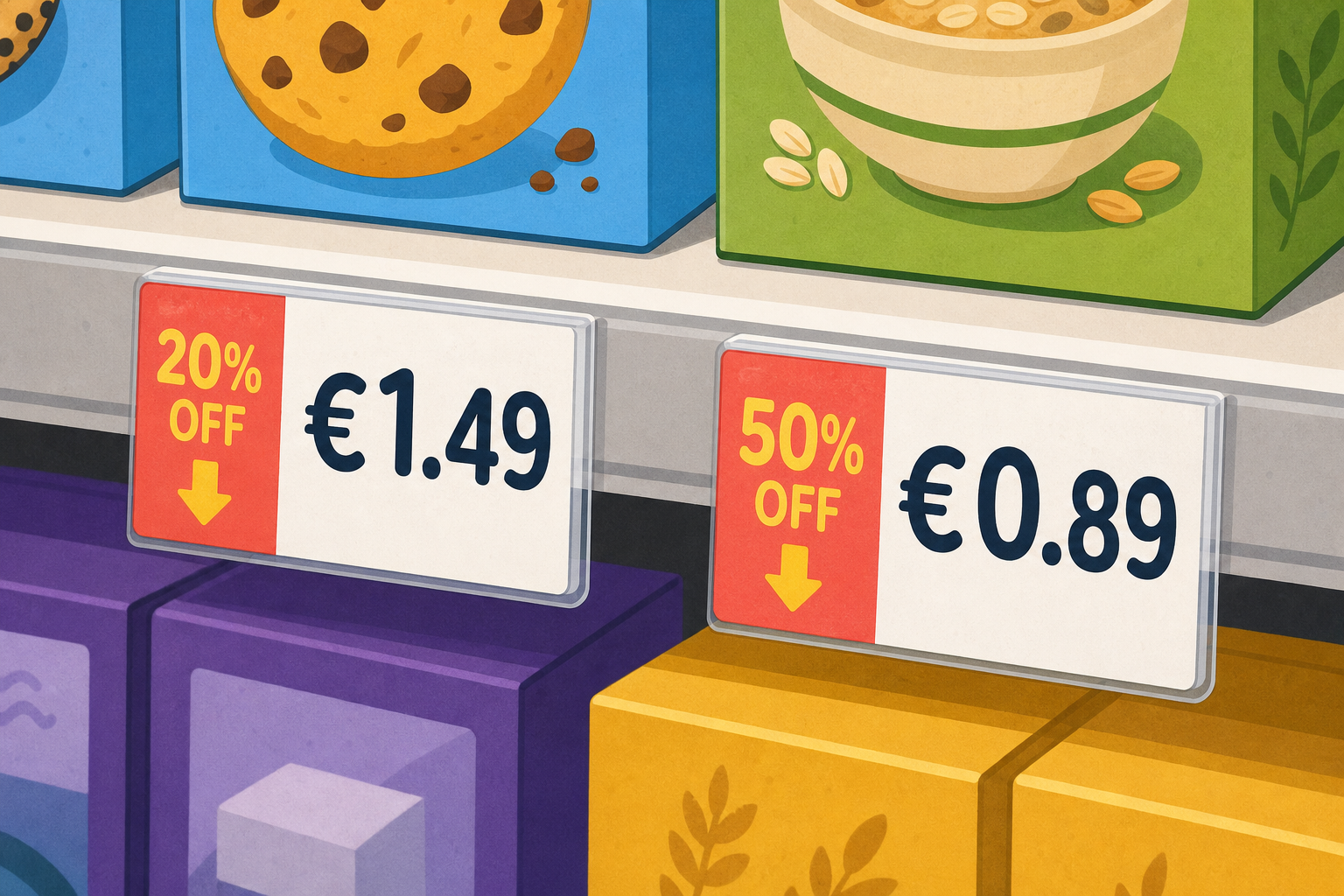
Look at this shelf tag: a game costs €200 with 10% off. Roughly how much comes off the price? Have a think before anyone answers.
Now look at the second tag. It says 50% off, which means half price. If a €200 game is half price, what do you pay?
Display the two shop tags (€200 with 10% off, then 50% off) as pupils settle. Take three hands-up answers for each, not open call-outs. Give five seconds of quiet think-time before hands go up.
Don't confirm the exact figures yet — we'll work out the quick way to do these in a moment. Listen for whether pupils already reach for 'a tenth' and 'a half' — that's the friendly-fraction idea the whole lesson hangs on.
Each bar shows a percentage of a number, split into equal parts with one part shaded. Watch how the percentage matches a simple fraction, and see what the shaded part is worth each time.
For each bar: name the friendly fraction, then the divide step, then read the value off the shaded part.
50% of 80: a half, divide by 2, one part is 40.
25% of 60: a quarter, divide by 4. Ask the class to predict one part, then confirm it is 15.
10% of 200: a tenth, divide by 10, one part is 20. This is the one that generalises: divide by ten is fast, and 10% is the building block for the next step.
Head off the slip: 50% is not take 50 off, it is half whatever the total is.
In your maths copy, work each percent calculation. First write the friendly fraction, then do the calculation underneath.
For each one, write the fraction step first (50% = ÷2, 25% = ÷4, 10% = ÷10), then the answer on the line below. Underline each answer.
Walk the room glancing for the fraction step written above each answer — that's the habit we want, not just the number. This is whole-class copybook practice, not marking.
Today we build percents on the bar together. We will work three, in order.
First, 20% of 50 as two tenth-parts. Next, 75% of 40 as a half-part plus a quarter-part. Last, 30% of 40 as three tenth-parts.
Before we shade each one, predict how big just one part will be.
This round is for talking it through together — pupils take turns at the board and the class agrees or corrects out loud.
Drive the ratio-bars on the IWB in explore mode; set the total, split into the friendly number of parts, shade the number the percent asks for, and read each part's value off the bar.
Individual pupils come up to set the bar each time; the rest predict one-part size first.
Sometimes we know the part but not the whole. Watch how we work this one the other way around.
A jumper had 25% off, and the saving was €5. What was the original price?
25% means one quarter. So one quarter of the price is €5. A whole price is made of four quarters, so we need four of those €5 parts. That gives 4 × 5 = 20. The original price was €20.
Check it forwards: 25% of 20 is 20 ÷ 4 = 5. That matches, so €20 is right.
Read the artefact aloud line by line, pausing on each highlighted move. This inverse case is the stretch idea for the lesson — the strongest pupils will meet it again in the Class Challenge.
Emphasise the key reversal: a quarter is 5, so the whole is four times 5. Keep it concrete — a €5 discount that was 25% off means the original was €20.
You're previewing this lesson. Get full access to this lesson and hundreds more — each one ready to teach, with interactive activities, printable resources and pupil progress tracking built in.