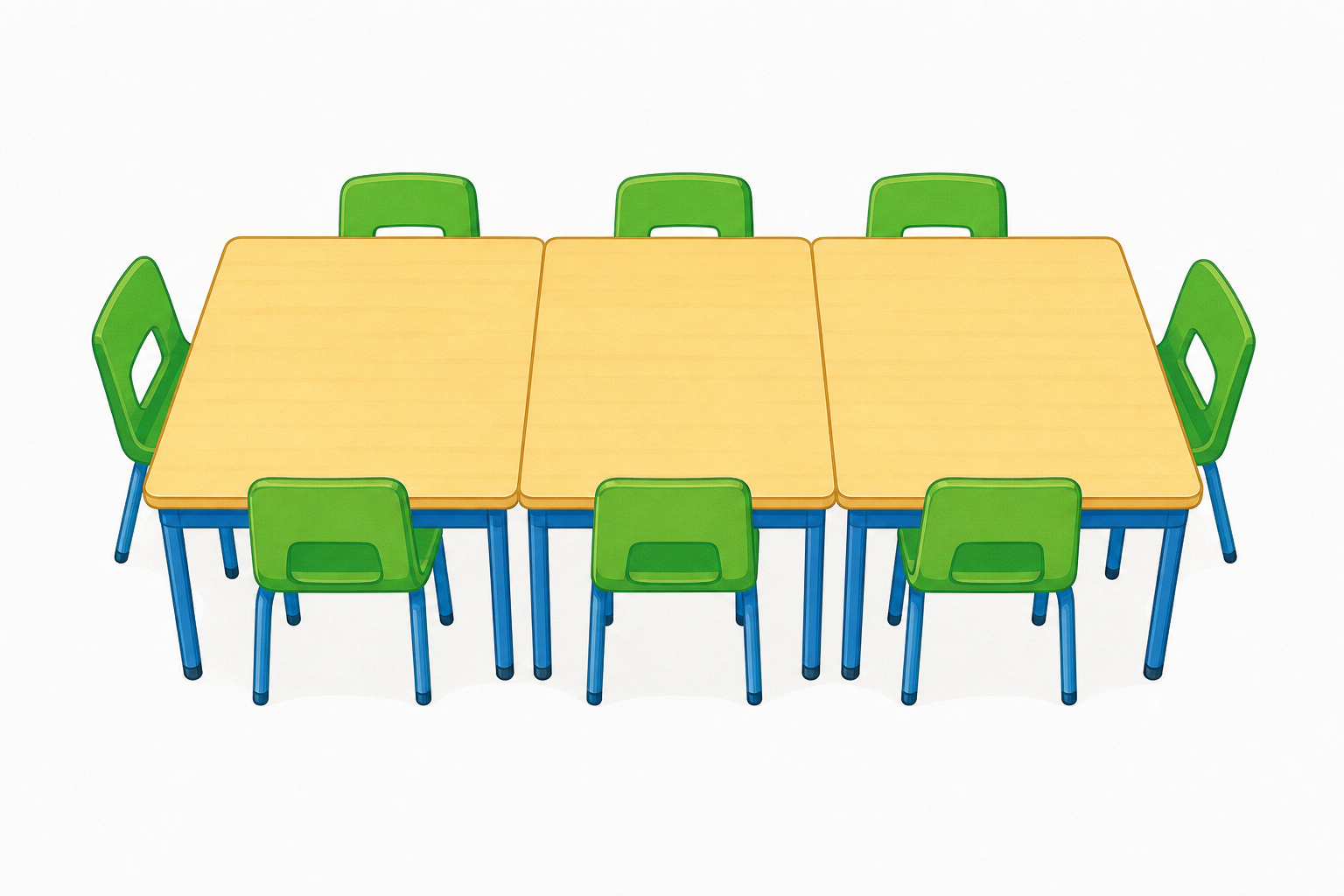
Count the seats around the tables on screen. One square table seats four people. Push two square tables together and more people can sit. Push three together for a longer table.
How many seats do you think each new table adds when we join one more? Hands up with your guess.
Take three hands-up guesses, not open call-outs. Don't confirm or correct yet — the count is the whole lesson. Hold the number back until Watch and Notice.
Here are three growing patterns on the number line. Look at where the markers sit, and be ready to say the jump between each pair.
For the first two, what is the same jump happening every time — and where would the very next marker go? The last one is different: its jump does not stay the same size. To double means to make something twice as big, so 1 doubles to 2, 2 doubles to 4, 4 doubles to 8. Watch how those jumps get bigger and bigger.
Work each one live — don't read out the answers. On the tables pattern, point to the equal gaps and ask what the jump is before anyone says 10; revoice a pupil's it goes up in twos as so the rule is add two each time.
On the triangles pattern, ask where the next marker (12) would land, the equal jump is the whole point. Watch for pupils reading the size of the marker rather than counting the jump.
On the doubling pattern, point to each jump in turn (1 to 2 is a jump of 1, 2 to 4 is a jump of 2, 4 to 8 is a jump of 4) and draw out that the jumps are growing, unlike the first two. This is the pupils' first look at a rule where the jump changes, so let them see it here before it returns in the Class Challenge.
We record each stage as a marker on the line, then predict the next one. Work in order:
Before each new marker, tell us where you think it will land. Then we check.
Talk this one through together — pupils take turns at the board and the class agrees or corrects out loud.
For each pattern, ask a pupil to state the rule before they drag ('add two'), then have them place the next marker. The class predicts the landing value first, then checks the equal jump matches. Watch for the slip of adding a different amount each time — steer back to is every jump the same size? Reset the marker to the pattern's first stage as you begin each new one so the class tracks only the current pattern.
In your maths copy, make a small table for a grow-by-3 pattern over four stages. The rule is the same jump the pattern makes every time.
Write the rule beside it in words, then predict what stage 5 would be.
Walk the room glancing at whether the rule is written in words ('add 3 each time') and whether stage 5 is 15. No individual marking — this is whole-class copybook practice.
Place the next marker for four growing patterns and find each rule:
Which one grows the fastest? Say your prediction before each check.
This is the practice round — pupils take turns at the board, check each answer, and the class confirms before moving on. Keep the board work brisk rather than over-explaining.
The first three add the same amount every jump; the last one doubles, so the jumps get bigger and bigger — pupils met this in Watch and Notice, so remind them of that look before they place it. Ask which grows the fastest and hold out for pupils noticing the doubling pattern overtakes the others. On the matchstick pattern (add 3), the minor ticks matter — have pupils count the jump, not eyeball it.
You're previewing this lesson. Get full access to this lesson and hundreds more — each one ready to teach, with interactive activities, printable resources and pupil progress tracking built in.