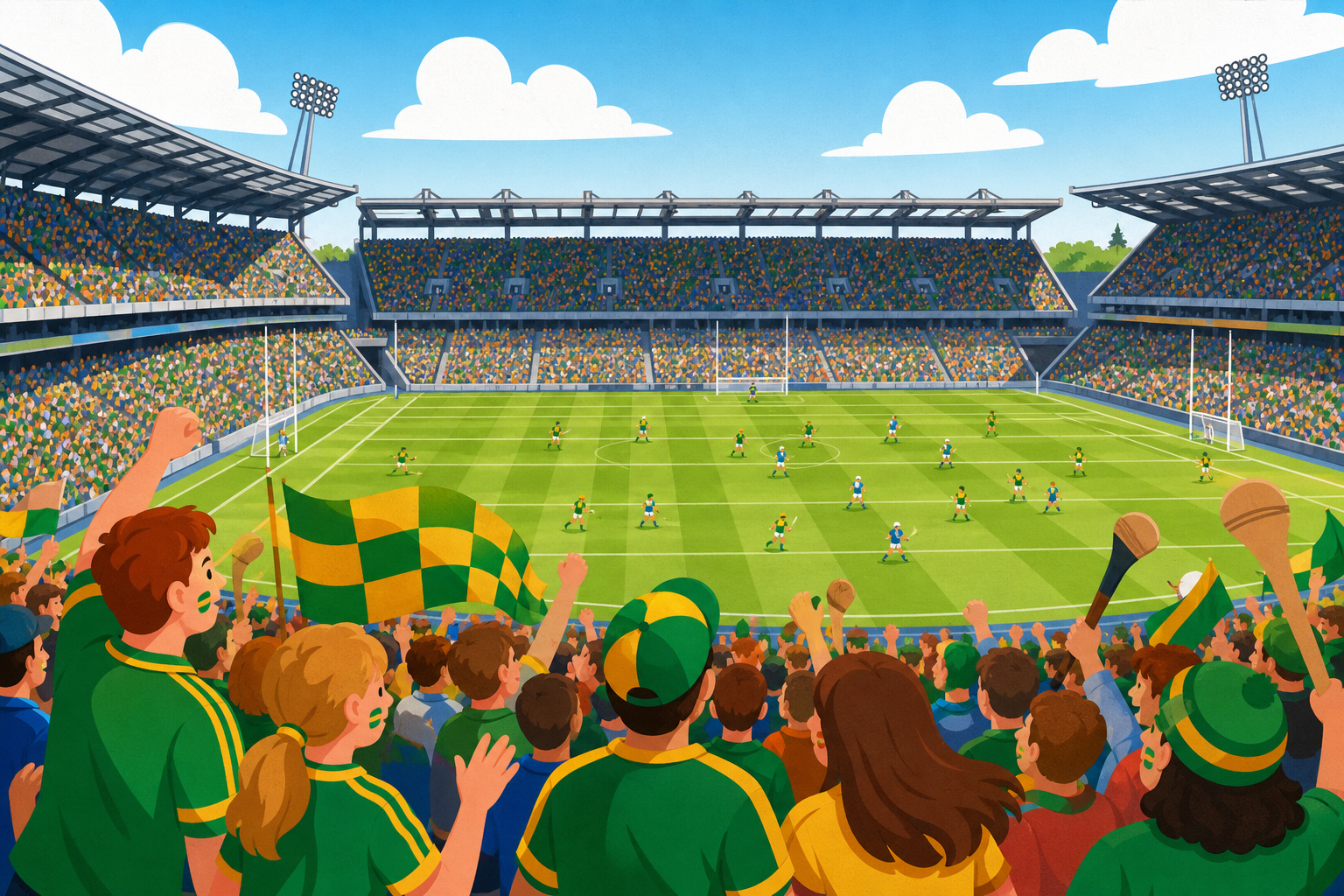
Here are five hurling match crowds from last summer, all jumbled up on the board: 1,200, then 980, then 1,020, then 875, then 1,105.
If you had to line them up from the smallest crowd to the biggest, where would you start? Which one jumps out at you as the smallest of all?
Take three hands-up answers to the opening question, not open call-outs. Listen for pupils spotting that 980 and 875 are three-digit and so must come before the thousands. Do not sort them yet — that is the work of the next steps; here you just want pupils noticing where they would begin.
Each set of numbers is shown already sorted from smallest to biggest. Watch which column decides the order, start at the thousands and only move right when they tie.
Slide a finger left to right to the first column that differs.
Set 1 (980, 1,020, 1,200): 980 has no thousands so it is smallest; a shorter number is automatically smaller because it has fewer columns. 1,020 then 1,200 decided by the hundreds.
Set 2 (4,005, 4,050, 4,500): same digits, thousands tie. Hundreds give 4,500 the biggest (5 hundreds). Tens split the rest: 4,005 smallest, then 4,050. Slow right down column by column.
Set 3 (6,030, 6,300, 6,303, 6,330): 6,030 smallest. Let the class predict 6,300 before 6,303 — the units settle it, 300 comes before 303. Then 6,330 biggest.
Now we order some sets together on the board, one at a time. We work through three sets in turn: first {720, 1,050, 950}, then {5,600, 5,060, 5,006}, then {4,180, 4,081, 4,810, 4,018}. Each set is a little trickier than the last — the last one has four numbers whose digits shuffle around, so we read right to the units before we decide.
Each time, a different pupil comes to the board and drags the smallest number that is left, then the next smallest, until the whole set is lined up from least to greatest. The rest of us say aloud which column decided each choice.
This round is for talking it through together — pupils take turns at the board and the class agrees or corrects out loud.
The interactive steps through the three sets one at a time. Ask a pupil to drag the smallest card into the first bucket, then the next, and have the class say aloud which column decided each choice. Then move to the next set for a fresh pupil.
Rotate a different pupil across each set.
First we will reverse an ordered set together on the board so you can see the move. Here is a set already lined up from smallest to biggest: 875, 980, 1,020, 1,105, 1,200. To go from biggest to smallest, we do not re-sort from scratch. We flip the line: start at the right-hand end and write the same numbers the other way round.
Now, in your maths copy, write this set of five numbers in order from smallest to biggest:
Then, underneath, rewrite the very same set the other way round, from biggest to smallest, just as we flipped the board example.
Board demo before copies open. Write 875, 980, 1,020, 1,105, 1,200 left to right (smallest to biggest). Point to the right-hand end and rewrite underneath as 1,200, 1,105, 1,020, 980, 875. Cue: flip the finished line, do not start comparing again.
Then copies: walk the room for smallest-first order and a true reverse underneath. Whole-class copybook practice, not marking. Watch for pupils who slot 980 into the middle rather than first, and for reverse rows that are a fresh sort instead of the flip.
Time for the challenge sets. We work through these in order, each a step harder: {850, 1,005, 990}, then {3,400, 3,040, 3,004}, then {7,210, 7,021, 7,201, 7,012}, and finally {9,090, 9,009, 9,900, 9,000}. That last one is the one that catches people out — every number is nines and zeros, so you have to read right along before you can decide.
These are the practice questions — pupils take turns at the board, check each answer, and the class confirms before moving on. Keep the board work brisk rather than over-explaining.
You're previewing this lesson. Get full access to this lesson and hundreds more — each one ready to teach, with interactive activities, printable resources and pupil progress tracking built in.