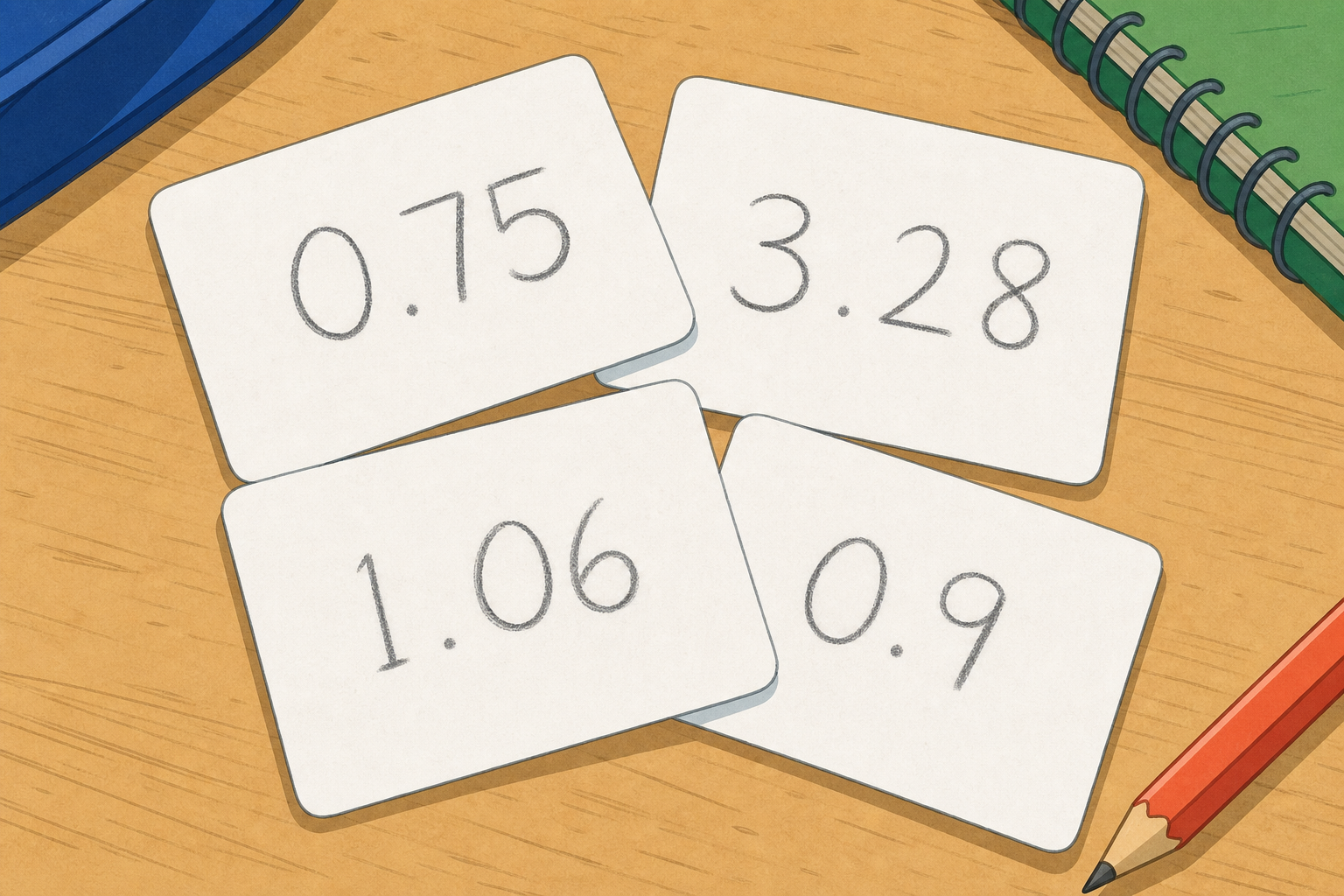
Here are four decimal cards, all jumbled up: 0.4, 0.04, 0.40 and 0.44. If we had to line these up from smallest to biggest, where would you start? Two of them look almost the same. Which two, and are they really the same size or not?
Write the four cards in a random order across the board. Take two or three hands-up answers, not open call-outs. Do not resolve it yet — we'll see which two are equal when we line them up. The pair to watch is 0.4 and 0.40.
The interactive sorts three sets of decimals from smallest to biggest, one set at a time. Line the cards up by place value and watch what happens when two look different but land in the same spot.
Set 1 (0.4, 0.04, 0.40, 0.44): point to the tenths column. 0.4 and 0.40 have the same tenths and nothing more, so they are equal; the trailing zero adds nothing. Order: 0.04, then 0.4 = 0.40, then 0.44.
Set 2 (1.2, 1.02, 1.20, 0.95): settle 0.95 first, no whole number so smallest. Then ask which is smaller, 1.02 or 1.2? Head off longer-means-bigger: 1.02 has 0 in the tenths, 1.2 has 2 tenths, so 1.2 is bigger. Stress this tenths zero matters, unlike a trailing zero. Order: 0.95, 1.02, 1.2 = 1.20.
Set 3 (0.7, 0.07, 0.77, 0.7): the key one, two identical 0.7 cards share a spot. 0.07 smallest, 0.77 biggest. Let them see truly equal numbers need not be separated.
Now we try a brand-new set together: 2.6 → 2.06 → 2.60 → 0.88. One pupil comes to the board to drop the cards; everyone else watches and gets ready to agree or correct out loud. We'll line them up by place value first, then decide the order smallest to biggest. Watch out for 2.06, where a zero hides in the tenths column, and for 0.88, which never even reaches one whole.
This round is for talking it through together — one pupil comes to the board while the rest of the class watches and agrees or corrects aloud.
Ask the pupil at the board to drop one card at a time and say aloud which column decides it. When 2.06 and 2.6 are in play, revoice: same units, but 2.6 has a bigger tenths digit, so 2.6 is bigger. If the class rushes 0.88, point out it has no whole number, so it is smallest.
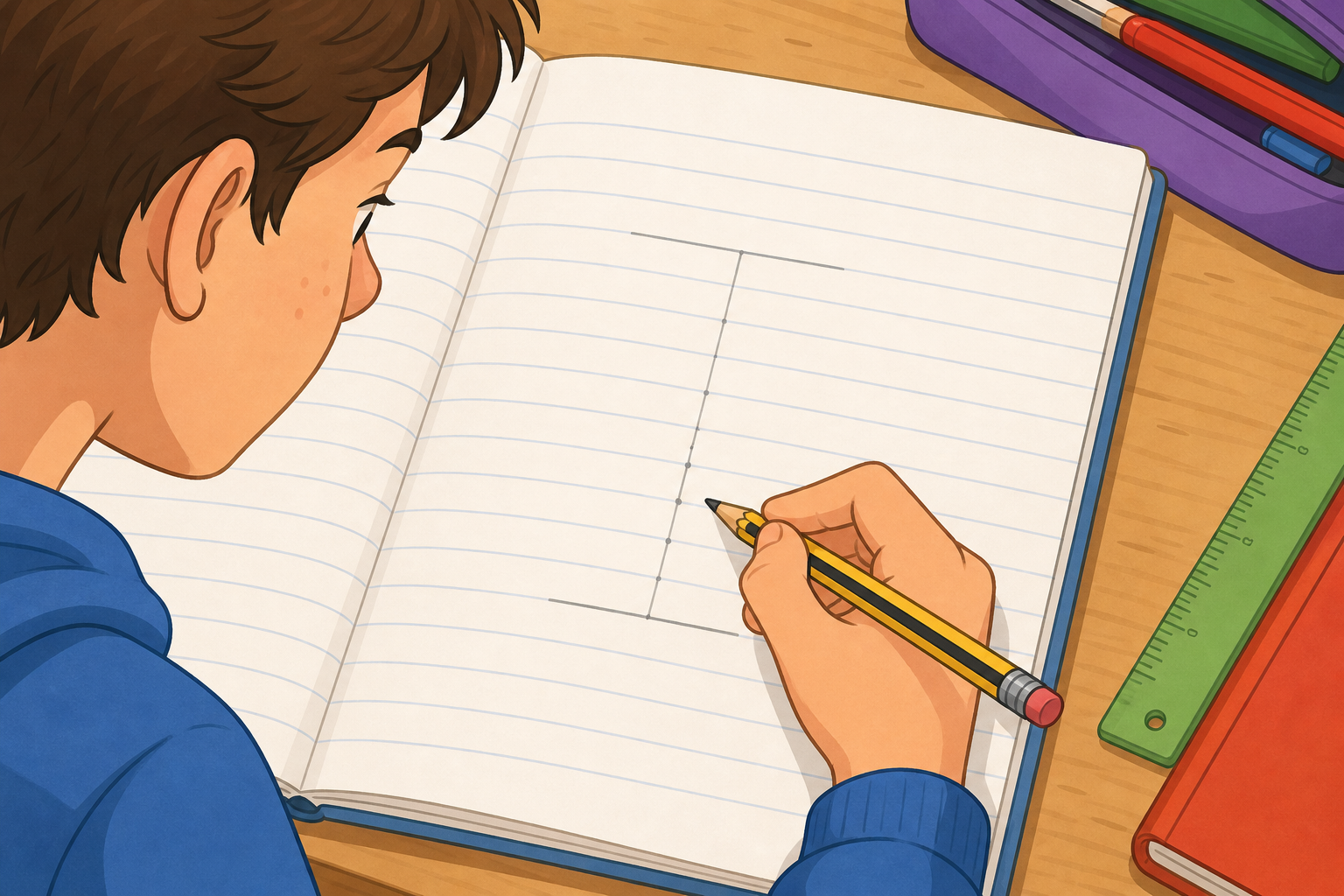
In your maths copy, write each set of four decimals in a column with the decimal points lined up, one under the other. Then number them 1 to 4 from smallest to biggest.
Walk the room glancing for lined-up decimal points and the 1–4 numbering — this is whole-class copybook practice, not marking.
Now we work through three ordering sets, each a step harder than the last. Line the points up, then read the columns left to right. On the last set, slow down and check every column before you decide.
These are the practice questions — pupils take turns at the board, check each answer, and the class confirms before moving on. Keep the board work brisk rather than over-explaining.
Watch for the longer-means-bigger error on the third set (0.14 vs 0.4). Revoice: more digits does not mean bigger — 0.4 has four tenths, 0.14 has only one tenth. Have the class predict the smallest card before each Check.
You're previewing this lesson. Get full access to this lesson and hundreds more — each one ready to teach, with interactive activities, printable resources and pupil progress tracking built in.