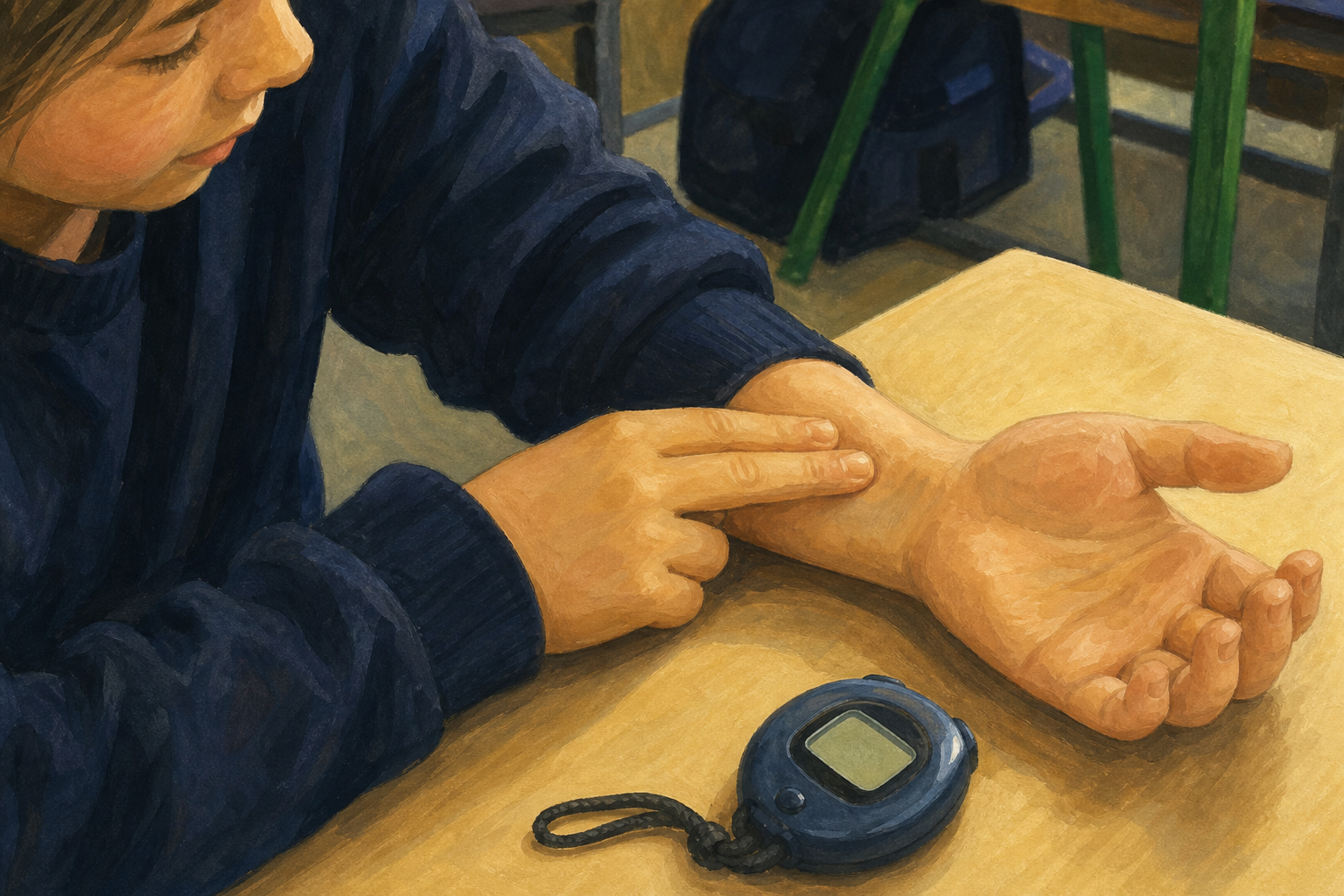
 Put two fingers gently on the side of your wrist. Can you feel a tiny beat under your skin?
That beat is your heart at work. Do you think it always beats at the same speed, or can something make it speed up?
Keep this beat light and curious. Do not hand out stopwatches or name the full investigation yet.
Invite a few volunteers to find their wrist pulse. If someone cannot find it, try the side of the neck gently, or have a partner check. Never press hard.
Key question: What do you already think makes a heart beat faster? Collect two or three ideas only, then move on.
Before the lesson: print the Investigation Journal pages (FairTestPlanner and DataTable); gather stopwatches or prepare to use the on-screen timer; clear a small floor space for marching or dancing on the spot.
Look at the body diagram on the board. Drag each label onto the organ you think it names.
Heart — the pump that pushes blood around the body. Pulse — the beat you feel when that blood is pushed through.
Where does the heart sit? Which two organs sit either side of it?
Where does the heart sit?
Key Concepts
| Concept | Why it matters | Example |
|---|---|---|
| Heart — a strong muscle that works like a pump, pushing blood around the body so oxygen and nutrients reach every part | Every time you run, climb stairs or dance, your body needs more oxygen, so the heart has to pump harder | Place a hand flat on the left side of the chest after a short march on the spot — you can feel the pump working faster |
| Pulse — the beat you feel in an artery as the heart pushes blood through it | We cannot see the heart from outside, so the pulse is how we measure how hard it is working | Two fingers on the wrist or the side of the neck, counting beats for 15 seconds |
Fair test and middle value are doing-language later in the lesson (live example on the board), not full terms to hold now. Keep this step on locating the heart and naming pulse.
Interactive activity: open the diagram-labeller on the IWB in explore mode. Labels start off the diagram: lungs, heart, stomach and intestines. Invite the class to place them together (volunteers at the board, or call-outs while you drag). Do not reveal placements until the class has had a go.
Answers to draw out (after placing): the heart sits slightly to the left of centre in the chest; the two organs either side are the lungs — they take in air so the blood can pick up oxygen.
Where and why (if a pupil asks why it sits there): the heart sits almost in the middle of the chest, a little to the left, protected by the ribcage and close to the lungs so blood can pick up oxygen before it is sent around the body. It is roughly fist-sized.
Misconception to head off: children often draw the heart as a cartoon valentine on the far left. The real heart sits almost in the middle, a little to the left, and is roughly fist-sized.
Nature of STEM: scientists once thought blood moved back and forth like a tide. Over time, careful measuring and observation showed the heart is a one-way pump that sends blood around a loop. A doctor called William Harvey helped show that the heart is a one-way pump — that is why counting the pulse tells us how hard the pump is working.
Ask: If the heart is the pump, what job do the lungs beside it do? (They take in air so the blood can pick up oxygen.)
We know the heart is a pump. Now we will find out what makes it work harder.
In your group, choose two activities to compare with resting. Will you try walking on the spot, dancing, or running on the spot? Predict: which activity will make the pulse highest, and why?
Later we will share on a class chart with three labels: resting, gentler activity, and livelier activity. Your quieter choice (for example a walk) will sit under gentler activity. Your stronger choice (for example a dance or run on the spot) will sit under livelier activity.
This is the open choice of the lesson. The theme is fixed (pulse and activity), but each group chooses which two activities to compare with rest. Typical choices: rest, walk on the spot, dance, run on the spot. Keep activities safe and in one place — no racing around the room.
Pacing cap for later: rest plus two chosen activities is the full target. A clean rest-plus-one-activity comparison is the minimum that still answers the question; the second activity is the stretch if time allows. A third activity is only if a group finishes early.
Format: think-pair-share, then whole-class. Hear two or three group predictions aloud. Predictions are never wrong; they start the science.
Pupils who should not exercise (asthma flare, recent illness, or any medical reason) become the group's timekeeper and recorder. Check quietly before you begin.
Sentence stems to offer: I think … will make the heart beat fastest because…
Pooling preview (say once, pointing at the board labels): later every group's results go into three shared bins — resting, gentler activity, and livelier activity — so different choices can still be compared fairly. Groups should already know which of their two choices maps to gentler and which to livelier.
Five cards appear on the board: the activity, how fast the heart beats, the counting time, who we measure, and how long we exercise (one minute).
Call out where each card belongs. We change one thing, measure one thing, and keep the rest the same. Then fill in your FairTestPlanner page for the test your group designed.
Plan our pulse investigation
Interactive activity: open the fair-test-planner in explore mode. Drive it on the IWB while the class calls out placements. Treat "fair test" as doing-language here: change one thing, measure one thing, keep the rest the same — no long definition to memorise.
- Change: the activity
- Measure: how fast the heart beats
- Keep the same: the counting time, who we measure, how long we exercise (one minute)
If a card lands in the wrong bin, ask what would go wrong if we changed that too? rather than simply correcting it.
Modelled investigation (do this live before groups write):
- I wonder whether my pulse is higher after marching on the spot than when I am resting.
- I predict marching will raise it, because my muscles will need more oxygen.
- I test by sitting still, then counting my wrist pulse for 15 seconds straight after a one-minute march. I do that full march-then-count go three times so I have three readings for the middle value.
- I observed resting middle value was about 22 beats in 15 seconds; after marching the middle value was about 28.
- I think the heart beat faster after marching because the body needed more blood pushed round. Taking the middle of three readings means one slip does not fool us.
Then each group completes its own FairTestPlanner page: their question, their chosen activities (rest plus two), what they will measure, and what they will keep the same. Circulate and check every group has only one thing in Change.
In each group you need three jobs:
- Person measured — does the activity and finds their pulse
- Timekeeper — starts and stops the 15-second count
- Recorder — writes the numbers
Only the person measured finds the pulse (two fingers on the wrist). Use this same way every time.
Resting
- Sit still for one minute.
- Count beats for exactly 15 seconds.
- Do that sitting count three separate times.
Each activity
- Do the activity on the spot for one minute.
- Sit straight away and count beats for exactly 15 seconds.
- Do that full go three times: activity, then count; activity, then count; activity, then count.
Finish resting first, then your quieter activity, then your stronger one. Stay in your space. If you feel dizzy or unwell, stop and tell the teacher.
How to find the pulse
Two fingers (not the thumb) on the inside of the wrist, in line with the base of the thumb, or gently on the side of the neck. Press lightly. Practise once as a class before the real trials. Only the person measured needs to find a pulse; timekeeper and recorder watch and write.
Group roles (name these on the board before you start)
- Person measured — does the activity, finds their pulse, then sits for the count
- Timekeeper — runs the 15-second count (stopwatch or the on-screen timer)
- Recorder — writes each trial on scrap paper ready for the DataTable
Rotate so more than one pupil is measured if time allows, but keep who we measure the same within one full set of activities so the comparison stays fair.
Method on the board (scannable — match the pupil screen)
- Resting: sit one minute, then three separate 15-second counts while still sitting. Resting is a steady state, so three sitting counts are fair repeats.
- Each activity: three full goes. Each go is: one minute of the activity on the spot → sit → count for 15 seconds immediately. Then repeat that full go twice more. Do not do the activity once and then take three sitting counts in a row — the pulse falls between those counts, so they are not repeats of the same state.
- Always count for the same 15 seconds.
- Rest first. Then do the gentler activity (three full goes). Then do the livelier one (three full goes). That way earlier effort does not spoil a later resting reading.
- Activities stay on the spot: sit, walk, march, dance or jog on the spot. No racing the room.
Pacing lever (say this before groups start)
Minimum that still counts: resting (three sitting counts) plus one chosen activity (three full activity-then-count goes). That is enough to answer the question and feed the class chart. Target if the group is on track: rest plus both chosen activities. Do not let groups start a second activity until the first comparison is clean. If the room is slow after rest plus one, stop there and move to recording — a valid fair comparison beats a rushed half-method. Cap at rest plus two in this slot; a third activity is only for a group that finishes early.
What to expect: resting 15-second counts for this age often sit around the low twenties (for example about 20 beats in 15 seconds), and livelier activity commonly lifts that higher. Exact numbers vary a lot by child. The pattern (higher after more effort) matters more than matching any textbook figure.
If the pulse is hard to find after exercise: wait only a second or two, breathe out, try again. Do not press harder. A slow hunt means the elevated pulse has already dropped.
Safety: anyone who should not exercise is timekeeper or recorder only. Stop anyone who looks pale, dizzy or short of breath. Clear space so nobody collides.
Open your DataTable page. For each activity, write the three trial counts.
Now find the middle value. Put the three numbers in order and circle the one in the middle. Example: if your counts are 22, 18 and 20, in order that is 18, 20, 22 — so the middle value is 20.
Keep what you counted separate from what you think it means. We will talk about meaning together in a moment.
This is careful observation and recording, not the conclusion yet. Model the middle-value example on the board once before groups circle their own.
Middle value (doing-language): put the three numbers in order and pick the middle one. Say aloud: 22, 18 and 20 — in order that is 18, 20, 22, so the middle value is 20. Pupils do not need a formal definition beyond this live example.
Look-fors while you circulate:
- three trials written for each activity
- middle value circled or written in its own column
- units clear (beats in 15 seconds)
- no early conclusion sentences mixed into the numbers
Differentiation: if ordering three numbers is slow, pair the recorder with a partner who helps sort them. If a group only managed rest plus one activity, that is still enough to compare and is a full success for this lesson.
Fast finishers sketch a second prediction: what would happen after two full minutes of the liveliest activity? They do not need devices.
We will put each group's middle pulse on the board using the three shared labels you already know: resting, gentler activity, and livelier activity.
First, check with your group: resting stays resting; your quieter choice goes under gentler activity; your stronger choice goes under livelier activity. Call out the label and your middle pulse for each one. Then we will show the bar chart.
Which bar is tallest? What does that tell us about the heart?
Our pulse readings
Alignment move first (1 minute): put the three shared bin names on the board again — resting, gentler activity (walk or light march on the spot), and livelier activity (dance, jog or run on the spot). Ask every group aloud to name which of their chosen activities sits under gentler and which under livelier before any numbers are entered, so calling out a middle value is not a guess. Groups that only completed rest plus one activity still contribute those two bins.
Interactive activity: open the data-recorder in explore mode. Columns are Activity and Middle pulse only — a simple two-column table of already-calculated middle values, not a trials grid. There are about 30 rows so many groups can each contribute resting, gentler and livelier middle values. Chart type is bar. Class average is on so a pooled figure can sit under the chart. Groups enter their middle values (already worked out on paper), not raw trial triples.
Invite groups to call out:
- the shared bin label (Resting, Gentler activity, or Livelier activity)
- their middle pulse for that bin (beats in 15 s)
Enter several groups' middle values as separate rows under the same activity labels. The bar chart then shows the pattern across the class.
What the chart should show: bars generally rise as the activity gets livelier. If one group's bar falls, ask what might have happened (started already breathless, lost the pulse, counted for the wrong time) — that is useful science talk, not failure.
Prompts: Which kind of activity made the heart beat fastest? Did every group see the pulse rise with effort? Why might two groups' resting numbers differ?
Our test showed the heart works harder when we move. Scientists who studied people over many years found that regular activity helps keep that pump strong.
Talk with a partner: why might regular activity help keep a heart healthy? What is one everyday way you already move your body in a normal week?
Display-only science talk. No typed reflection.
Draw out from the evidence: livelier activity raised the pulse, so the heart is a muscle that works harder when we need it. Like other muscles, it stays stronger when we use it often in safe, enjoyable ways — walking to school, games in the yard, swimming, cycling. Be clear that today's 15-second counts showed the pump working harder; the health message comes from longer scientific studies of real people, not from our single lesson alone.
Nature of STEM: Irish public-health advice has shifted over time toward everyday movement for everyone, not only sport stars. Scientists and doctors learned that regular activity helps the heart by studying real people and their health over many years.
Misconception to head off: a faster pulse during exercise is not danger in a healthy child — it is the heart meeting the body's need. Danger signs are dizziness, pain or feeling unwell, which is why we stop if that happens.
Tidy and safety close: stopwatches away, journals closed, chairs back, calm breathing for 30 seconds so elevated pulses settle before the next lesson.
Optional homework (hands-on, journal): ask an adult at home one way they keep active in a normal week, and note it in the journal.
Unlock the full learning experience
You're previewing this lesson. Get full access to this lesson and hundreds more — each one ready to teach, with interactive activities, printable resources and pupil progress tracking built in.
This lesson is copyright of Coding Ireland 2017 - 2025. Unauthorised use, copying or distribution is not allowed.