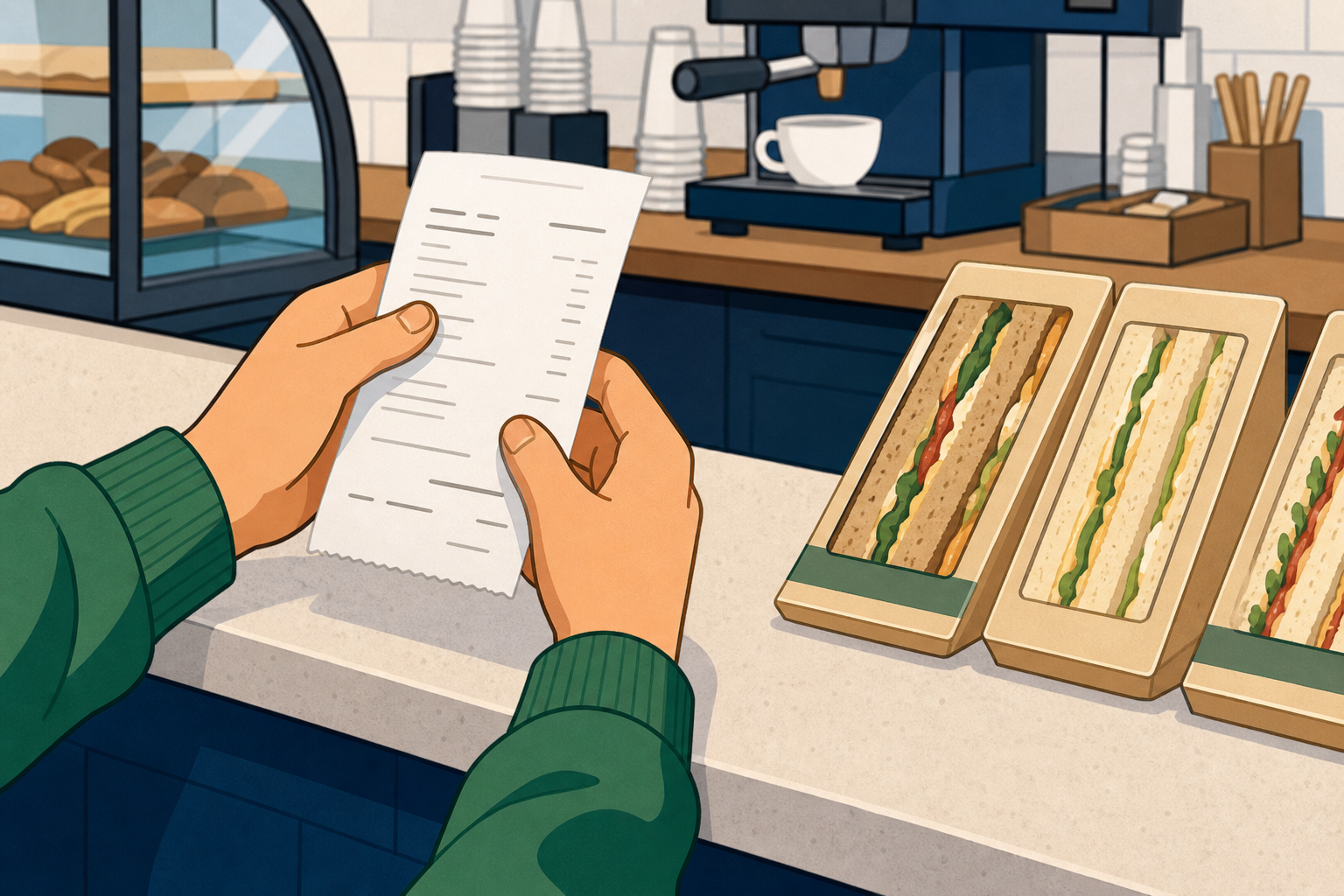
Here is a real shopping moment: you buy 4 sandwiches at €3 each, then you split the bill evenly between 2 people. Before we work anything out, hands up: which calculation would you do first, and which one comes second?
Take three hands-up answers, not open call-outs. Give five seconds of quiet think-time before any hands go up.
You are only fishing for the order here (multiply the cost first, then divide) — don't work the numbers yet. If a pupil jumps to €6, revoice: good, but which sum did you do to get there, and what was the step before it?
We will work through three money problems together, each built in stages on the board. Watch for the signal words that tell us which operation each step needs, and make a rough estimate before every answer is revealed. Predict each result before you see it.
Ask the class to name the two operations before each example; take two hands-up. Pause for a prediction before every reveal, same invitation each time.
Buns, 6 at €1.20 shared between 3. 'Each' signals multiply, 'share' signals divide. 6 x €1.20 = €7.20, then €7.20 ÷ 3 = €2.40. Sketch a ratio bar: one whole bar for the total, then split into 3 equal parts. The total is the bridge into step two.
Estimate beat, do slowly: each bun about €1, six is about €6, shared 3 ways about €2 each. Reveal €2.40 landing near €2 confirms the operations. If it had come out €20 each the estimate would have flagged the wrong operation.
Change from €50, three items at €7.50. 'Each' multiplies, 'change' subtracts, a different pair from example one. Estimate: three at about €8 is roughly €24, so change from €50 about €26. Exact: 3 x €7.50 = €22.50, then €50 - €22.50 = €27.50. Ask why subtract this time when last was divide, the word 'change' is the clue.
Trip, the escalation, three steps that feed each other. Bus €90, entry €4 each for 20 pupils, want cost per pupil. Step 1: 20 x €4 = €80. Step 2: + €90 = €170. Step 3: ÷ 20 = €8.50 per pupil. Stress the order cannot be swapped since each answer feeds the next.
The zeros and the cent columns catch people out, so let's say every step aloud before we check it, and make a rough estimate first each time.
Today we'll work through three problems together, planning the steps out loud before we calculate. First, eight pencils cost sixty cent each, and the total is shared between four friends. Next, five stickers cost €1.40 each, so how much change from €10? Last comes our trip problem: a €120 bus plus €6 entry for each of thirty pupils, so what does the trip cost each pupil?
Plan the steps for each shopping and trip problem, name the operation for each step, then work it out.
Ways to start:
Stretch:
This round is for talking it through together — pupils take turns at the board and the class agrees or corrects out loud. Surface each problem on the board only as the class reaches it, rather than showing all three at once, so pupils aren't holding three sets of numbers in their heads.
Start by modelling a quick estimate on the first problem (about 8 × 60c is roughly €5, shared between 4 is about €1 each) so pupils see the estimate they used in Watch and Notice carried straight into their own practice. Pupils can sketch a bar for each problem on their plan-then-solve recording sheet to show what step 1 produces before step 2 shares or subtracts.
These are paper/seat problems surfaced as a task list — there is no on-screen tool to drive. Work each one on the board strand by strand: name the operation for step 1, take the answer, then name the operation for step 2.
In your maths copy (or on your plan-then-solve sheet), for each problem write the steps as a short plan (Step 1: …, Step 2: …) with the operation named, sketch a bar to show what each step produces, then show the working and box the final answer.
Walk the room glancing for a named operation beside each step and a bar sketch, not just numbers — this is whole-class copybook practice, not marking.
Each clue is its own mini-problem, and its answer feeds the next clue. We work through them in this order: Clue 1 is a single operation, Clue 2 needs two steps, and Clue 3 needs three steps to reveal the final amount. The mystery answer only appears when every clue is solved in order.
Solve each clue in order — each answer unlocks the next — to reveal the final amount spent at the school shop.
Ways to start:
Stretch:
These are the practice questions — pupils take turns at the board, check each answer, and the class confirms before moving on. Keep the board work brisk rather than over-explaining.
These are seat/paper puzzles surfaced as a task list — there is no on-screen tool. Solve each clue on the board, then carry its answer forward.
Close with the journal-entry beat below before the maths-talk wrap.
You're previewing this lesson. Get full access to this lesson and hundreds more — each one ready to teach, with interactive activities, printable resources and pupil progress tracking built in.