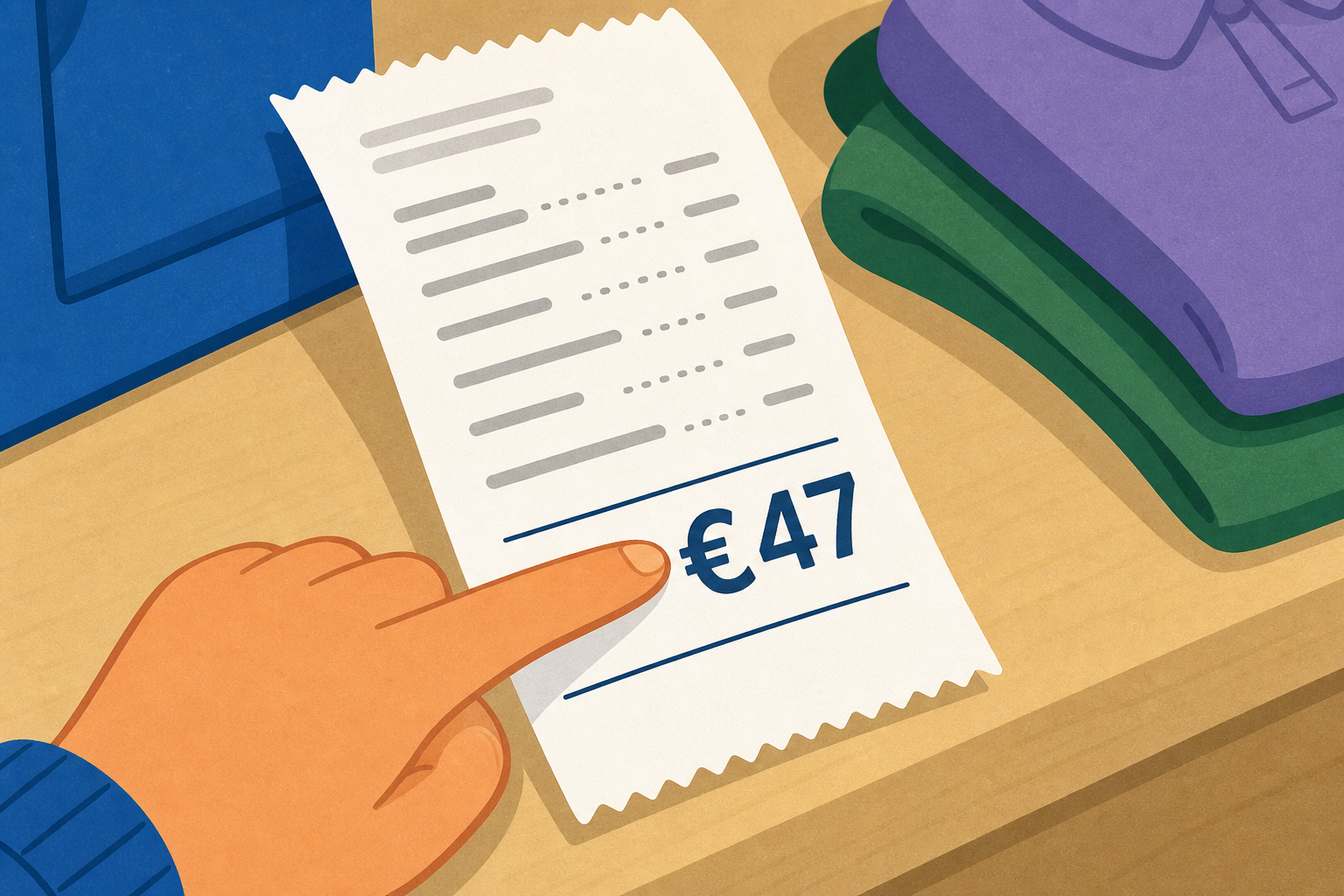
Here is a spot-the-mistake. Someone worked out 47 × 10 and wrote 47.0, they added a decimal point and zero and left the digits where they were. Is that right?
Have a good look. What does 47 × 10 really equal, and what has gone wrong in this answer?
Take three hands-up answers, not open call-outs. Give five seconds of quiet think-time before any hands go up.
Don't confirm the answer yet — leave both the wrong 47.0 and any pupil suggestions on the board. The lesson resolves it in Watch and Notice.
Watch the place-value chart as we multiply by ten, a hundred and a thousand. Every time, the digits slide left and the point stays put. Watch where each digit lands and what fills the empty columns behind it.
Big idea for the class: each column left is worth ten times as much, so a slide left means ten times bigger. Say ten times bigger, not digits step left.
47 x 10 = 470: 4 tens to hundreds, 7 units to tens. Point at the empty units column, ask what fills it. Draw out zero as a place-holder, not a value added.
47 x 100 = 4700: ask them to predict how many columns before revealing. Two columns. 4 lands in thousands, 7 in hundreds, two zeros in tens and units.
4.7 x 10 = 47: the make-or-break one. Point does not move, digits do. 4 to tens, 7 to units, nothing after the point so it becomes whole number 47. Return to the 47.0 trap from the hook and cross it out.
4.7 x 1000 = 4700: trace digit by digit, three steps. 4 from units through tens, hundreds, to thousands. 7 from tenths through units, tens, to hundreds. Tens and units fill with zeros. Name that the 4 lands in thousands, not ten-thousands, because it began one column right of a whole-number 47 the tenths gap absorbs one step.
We say the answer aloud before we slide the digits, so we can check our prediction against what the chart shows.
Today we work through these together on the place-value chart, in this order: 6 × 10, then 6 × 100, then 3.5 × 10, then 3.5 × 100, and finally 3.5 × 1000. The chart starts on 3.5, so for the first two examples we type 6 into the starter, then set it back to 3.5 for the last three.
Watch how 3.5 × 10 turns a decimal into a whole number, and how 3.5 × 1000 sends the digits three columns left and fills the gaps with zeros.
This round is for talking it through together — pupils take turns at the board and the class agrees or corrects out loud.
Re-seed the starter for each example. Type 6 in for the first two (6 × 10, 6 × 100), then reset the starter to 3.5 for the last three. The chart handles both values — you just change the starting number between examples. Have a pupil choose the operation each time; the class predicts the answer before the slide, then the chart confirms.
Watch for the pupil who says 3.5 × 10 = 3.50. Revoice: the point stays still — the 3 and the 5 each move one column left, so we land on 35, a whole number.
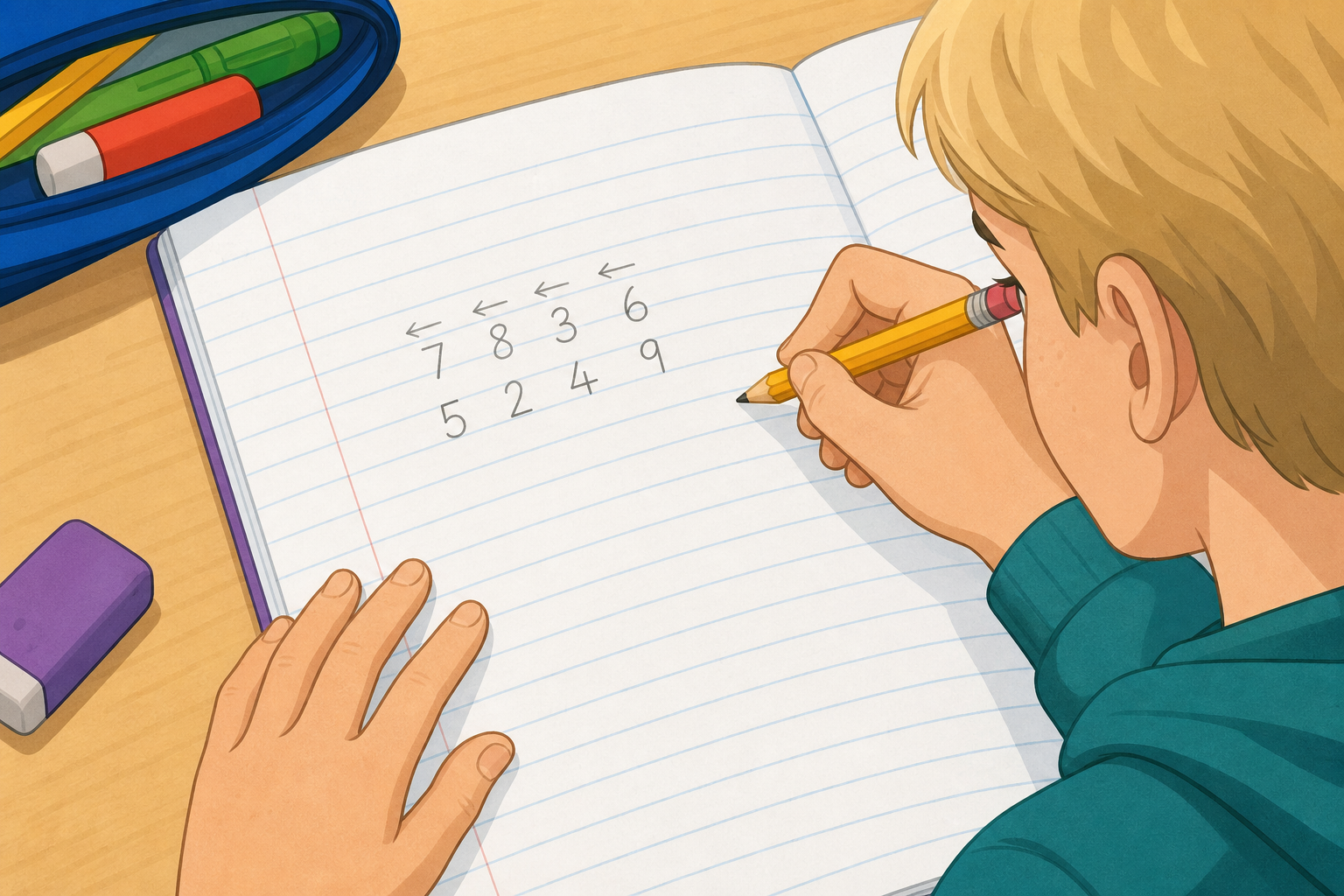
In your maths copy, write each starter and its answer one above the other, with the digits lined up by column. Then draw an arrow above each digit showing how far it slid to the left.
Keep your columns straight so you can see exactly which column each digit moved into.
Walk the room glancing at column alignment and the direction of the arrows — this is whole-class copybook practice, not marking. Watch for arrows drawn to the right; the digits always slide left when multiplying.
In today's challenge, you'll turn a starting number into a target number, using only the buttons that are lit up. Some look easy at first, but the lit buttons make you plan a route — sometimes ×100 or ×1000 is switched off, so you have to press two buttons in a row to get there.
You can press more than one lit button in a row to build a route.
We work up through: 4 to 400, then 4 to 4000, then 0.6 to 600 with ×1000 switched off, and finally the tricky one — 7 to 7000, also with ×1000 switched off, so you must find another way.
These are the practice questions — pupils take turns at the board, check each answer, and the class confirms before moving on. Keep the board work brisk rather than over-explaining.
The two chaining challenges are the key one, and both have ×1000 switched off:
Ask the class to predict the route before the pupil at the board tries it. Watch for pupils who reach for a button that isn't lit — remind them the aim is the fewest moves within the lit set.
You're previewing this lesson. Get full access to this lesson and hundreds more — each one ready to teach, with interactive activities, printable resources and pupil progress tracking built in.