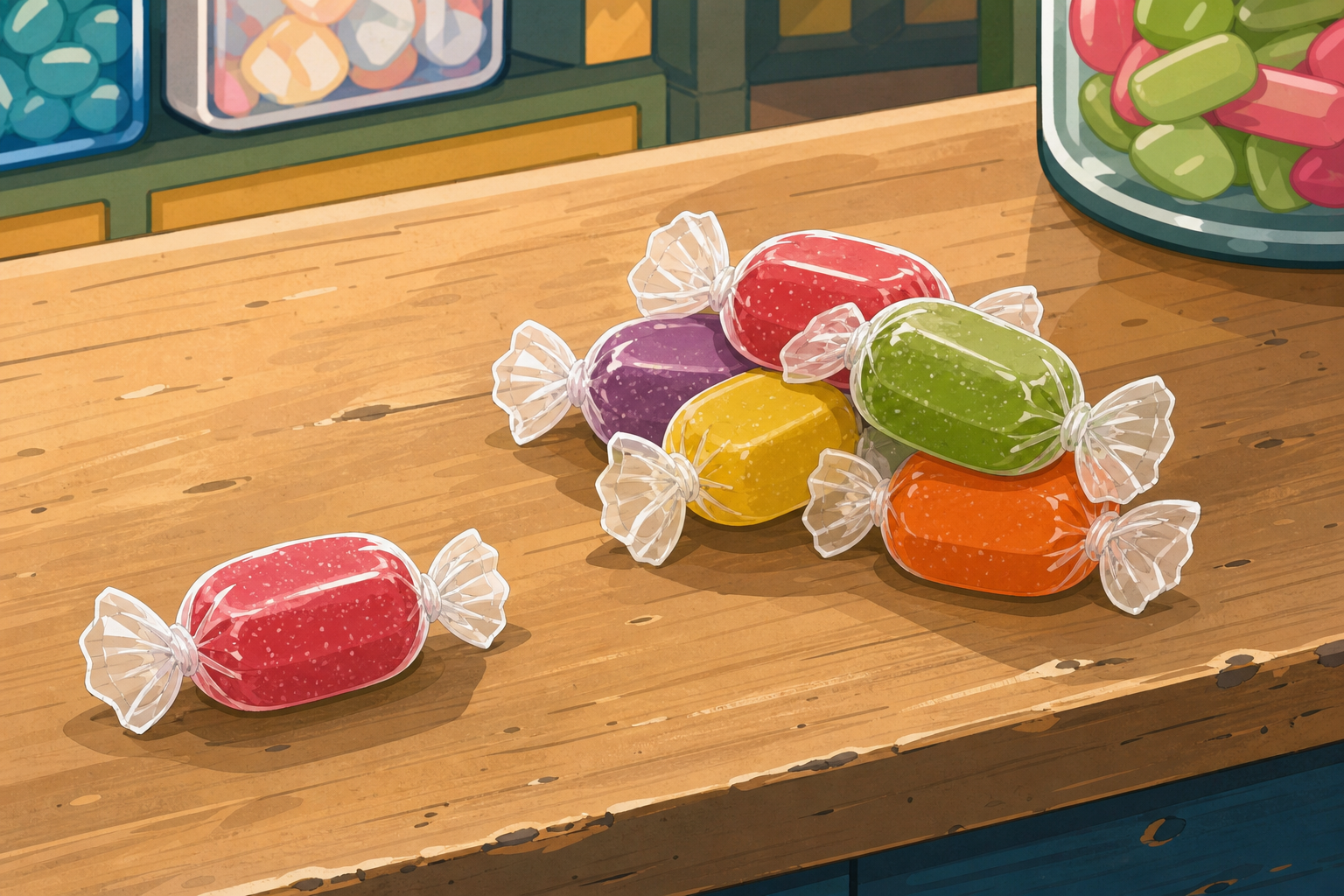
Here is a price puzzle. One jelly sweet costs 3.4 cent to make. A shop buys them in packs of ten. How much does one pack of ten cost the shop to make? Roughly how big will the answer be, and which way will the digits move?
Give five seconds of quiet think-time before any hands go up, then take three hands-up answers. Listen for pupils who reach for "move the decimal point" — hold that thought; the lesson will reframe it as the digits moving, not the point.
The place-value chart shows each number before and after we multiply or divide. Watch which way the digits travel, and keep your eye on the decimal point. Be ready to predict the next one before it appears.
47 × 10 = 470: whole number first so the shift is obvious. Each digit steps one column left, 4 to hundreds, 7 to tens, zero fills units. Draw out: nothing added, digits just moved.
3.4 × 10 = 34: 3 to tens, 4 to units. Point at the decimal point on screen, it did not move, digits walked past it. This is the whole lesson.
Before revealing the next: predict what ×100 does instead of ×10.
0.6 × 100 = 60: two columns left because a hundred is ten twice. Ask what must fill the units column before revealing, 6 to tens with placeholder zero. Trap: without the zero you get just 6.
25 ÷ 100 = 0.25: mirror of multiplying, digits go two columns right, 2 to tenths, 5 to hundredths. Stress the point stays still, the digits travel.
Let each animation finish before you speak.
Today we work through these together on the chart, in this order: 4.5 × 10, then 0.07 × 100, then 1200 ÷ 1000, then 0.3 × 1000. Each one nudges the digits a little further, so predict where they will land before we shift them.
This round is for talking it through together — pupils take turns at the board and the class agrees or corrects out loud.
In your maths copy, write each calculation with an arrow showing how many columns and which direction the digits shift, then record the answer. Do these four:
Draw the arrow above each calculation (left for multiplying, right for dividing) and write how many columns beside it.
Walk the room glancing at the arrow direction and the placeholder zeros — this is whole-class copybook practice, not marking. Watch for pupils who "move the point" instead of the digits.
Today we route each starter number to its target using only powers of ten. We work through these in order: 0.07 → 70, then 4500 → 4.5, then 0.3 → 300, then 0.045 → 45. Some can be done in one jump, some need two — predict the shortest route before we try it.
Try Together first, then this Class Challenge — pupils take turns at the board, check each answer, and the class confirms before moving on. Keep the board work brisk rather than over-explaining.
You're previewing this lesson. Get full access to this lesson and hundreds more — each one ready to teach, with interactive activities, printable resources and pupil progress tracking built in.