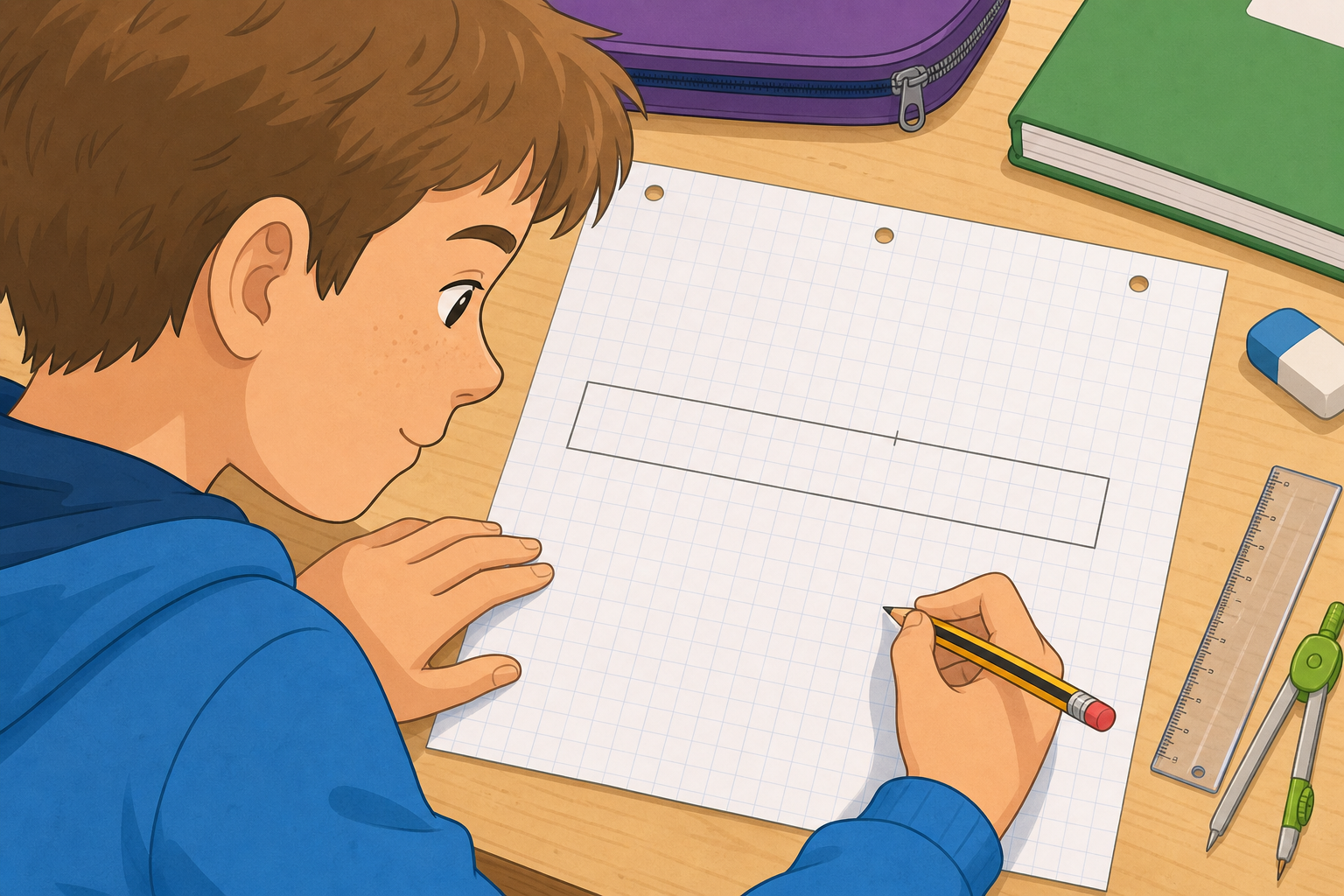
Here is a rectangle that is 23 squares long and 4 squares tall. Hands up: roughly how many little squares do you think fill it? Have a guess before we work it out. If we split the long side into 20 and 3, does that give us a friendlier way to count than one square at a time?
Take three hands-up estimates, not open call-outs. Do not work the answer yet — the point is that counting 92 squares one by one is slow, so we need a better plan. Hold the split idea (20 + 3) for the next step to develop.
The interactive splits each rectangle into boxes and shows the column method beside it. Watch where the number breaks apart, and see if the boxes and the column land on the same answer.
Point at each box, say the partial product, then add. One question between examples to keep the room with you.
23 × 4: friendly starter. 20 × 4 = 80, 3 × 4 = 12, add to 92; check the column agrees. Ask a pupil which box is bigger and why.
47 × 6: 40 × 6 = 240, 7 × 6 = 42. Before adding, take two predictions: more or less than 300? Reveal 282. Then point from box answer 42 to the column: 2 units stay, 4 tens carry. The carried 4 is the tens from 42.
235 × 7: the key one, three boxes. 200 × 7 = 1,400, 30 × 7 = 210, 5 × 7 = 35, total 1,645. Column carries twice. Ask them to find both carries before you confirm, then have a pupil name which box each carry came from.
Today we work through two products together on the board. First 138 × 6: we split 138 into 100, 30 and 8, so we get three boxes. Find each box: 100 × 6, then 30 × 6, then 8 × 6. Add the three partial products to reach the whole answer. Then we do a second one, 216 × 4, the same way. Call out each box answer before we drop it in.
This round is for talking it through together — pupils take turns at the board and the class agrees or corrects out loud.
For 138 × 6, set factor1 to 138 and let pupils drag the partition into 100, 30, 8. Have the class say each partial product aloud: 100 × 6 = 600, 30 × 6 = 180, 8 × 6 = 48. Total = 828. For 216 × 4, split into 200, 10, 6: 200 × 4 = 800, 10 × 4 = 40, 6 × 4 = 24, total = 864. Keep the column-shorthand panel visible and link the carried digits to the box totals as you go.
In your maths copy, sketch the area-model rectangle for each example. Write the partial products inside each box, then total them at the bottom. Check your total against the column shorthand.
Walk the room, glance for correctly split boxes and neat totals — no individual marking, this is whole-class copybook practice, not assessment.
Big numbers make a lot of boxes, so once we trust them we switch to the column shorthand (shown on the right) to keep things tidy. Working right to left: 4 × 9 = 36, write 6 and carry 3; 8 tens × 9 = 72, plus the carried 3 makes 75, write 5 and carry 7; 0 hundreds × 9 = 0, plus the carried 7 makes 7; 1 thousand × 9 = 9. The answer is 9,756.
The zero in the hundreds column still needs working: nothing times nine is nothing, then add the carried seven. On screen the hundreds box has a side of 0, so its area is 0 — a zero box holds the place but adds nothing. You will meet a zero box again in the next challenge.
This is the worked-example beat: the four-digit case where the column method keeps the working tidy. Narrate each column and each carry slowly, naming the digit AND its place value each time (the units 4, the tens 8 meaning 80, the hundreds 0, the thousands 1 meaning 1,000) so the digit on screen matches what you say. Highlight the zero in the hundreds column — 0 × 9 = 0, then add the carried 7 — this is where pupils most often skip a step. Point to the hundreds place on screen as you say it so the label matches the digit. Point at the hundreds box on the area model too: it has a side of 0, so its area is 0. This is the zero-box picture pupils will need for 408 × 7 in the challenge. Confirm the answer is 9,756.
You're previewing this lesson. Get full access to this lesson and hundreds more — each one ready to teach, with interactive activities, printable resources and pupil progress tracking built in.