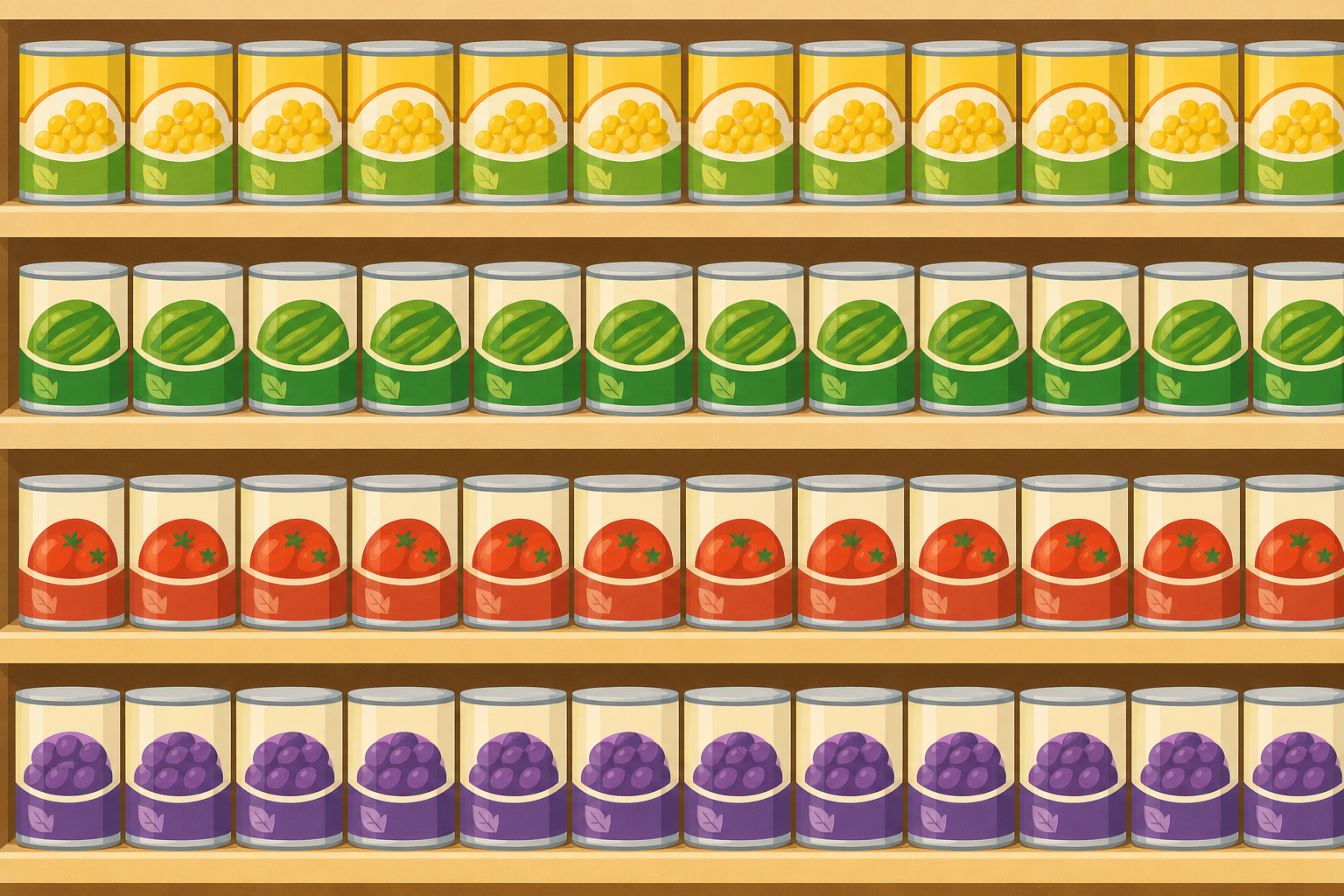
A shop stacks its shelves in rows. One shelf holds 23 tins of beans, and there are 4 shelves the very same. Roughly how many tins is that on the wall altogether? Hands up: is it closer to 80, or closer to 100?
We could count every tin one by one, but that would take an age. Today we will find a quick, tidy way to work out 23 × 4 and sums like it.
Take three hands-up estimates, not open call-outs. Don't work the answer yet, and don't correct the estimates — the point is to get the class thinking that 23 fours is a lot of tins.
Keep this brief; the method is built in the next step.
The interactive draws each multiplication as a rectangle that splits into two boxes. Watch where the two-digit number breaks into tens and units, and how each box gets multiplied on its own before we add them.
Take each example on its own; don't rush to the second.
Ex 1, 23 x 6: splits into 20 and 3. Big box 20 x 6 = 120, small box 3 x 6 = 18, add 120 + 18 = 138. Clean case, no carry when adding. Say partial product as you point at each box answer.
Between examples, turn-and-name: when we split, how many boxes will we always get? Revoice the answer for the back rows.
Ex 2, 47 x 6: both parts large. Splits into 40 and 7. Big box 40 x 6 = 240, small box 7 x 6 = 42, add 240 + 42 = 282. Stress that the two boxes hold 240 and 42 apart so they don't get muddled.
Optional middle, only if the two landed quickly: 35 x 3, big box 30 x 3 = 90, small box 5 x 3 = 15, add 90 + 15 = 105 (units box tips over ten).
Revoice to close: split into tens and units, multiply each box, then add, every time.
Now we build 34 × 6 together on the split rectangle. The 34 splits into a tens box and a units box, and we add the two partial products for the answer. Watch the board, predict the big box first, then we check it together.
After that, I will work two more on the board with you: 28 × 5 and 56 × 4. Watch the units box in 28 × 5 — it gets big, so the adding needs care.
This round is for talking it through together. Build 34 × 6 on the interactive with the class — ask a pupil to split the number into tens and units first, let the class predict the big box, then reveal and add.
Then work 28 × 5 and 56 × 4 as teacher-led board sketches (draw the split rectangle by hand), keeping the class predicting each big box before you write it.
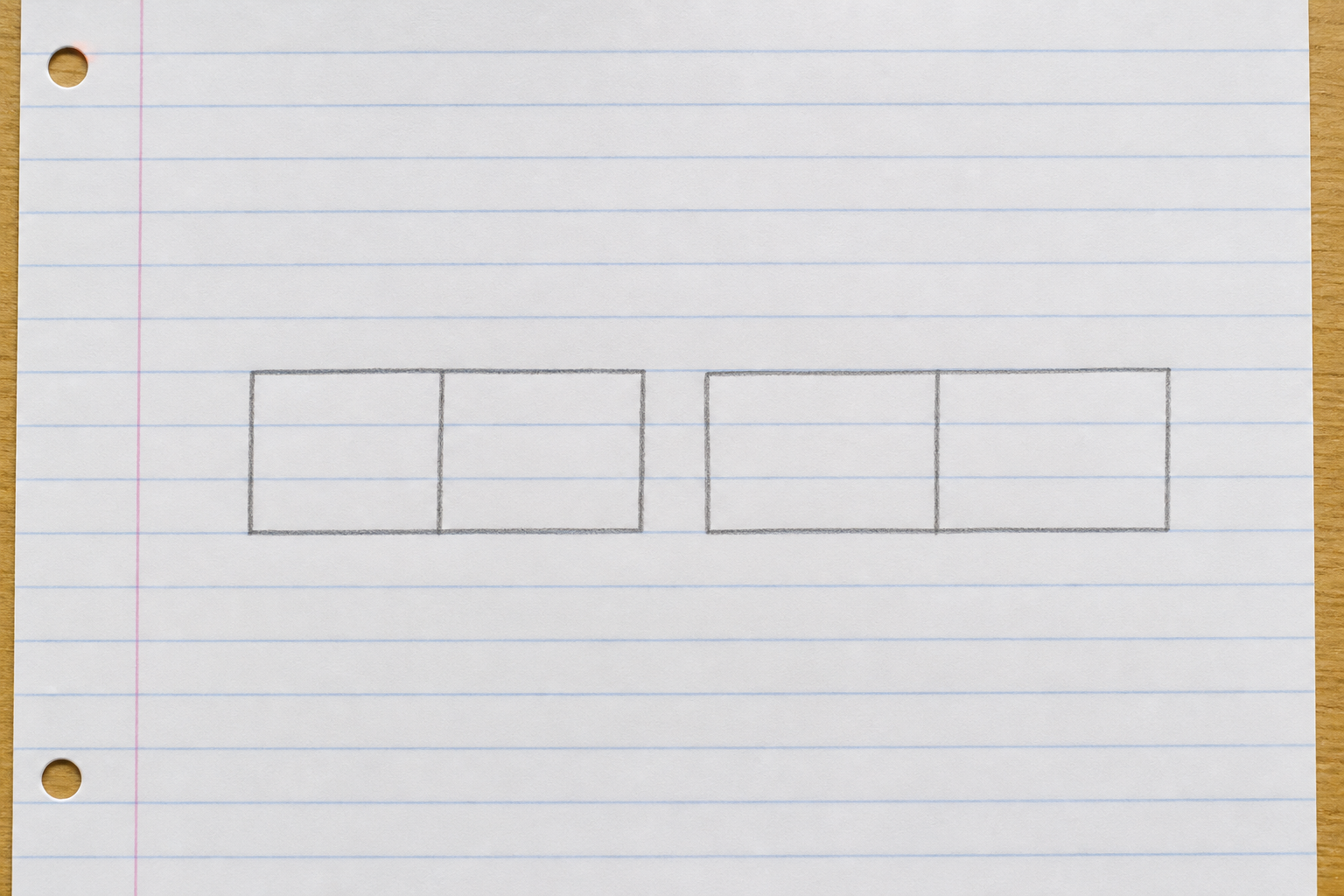
In your maths copy, draw a rectangle split into two boxes for 34 × 6, and another for 46 × 5, just like the ones on the board. Fill in each partial product, then add the two boxes to find the answer for each one.
Remember to split the two-digit number into tens and units before you fill the boxes.
Walk the room glancing at whether the rectangle is split into two boxes labelled with the tens part and the units part — this is whole-class copybook practice, not marking. Watch for pupils who forget to add the two boxes at the end.
Today we solve these shop-and-sport problems together: first 21 stickers on each of 4 pages, then 34 cones costing €5 each, then 47 euro raised by each of 6 pupils, and finally 58 metres run in each of 7 laps. Read each story, spot the words that tell you to multiply, then split the rectangle into boxes to find the answer. The later ones have a units box that carries when you add.
These are the practice questions — pupils take turns at the board, check each answer, and the class confirms before moving on. Keep the board work brisk rather than over-explaining.
Ask which of these needs a carry when adding the two boxes, and let a pupil name it before checking.
You're previewing this lesson. Get full access to this lesson and hundreds more — each one ready to teach, with interactive activities, printable resources and pupil progress tracking built in.