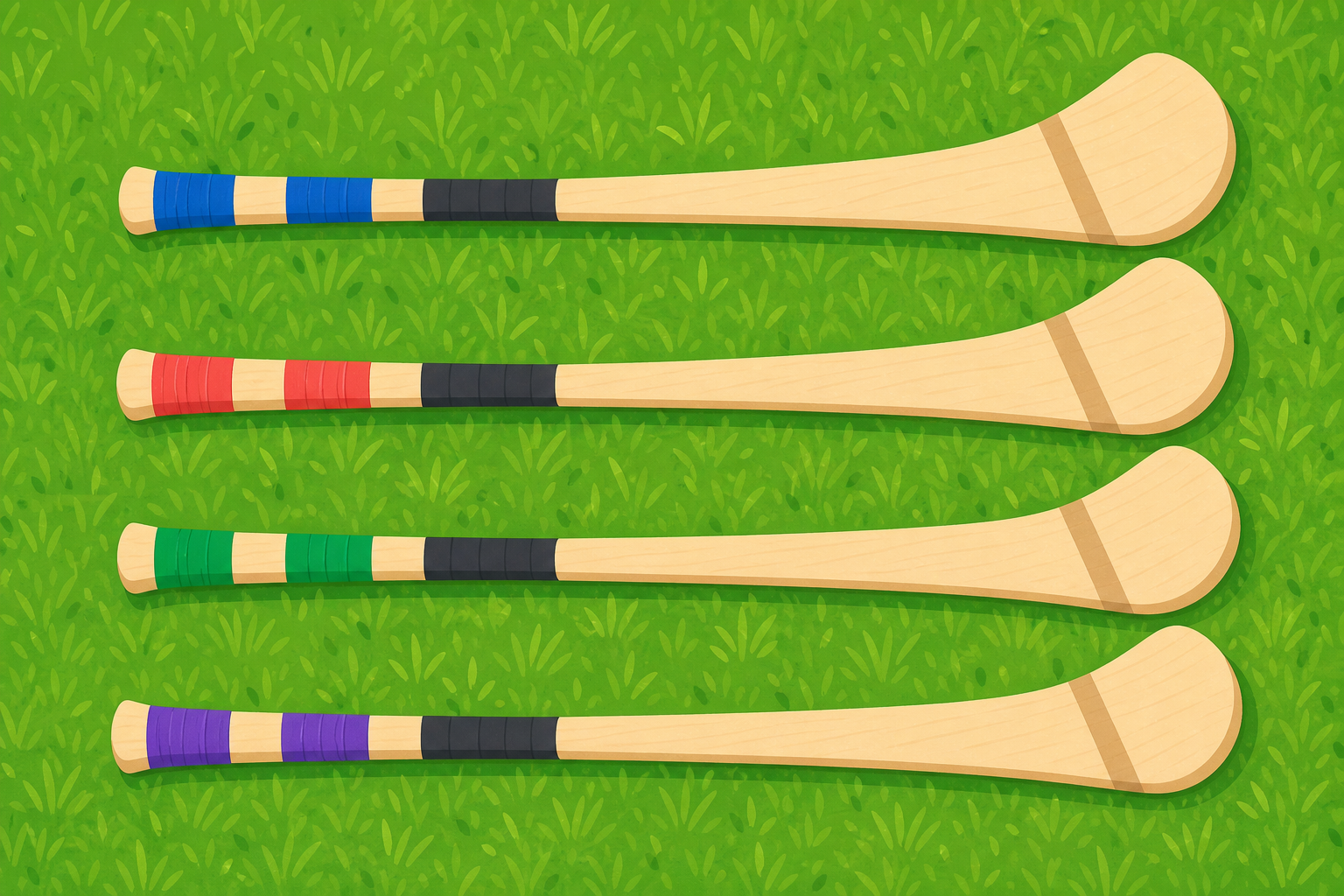
Look at these four hurleys on the screen. Each one has two grip bands wrapped around the handle. Hands up: how could we count how many grip bands there are altogether, without pointing at every single one?
There are four groups, and every group has the same number in it: two. When the groups are all the same size, there is a quick way to count them, and that is what we will learn today.
Take three hands-up answers, not open call-outs. Listen for anyone who says "two, four, six, eight" and revoice it as "you counted in twos — that is our short cut".
The hundred square shades the count for you: first twos, then tens, then fours. Read each count aloud and watch which numbers light up and what shape they make on the grid. Before the tens appear, predict how many columns you will see.
2s: read the count aloud together; multiples of 2 make five columns marching down. Name 2, 4, 6, 8 as the shaded numbers land.
Before revealing 10s: take the prediction on how many columns.
10s: one straight column down the right edge, 10, 20, 30, 40; each step jumps a whole row, only one ten added each time.
4s: the make-or-break noticing. Fours land on 4, 8, 12, 16, 20. Ask first: is every fours number already a twos number? Let them check, so every multiple of 4 is also a multiple of 2.
Then trace the fours taking every other two: 4, skip 6, 8, skip 10, 12.
Finally show the doubling side by side: 2 x 3 = 6 and 4 x 3 = 12, so 12 is double 6. Every fours fact is its twos fact doubled. Flag this as the clue for the wrap.
Now we shade the counts one table at a time on the board: first the multiples of 2, then the multiples of 10, then the multiples of 4. One pupil comes up and shades on the board while the rest of us watch and skip-count aloud together to check the total, and we read off the multiplication fact it shows.
Watch what stays the same and what changes as we move from one table to the next, so you can predict the pattern before it appears.
This round is for talking it through together — one pupil shades at the board at a time while the whole class watches and skip-counts aloud to check.
Call a fact (e.g. 4 × 2), send one pupil up to shade the multiples that count it out, and have the class skip-count aloud to confirm the total. Rotate a few pupils across the 2s, 10s and 4s. Revoice a strong answer: "you shaded four twos and counted eight — so four groups of two is eight". Watch for pupils counting cells one by one instead of in steps; prompt "count in twos, don't count each square". When the fours go up, remind the class every fours number is also a twos number.
First watch one full table written on the board so you can see the method: start at the top with 1 × 2 = 2, then under it 2 × 2 = 4, and keep going one fact under the other until 10 × 2 = 20. That is the 2-times table written in full.
In your maths copy, write the 2-times table in full the same way, one fact under the other, all the way to ten twos. Beside it write the 4-times table in full, and beside that write the 10-times table in full, each all the way to ten.
Now look at the 2s and the 4s carefully and ring every answer in the 2s that also appears in the 4s.
Board demo first (one concrete run-through only): write the 2s down the board as 1 × 2 = 2, 2 × 2 = 4, … up to 10 × 2 = 20, saying each fact as it lands so the layout is clear. Then send them to copies for all three tables: 2s, 4s and 10s, each to ×10.
Walk the room glancing at three neat columns and the rings, this is whole-class copybook practice, not marking. Slip to watch: facts written across the page, missing equals, or stopping before ×10. Pupils should ring the twos answers that turn up in the fours as well (4, 8, 12, 16, 20 and so on); that overlap feeds straight into the Class Challenge and the wrap.
Today we work through these shading challenges together at the board, one after another: shade the multiples of 2, then the multiples of 10, then the multiples of 4, and finally shade the multiples of 4 again , remembering that every multiple of 4 is also a multiple of 2. Each one is a little harder than the last, so predict where the shading will land before we check.
These are the practice questions — pupils take turns at the board, check each answer, and the class confirms before moving on. Keep the board work brisk rather than over-explaining.
The final challenge is the key one: because every multiple of 4 is also a multiple of 2, the fours you shade are exactly the numbers that live in both tables. Ask "what do you notice about the numbers that got shaded — are they in the twos too?" and let a pupil name it. This is the bridge straight into the wrap.
You're previewing this lesson. Get full access to this lesson and hundreds more — each one ready to teach, with interactive activities, printable resources and pupil progress tracking built in.