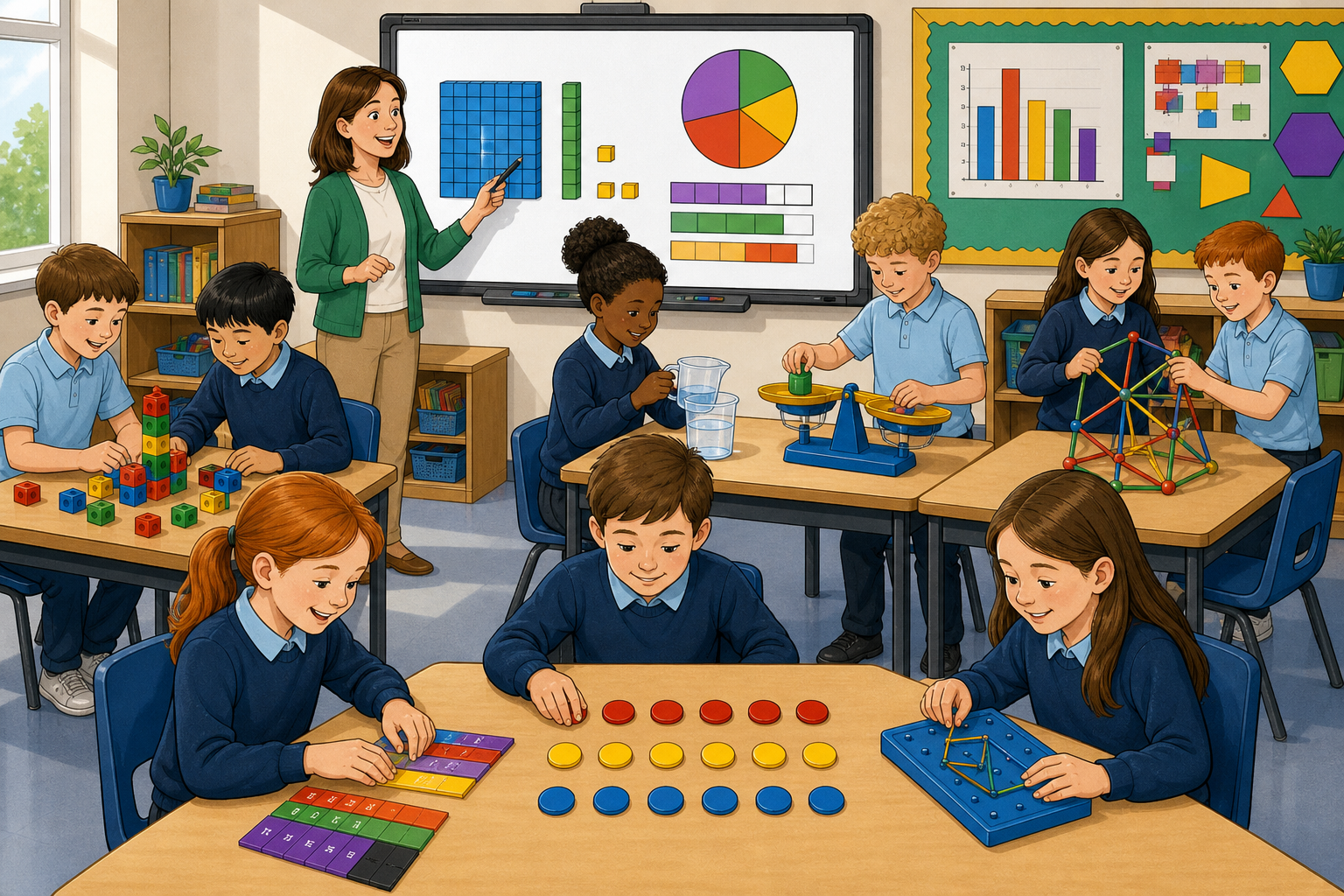
Look at this: three rows of five counters, all lined up neatly. Is this three fives, or five threes? Hands up — which one do you think it is, and does it even matter which way we say it?
Show three rows of five counters (real or on the board) and give five seconds of quiet think-time before hands go up. Take two or three answers, not open call-outs. Don't settle the argument yet — this is the exact question the lesson answers. Just let the disagreement sit.
The interactive lists three arrays by title. Read each title aloud as an addition, then as a multiplication. Notice the last one is 4 rows of 3, the same twelve as 3 rows of 4.
First array: 2 rows of 6. Read as 6 + 6, then 2 × 6, total 12. Point out reading a whole row beats counting one by one.
Second array: 3 rows of 4. Read as 4 + 4 + 4, three lots of four. Pause before the total and take a predict-more-or-less answer. Also 12, but a different shape from the first array. The shared total is the surprise worth naming.
Third array: the same 12 counters turned a quarter-turn, now 4 rows of 3. Read as 3 + 3 + 3 + 3. Gloss quarter-turn as tipped onto its side if needed.
This is the key one: same counters, so 3 × 4 and 4 × 3 give the same total. Don't move on until the class can say why turning it cannot add or lose counters.
Today we lay out counters to build the fact I call out. Everyone builds at their own desk at the same time as the pupil building it on the board, so keep your counters ready. We'll build these together, one at a time: 2 rows of 5, then 4 rows of 3, then 5 rows of 2, and finally 6 rows of 3. For each one we say the repeated addition first, then the multiplication, then read the total off the array.
This round is for talking it through together — one pupil builds on the board while the whole class builds along at their own desks and agrees or corrects out loud.
Call a fact, hand real counters to one pupil to lay into neat rows and columns under the visualiser while everyone else lays their own at their desks. Insist the rows are equal and straight — a wonky array hides the pattern. For each fact ask "say it as an addition first" before anyone reaches for the answer. When you reach 5 rows of 2, put it beside the earlier 2 rows of 5 and ask the class what they notice — same ten, turned. Rotate four pupils through the board turn.
In your maths copy, draw a 4-by-3 array of dots — four rows with three dots in each row. Underneath, write it as a repeated addition, then write both multiplication facts it shows.
Walk the room glancing at whether the rows are equal and straight and whether both facts (4 × 3 and 3 × 4) appear — this is whole-class copybook practice, not marking.
Today we work through these arrays together on the board: build 2 × 6, then 3 × 5, then 4 × 6, and finally a different rectangle that has the same total as 4 × 6. That last one is the thinking one.
Once you have built 4 × 6, find a different rectangle that has the same total. There is more than one way to make the same total.
These are the practice questions — one pupil builds each array on the board, the class predicts before the reveal, and everyone confirms before moving on. Keep the first three builds brisk so the open final challenge has room.
For the final challenge, the on-screen array shows 3 rows of 8 as one worked example of a different rectangle that still totals twenty-four. Take more than one answer from the class (6 × 4, 8 × 3, 2 × 12 all work) and ask each time how they knew the total stayed twenty-four. Give this last part two or three minutes so pupils can reason it out rather than rush.
You're previewing this lesson. Get full access to this lesson and hundreds more — each one ready to teach, with interactive activities, printable resources and pupil progress tracking built in.