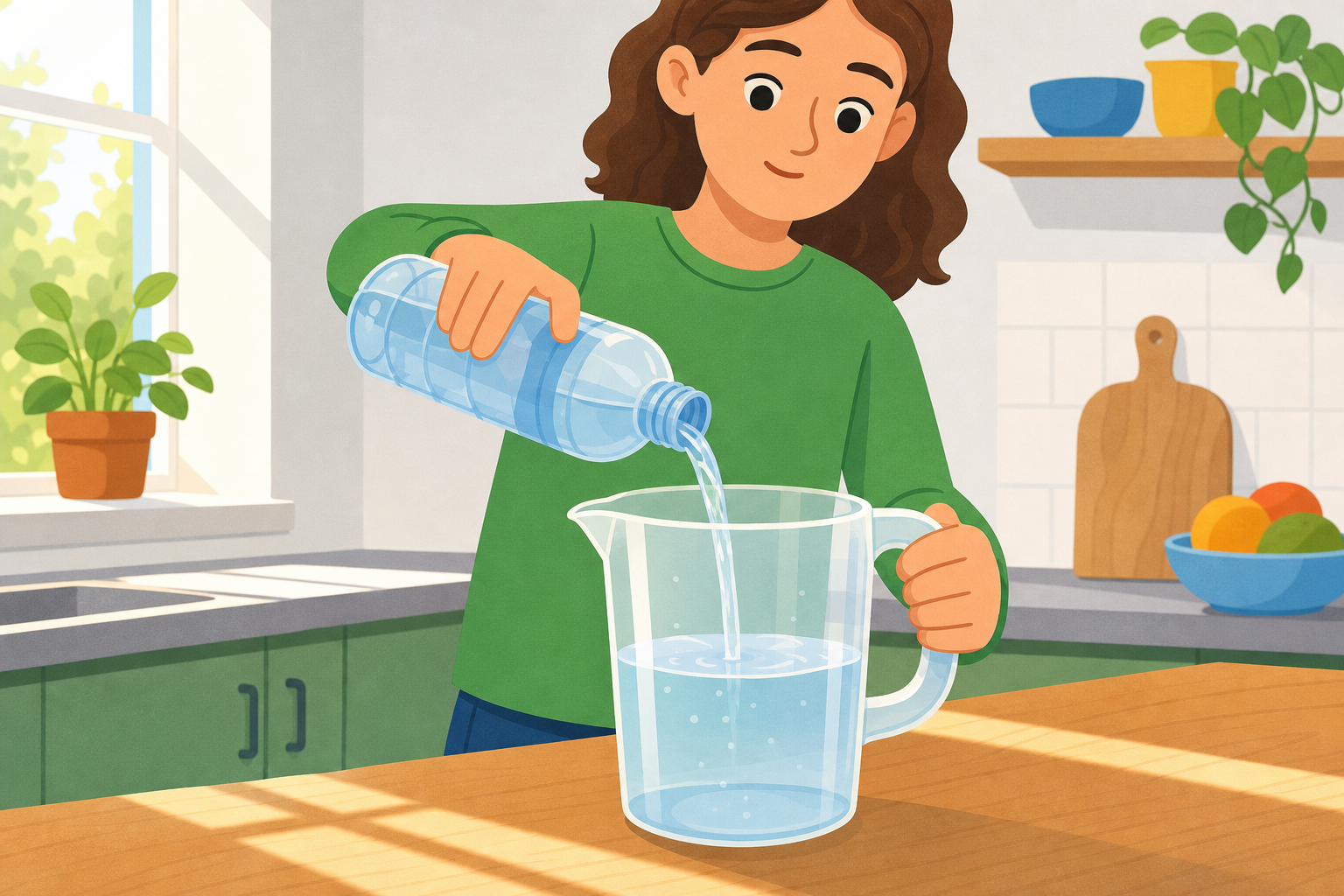
Here is a small problem to turn over in your head. A jug holds 2 litres, and you are filling it from a bottle that holds 500 millilitres. Before we work anything out: what is the question really asking us to find, and what unit should our answer be in?
Take two or three hands-up answers, not open call-outs. You are fishing for two things: that the question asks 'how many bottles fill the jug' and that the answer will be a plain count of bottles (not ml). Do not solve it here — this is just to prime the class to read a problem before grabbing numbers.
Look at the three measure problems on the board: ribbons, apples and cups of juice. For each one, find the signal word and decide whether to add or subtract. Watch for the units, and predict the answer before we work it out together.
Habit throughout: read, spot the signal word, then decide add or subtract. Put a short question between each so the watching room stays with you.
Ribbons: signal word 'joined' means add. Both already in cm, no renaming. Ask which word tells us to add, take two hands. 45 + 30 = 75 cm; stress the answer keeps its unit, 75 cm not 75.
Apples: the make-or-break one. Signal 'eaten' means subtract, but the board still shows 2 kg. Ask can we take grams from kilograms as they stand, take a hand. Rename 2 kg to 2,000 g in front of them, then 2,000 - 750 = 1,250 g, tidy to 1 kg 250 g. The rename is the pupil's first job on the interactive too, not done for them.
Juice: signal 'each' with three cups means add three lots. Ask them to predict under or over a litre, take two hands before revealing. 250 + 250 + 250 = 750 ml, which is three-quarters of a litre, still under a whole litre.
Now we work through some measures problems together, one at a time. We start with a length problem: a 1 m ribbon with 25 cm cut off. Then a weight problem: a 1 kg bag of flour with 250 g used. Then a capacity problem: a 1 l 500 ml jug with 600 ml poured out. For each one, before we touch the numbers, we decide: what is the signal word, do we add or subtract, and do the units match yet or must we rename first?
This round is for talking it through together — pupils take turns at the board and the class agrees or corrects out loud. Reveal the problems one at a time rather than all at once, so nobody is trying to hold three in their head.
For each problem, freeze before the numbers: which word tells you the operation, and are the units the same? The ribbon problem needs 1 m renamed to 100 cm; the flour problem needs 1 kg renamed to 1,000 g; the jug problem needs 1 l 500 ml renamed to 1,500 ml. The board problem shows the mixed unit each time, so the pupil at the board must do the rename first. Revoice a strong answer as 'so you renamed first, then you subtracted — that's the whole trick'. Rotate three or four pupils across length, weight and capacity so everyone sees a rename in at least one.
Now we work through these problems together, each a step harder than the last: two pieces of string joined (40 cm and 35 cm), a 1 m ribbon with a piece cut off, a 1 kg bag of apples with some eaten, and a 1 l 500 ml jug poured out. Watch for where the units do not match yet, because that is where you must rename before you calculate.
These are the practice questions — pupils take turns at the board, check each answer, and the class confirms before moving on. Keep the board work brisk rather than over-explaining.
The practice set climbs on purpose: the first is same-unit adding (no rename), then a length problem needing 1 m → 100 cm, then a weight problem needing 1 kg → 1,000 g, then a capacity problem needing 1 l 500 ml → 1,500 ml. Each board problem shows its original mixed unit, so the pupil at the board performs the rename themselves. Ask 'do the units match yet?' before every calculation. Watch for pupils reaching for the numbers before reading the signal word.
In your maths copy, solve two of the problems we worked through together today. For each one, write the unit you renamed to (if you needed to rename), show your working underneath, and finish with the answer and its unit.
Walk the room glancing for the unit written on the final answer and a rename shown where it was needed — this is whole-class copybook practice, not marking. The problems pupils choose from are the ones the class has already worked through in Try It Together and Class Challenge. Catch any answer that ends as a bare number with no unit.
You're previewing this lesson. Get full access to this lesson and hundreds more — each one ready to teach, with interactive activities, printable resources and pupil progress tracking built in.