1 - Getting Started ~5 mins
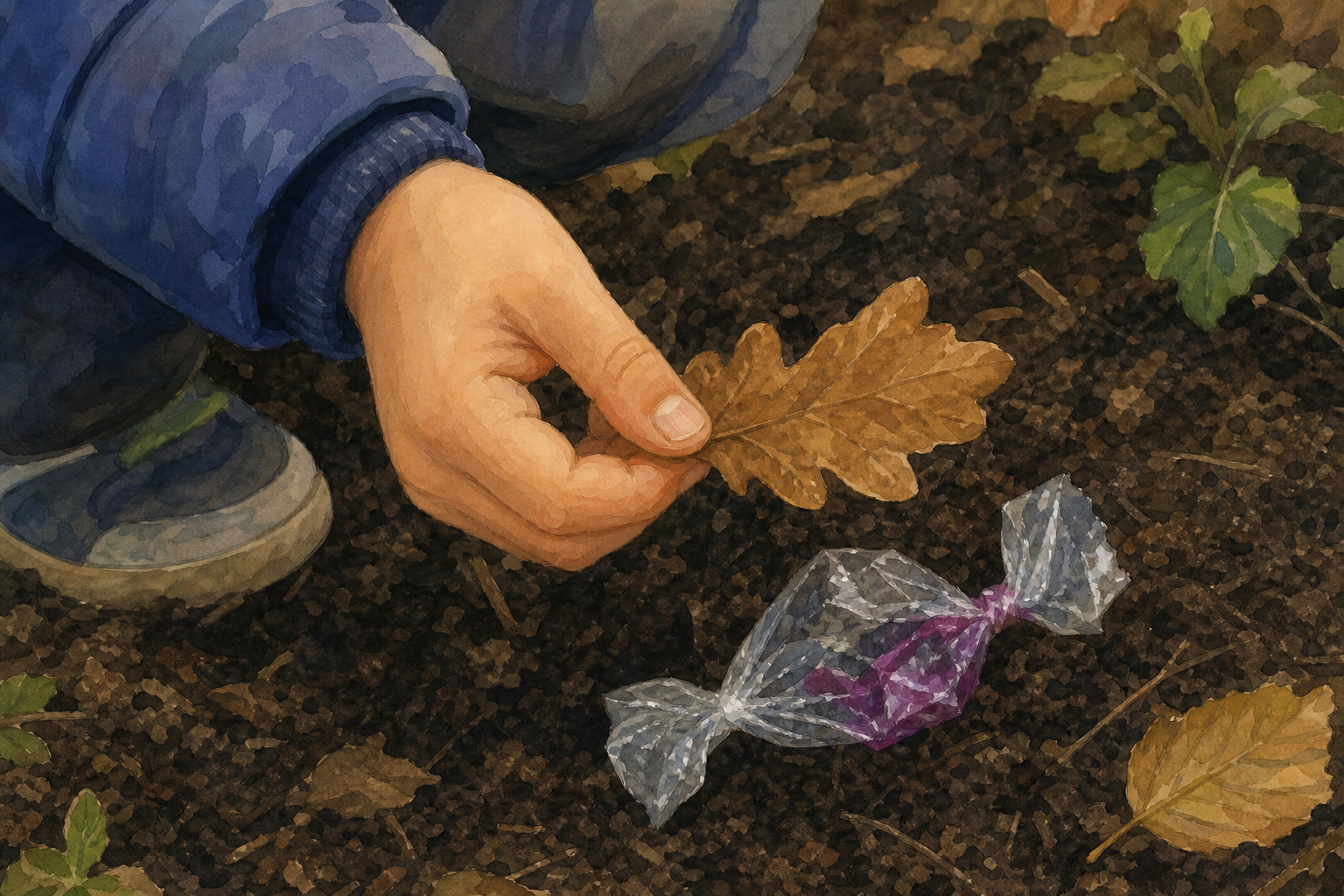 Look at these four everyday things: a leaf, a scrap of paper, a bit of foil, and a plastic wrapper. If we buried them in soil today, which ones do you think would still be there in a few weeks? Hands up your guess for each one.
Have the four sample materials ready to show briefly — a leaf, paper, foil and a plastic wrapper. Do not bury them yet. Keep the hook as a curiosity beat only.
Key questions: Which one might change first? Which one might still look almost the same?
Misconception to head off: children often think anything buried just vanishes. Rot is living things in the soil breaking some materials down; other materials hardly change at all. Softening or fraying can take weeks; full breakdown often takes longer, especially in a cool Irish garden or a slightly damp classroom tray.
2 - What Does Rot Mean? ~8 mins
A leaf can soften into soil because tiny living things eat it. Foil mostly just sits there.
That word is rot: living things in the soil break some materials down so they can become part of the soil again.
Look back at our four samples. Which ones do you think will rot a lot, a little, or hardly at all? Whisper your guess to your partner, then show hands when I call each sample.
Project only the short board version above. Teach rot as the anchor idea for the bury set-up. Hold environmental impact and kinder swap until the sort and swap steps need them — do not dump all three terms here.
| Concept | Why it matters | Example |
|---|---|---|
| Rot — living things in the soil break a material down so it can become part of the soil again | Rotting materials do not pile up as lasting rubbish in the ground or the sea | A fallen oak leaf in the school garden softens and starts to break down over weeks |
Teacher reference (introduce later, not on the board yet):
- Environmental impact — how much help or harm a material causes for living things, soil, water and waste (use when the sort begins).
- Kinder material swap — choosing a material that does the same job with less lasting harm (use at the swap step).
Nature of STEM weave: Ireland has worked hard to cut single-use plastic and waste. You can gently name the green and brown bins children already sort at home, and litter they may have seen in a local park or on a familiar beach — without guilt-tripping.
Misconception: "natural" does not always mean kind, and "plastic" is not always the worst choice for every job. Later we sort by lasting harm and whether something can rot. Predictions today should use change a lot / a little / hardly at all — do not promise the leaf will be gone by the first dig-up.
3 - Bury Samples and Start Watching ~13 mins
Work in groups of four. We will bury four equal pieces — a leaf, paper, foil and plastic — and watch them over the coming weeks. We do not dig them up today.
- On your journal page, write a short prediction for each sample: will it change a lot, a little, or hardly at all? Add one reason if you can.
- Bury the four equal pieces at the same depth in the same soil so the test is fair. Label each spot with the material and your group name.
- As a whole class we will agree one dig-up day and what to photograph or measure when we come back. One person from your group writes that class plan on the journal fair-test lines.
Before the lesson
Print the Investigation Journal SortingGrid page (it carries predict stems, fair-test/evidence lines, and a table for the new classroom finds in step 5). Cut four equal-sized samples per group from leaf, paper, foil and plastic wrapper. Prepare soil trays if you have them, or plan the shared class bury option below.
Groups
Form groups of four at the start of this step (a five is fine if numbers need it). Say the group size aloud so tray, sample and label counts match the room. Each group needs four sample pieces, four labels, and either its own soil tray or a marked share of a class tray/patch.
Time-box (keep inside 13 minutes)
- About 3 minutes: predictions on the journal predict stems at desks (gloves still off).
- About 7–8 minutes: glove up, bury, label.
- About 2 minutes: whole-class dig-up plan on the board; pairs copy it onto the fair-test/evidence lines.
Stay on this path only. Do not dig up today. If time is tight, skip extra fair-test talk beyond naming same size and same depth.
Simpler class-scale bury (use when trays per group are not ready)
Set out one or two shared soil trays at the front (or one outdoor patch with clear group spots). Groups write predictions at desks first, then send two pupils per group forward in turn to bury and label their four pieces in their marked strip. The rest of the class watches and checks fair-test rules (same size, same depth). This still gives every group labelled samples and finishes inside the slot.
Quick front model (about 2 minutes, once)
I wonder which will still look almost the same after a few weeks. I predict the leaf will soften first and the plastic will barely change. I test by burying equal pieces at the same depth and labelling each spot. Evidence is incomplete until dig-up — today's job is a fair start only.
Group set-up checklist
- Same sample size for all four materials
- Same depth and same soil tray or patch
- Label with group name and material
- Record predictions on the journal predict stems before burying
When we return (check-back protocol — whole class, once)
Before leaving this step, agree with the whole class and write on the board:
- When: a dig-up date about 3–4 weeks from today
- What to photograph: each sample next to a ruler or craft stick for scale
- What to notice or measure: colour, shape, how much of the piece is left, whether it tears or crumbles easily, smell only if safe and optional
- What counts as evidence: compare each sample with the group's prediction (changed a lot / a little / hardly at all)
One pupil per group copies that single class plan onto the journal fair-test/evidence lines — it is not a separate choice per group.
Safety: gloves on for soil work (prefer reusable non-latex class gloves, or thorough handwashing if gloves are unavailable); wash hands after; no tasting; return any outdoor minibeasts gently if found.
Differentiation: less confident groups use sentence stems such as "I think the ___ will rot because...". Confident groups also note one fair-test rule they kept the same.
4 - Sort by Environmental Impact ~12 mins
Environmental impact means how much help or harm a material causes for living things, soil, water and waste.
On the board is a sorting tree — a yes-or-no path. We will answer the on-screen questions one card at a time and land each material in one primary group:
- rots fairly easily
- reuse or recycle well
- lasting waste if thrown away
Call out where you think each card should go and why.
Sort materials by impact
Introduce the phrase environmental impact with the one plain board line, then open the sorting-tree interactive on the IWB in explore mode straight away. Reveal one card at a time — do not ask pupils to read a full list of eight materials first. The cards on screen are exactly: leaf, paper, cardboard box, aluminium foil, plastic bottle, plastic wrapper, glass jar, cotton cloth.
Frame the activity as answering the branching questions, not free-sorting into three piles at once. The branching questions are: Can living things in soil break it down fairly easily? then Can people reuse or recycle it well?
Leave the three group names visible on the IWB for the rest of the lesson (step 5 still needs them).
Holding the paper / cardboard / cotton tension (say this only when one of those cards lands under rot): the tree asks about rot first by design, so paper, cardboard and cotton land in rots fairly easily and never reach the reuse/recycle branch. That can feel "wrong" because children recycle paper and cardboard at home. Then say: in real life a material can still be recycled even if the sorting tree put it under rot; the tree forces one primary impact group so we can compare cleanly. Foil and glass are useful debate cards the other way — they do not rot, yet they recycle well.
Invite groups to call out where each card should go and why. Short debate is useful science talk.
Optional Irish anchor while debating lasting waste: thin wrappers that end up as litter in a local park or on a beach the class knows, compared with bottles and glass that go in familiar recycle streams, and with food scraps or garden waste that belong in the brown bin.
Recording: do not ask pupils to copy the full board sort onto the journal. The IWB sorting tree is the class record for these eight cards. The printed SortingGrid table is reserved for the new classroom finds in the next step. If a pupil wants a personal note, they may jot one interesting board card and its group on the reverse of the page — optional only.
Optional teacher-display objects (one cardboard scrap, bottle piece, cloth scrap, or a glass jar kept with you) can sit at the front if helpful — they are not per-group kit.
Look-fors: children separate "rots" from "recycles"; they do not dump every plastic into one heap without thinking about bottles versus wrappers.
5 - Tricky Finds and Hard Choices ~8 mins
Keep the three impact groups in view on the board:
- rots fairly easily
- reuse or recycle well
- lasting waste if thrown away
Your group gets two or three new classroom materials that were not on the board cards. Sort only those new finds into the same three groups. Use the table on your journal page: write the material, the group, and one reason. Pick one placement you found tricky. A few groups will tell the class why; everyone else listens and may agree or disagree with a reason.
This is not a repeat of the board sort. Do not re-sort the same eight cards. Give each group 2–3 new offcuts or objects not already placed on the IWB, for example: a wooden pencil stub, a clean cling-film scrap, a rubber band or eraser, a cotton wool ball, or a clean yoghurt-pot piece. No glass in pupils' hands — glass stays teacher display or picture card only.
Leave the three group names on the IWB (or write them as three simple desk headings) while groups sort so nobody freezes on the labels.
Groups physically sort the new finds on the desk and fill the SortingGrid table (about 4–5 minutes). That table is headed for these new classroom finds — it is the written sort for this step, not a copy of the eight board cards. Then take only two or three quick shares of the trickiest placement — not a full round of every group. Fold the rest of the class in with brief questions: "Would you put it there too? What evidence are you using?" Optional stretch if a group finishes early: challenge one board placement they still disagree with and say what evidence would change their mind.
Key questions: What evidence are you using? Is reuse different from rotting? Could a material fit more than one group depending on how people use it?
Common snag: cling film often sparks debate (reuse is weak; rot is poor; lasting waste if thrown away is a fair primary group). Accept reasoned talk.
Unlock the full learning experience
You're previewing this lesson. Get full access to this lesson and hundreds more — each one ready to teach, with interactive activities, printable resources and pupil progress tracking built in.
This lesson is copyright of Coding Ireland 2017 - 2025. Unauthorised use, copying or distribution is not allowed.