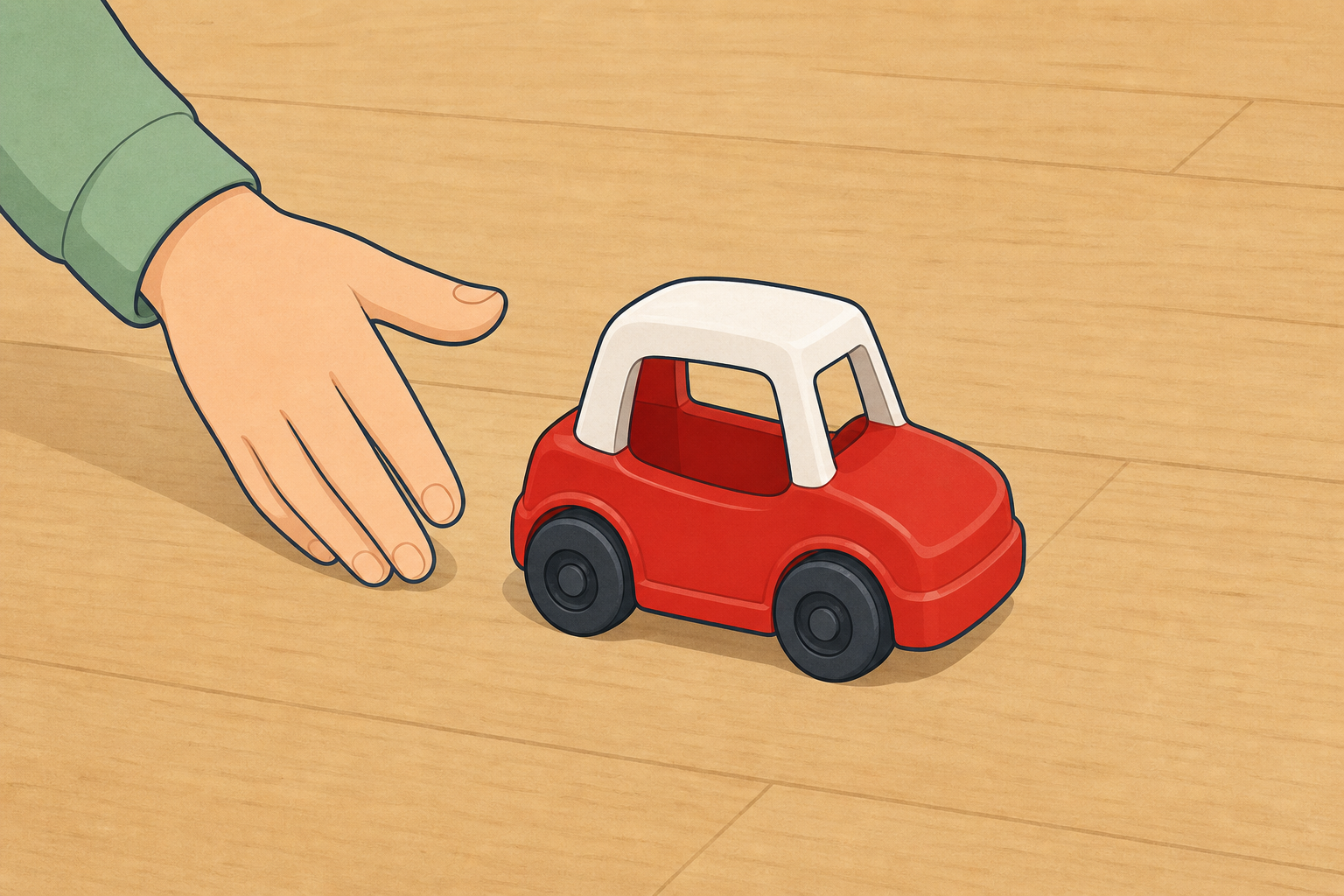
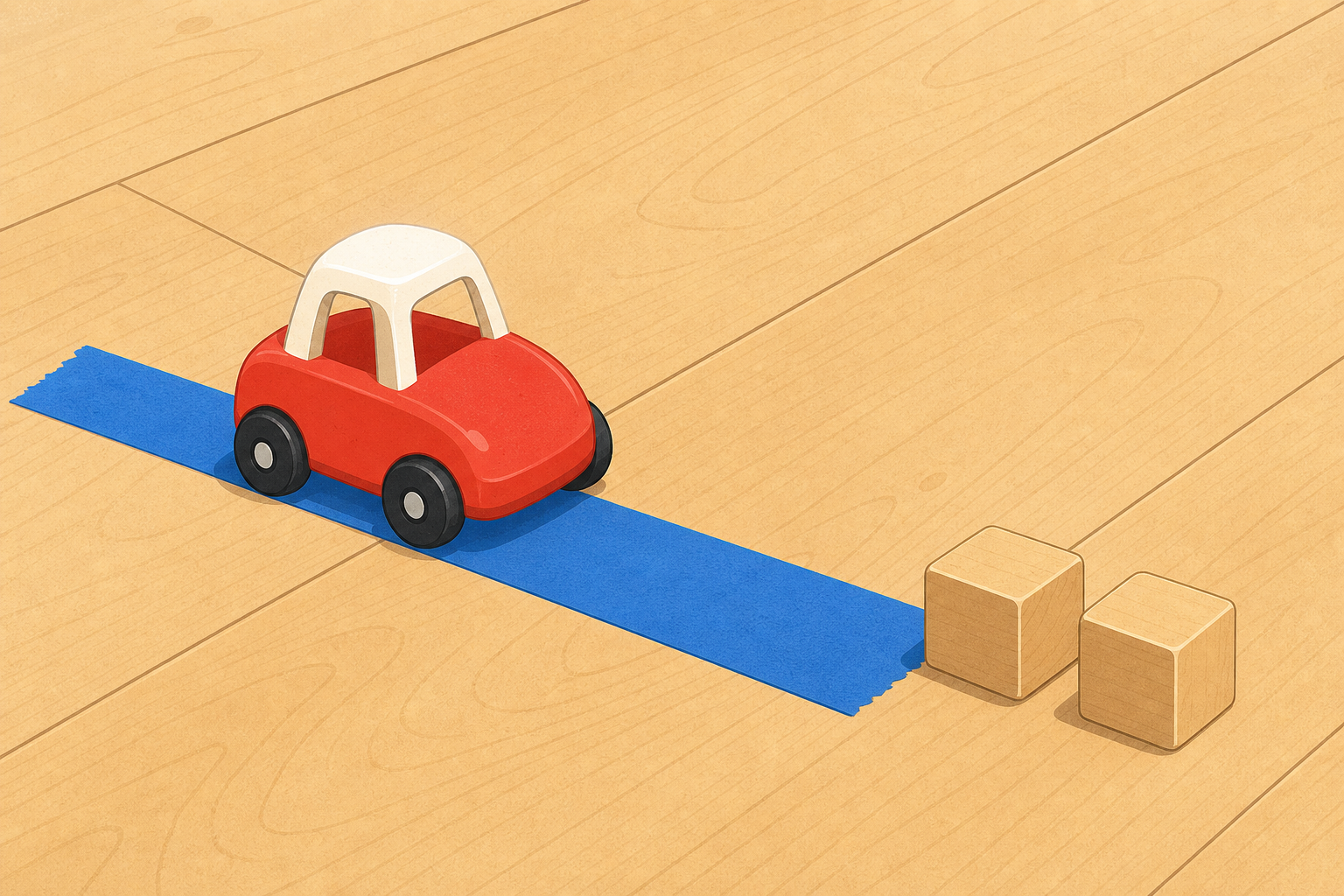
Look at this toy car (or soft ball). If I give it a tiny push, and then a really big push, which one do you think will go further along the floor?
Show me with your hands: small push, or big push?
Hold one soft ball or toy car where the class can see it. Use the same type of object the groups will roll later. Do not roll it yet and do not lay out the full lane. This is only the curiosity beat.
Take a quick show of hands. Accept every idea. Do not tell them the answer. Say we will find out by trying it.
STEM eyes: link to play they already know: kicking a ball softly or hard in the yard, pushing a scooter, rolling a marble.
Watch the car in my hand. Small push. Bigger push. Further means it rolls a longer way before it stops.
Today we will find out: does a bigger push send the same car or ball further?
| Concept | Why it matters | Example |
|---|---|---|
| Push — a force that presses something away from you and can start it moving | Almost everything that starts moving on the floor or yard begins with a push or a pull | Pushing a toy car with your hand so it rolls across the lino |
| Bigger push — pressing harder so you push with more force | How hard you push changes how the object moves, which is useful in games and when we move things safely | A soft nudge on a football versus a strong kick toward the far wall |
| Further — travelling a longer distance before stopping | We can compare two pushes by looking at where each one stops | Two tape marks on the floor: the mark nearer the far wall is the one that went further |
Keep the board text short. Do the teaching with gestures on the real object in your hand: small hand push, bigger hand push, point further down the floor. Do not read the table aloud as a glossary.
Misconception to head off: some children think the heavier car always goes further, or that the second try always wins because it is "better". Keep the same car (or ball), the same starting line, and change only how hard we push.
Modeled cycle (say this thinking aloud later with the real car, not as a board script): I wonder if a bigger push makes the car go further. I predict the big push will go further because I am pressing harder. I try a small push and mark where it stops. I try a big push from the same line and mark again. I observed the big-push mark is further down the lane. I think a bigger push makes the same object move further.
Quick practise on the board before our floor test. We will run the car twice and leave both marks so we can see them side by side.
Watch what stayed the same and what we changed.
The board was only practise at changing one thing. Our real test is flat floor, same car or ball, small push then big push — no ramp.
Open the ramp-and-roll interactive in explore mode on the IWB. Start on a gentle slope (slope 1) and a smooth surface, with tiles on so the class can count how far.
Why this step is here: a very short fair-test habit demo only (change one thing, keep the rest the same, compare both marks). It is not today's investigation. Do not ask a separate ramp prediction as if ramps were the lesson question.
How to drive it (keep to about 5 minutes):
Bridge — say this clearly before you leave the board: "On the board we only practised changing one thing. Our real test is next: the floor stays flat. Same car or ball. Small push, then big push. No ramp."
Fold the watchers in: "Which mark is further? What did we keep the same?"
If the ramp still steals attention, close the interactive after one clear pair of runs and move straight to the floor model.
Our real question today: does a bigger push make the same car or ball go further?
First, say your group prediction out loud: small push or big push?
Then take turns at the lane. One child pushes. One child marks where it stops. Keep the same car or ball, the same floor and the same starting line. Change only how hard you push. Each group does one small push and one big push, then steps aside when the teacher signals.
While you wait your turn, join in with the class: will their big push go further? What must they keep the same?
Default delivery for a typical 1st Class room: clear one or two shared floor lanes (about 2–3 metres each), not one lane per group. Mark a shared starting line with masking tape. Have one toy car or soft ball ready per lane, plus spare tape strips or sticky notes for stop marks (S and B). Place Investigation Journal pages ready to hand out as groups finish their rolls (or put them on desks now if space allows).
With the class watching one lane, think aloud:
What to expect: on a smooth classroom floor the big push should clearly outrun the small one. If both look similar, the "big" push was not big enough — model a clearer contrast. If the car hits a bag or foot, clear the lane and repeat.
Timebox: each group gets one small push and one big push only, marks both stops, then steps aside on your signal (about 1–2 minutes per group at the lane). Do not let groups add extra trials unless the lane is empty and time remains.
Run order for one or two shared lanes:
Fallback if the queue is long: when about 3 minutes remain, stop new groups at the lane. Remaining groups stand where they can see and watch one final modelled small push and big push (teacher or a confident pair). Leave clear S and B class marks. Those children still complete the journal from the shared class marks so every child compares further and nearer. Say this calmly so nobody feels left out: "Your job now is to watch carefully and record what the whole class saw."
While groups wait — ready class questions (use these every waiting beat):
Watching is participation; do not set a separate desk task for waiters.
If the room is very tight, use one class lane only and keep the same run order and fallback.
Safety: roll along the floor away from feet and faces; walk around lanes, do not step into a roll; stop the car with a hand at the end of the lane if needed.
Key questions while you circulate: "What did you keep the same? Which mark is further? Does that match your prediction?"
Hand out journals as each group finishes its two pushes (or while the last groups roll) so pages are on desks before the next step.
Look at your two marks on the floor. On your Investigation Journal page, draw two short lanes and put an S mark and a B mark where each push stopped. Circle which one went further.
That is your main job. If you have time, add a tick for your prediction and one short phrase about what you found out.
This is the paper recording beat. Pupils use the Investigation Journal page. You do not design the page layout.
Before they write (about 20 seconds on the board): sketch two simple lanes, mark S near the start on one and B further along on the other, then draw a circle or tick on the B lane. Say out loud: "Drawing only is enough. Copy your real floor marks. Circle which went further." Leave that model visible while they work.
Main ask for every child:
Optional extras if they finish quickly (model once, do not pile on):
Help anyone stuck by pointing at their real tape marks: "Which mark is further from the start? That is what you draw and circle."
If a group's big push hit a bag or chair, let them note that the lane was blocked and, if time allows, try once more with a clear path. Children who only watched the shared class marks still draw those S and B marks from the front lane.
Optional: hold a metre stick between the two marks and talk about "more centimetres" or "further" without turning it into a formal measuring lesson. Eye comparison and tape marks are enough.
If any journals were not handed out at the end of the floor work, distribute them now before children sit to record.
You're previewing this lesson. Get full access to this lesson and hundreds more — each one ready to teach, with interactive activities, printable resources and pupil progress tracking built in.