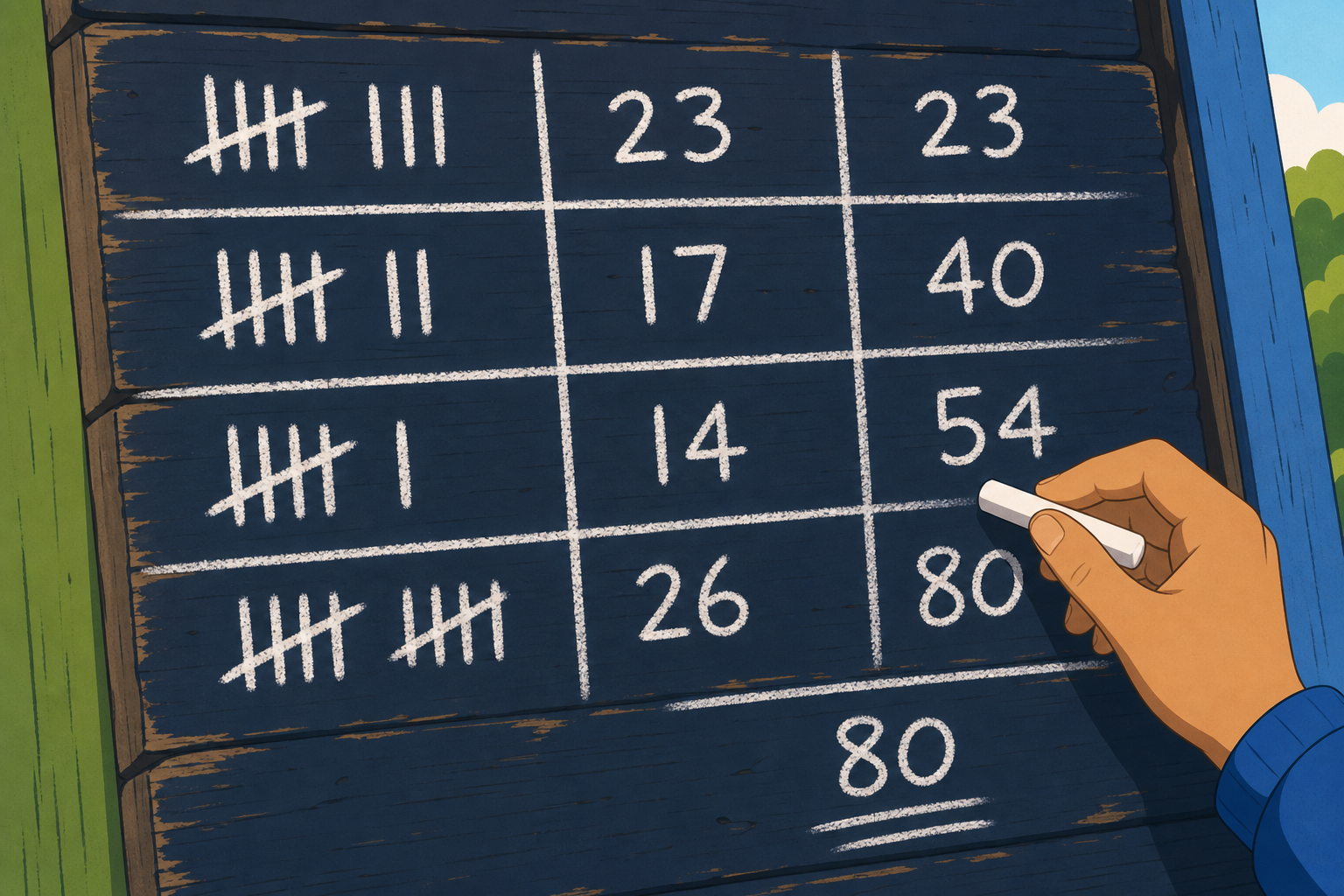
Here is a scoreboard sum someone worked out on the board: a club added up the points scored across a whole season of matches, 384 × 27, and got 1,363. Is that right? Before we check with a pencil, roughly how big should the answer to 384 × 27 actually be?
Show the wrong answer (1,363) on the board as you settle the class. Take three hands-up estimates, not open call-outs. Do not confirm right or wrong yet — the point is that pupils sense 1,363 is far too small before we prove it. Give five seconds of quiet think-time first.
We will work three multiplications on the board, each in two parts: first a rounded estimate, then the real working row by row. Watch what happens to the second row each time, and keep an eye on where the real answer lands compared to the estimate.
Write each one out live as you go. First two get full time; third is a quick guided check with the class calling numbers.
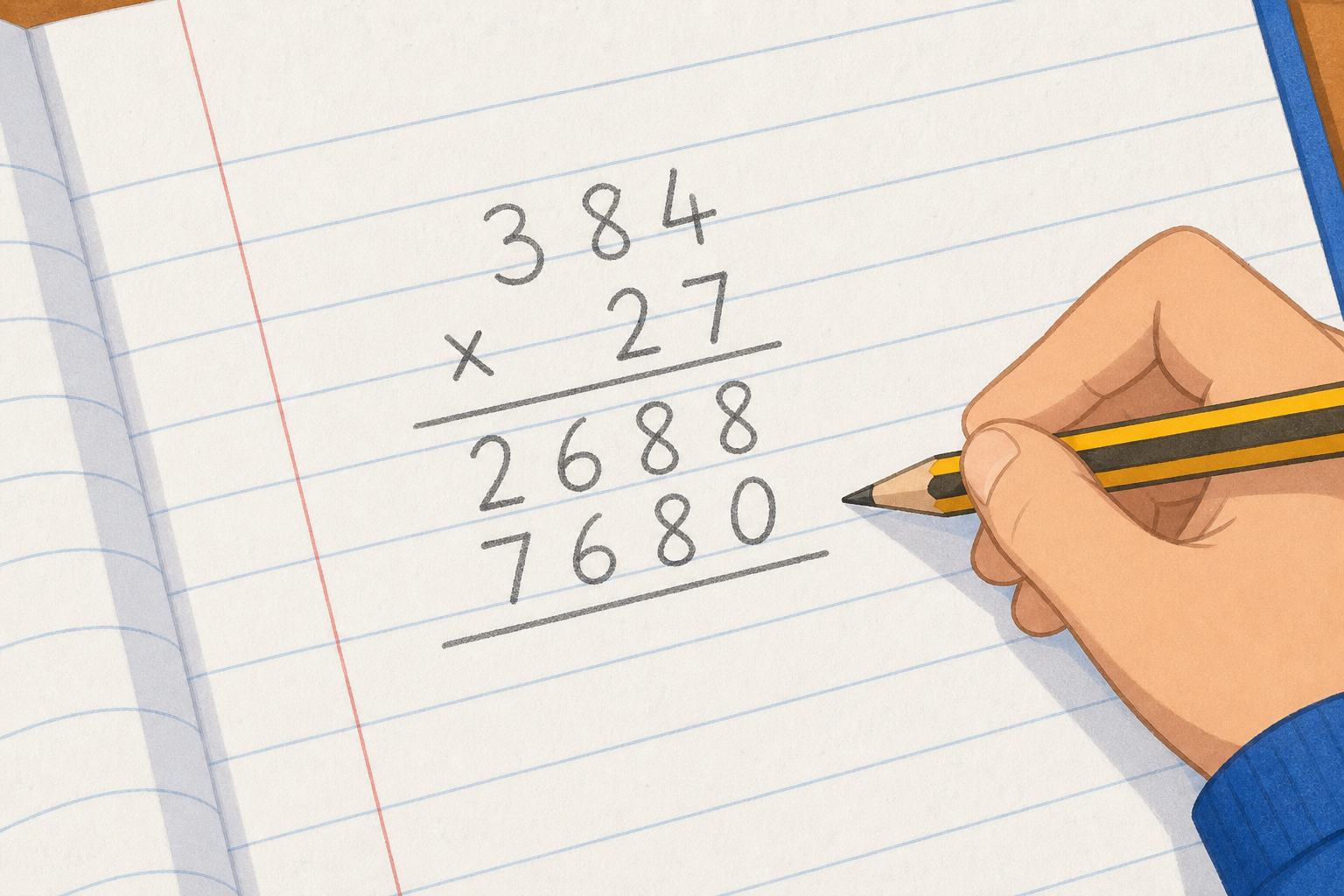
Example 1, 384 × 27: round to 400 × 30 = 12,000. Working: 384 × 7 = 2,688, then 384 × 20 = 7,680. Stress the placeholder zero — the 20 means two tens, so a zero holds the units column and stops the row slipping right. Add for 10,368; note it sits near 12,000.
Example 2, 506 × 48: pause on the zero in 506. Round to 500 × 50 = 25,000. Working: 506 × 8 = 4,048, then 506 × 40 = 20,240 (zero holds units again, four tens). Add for 24,288. Turn-and-name: is 24,288 above or below 25,000? Take two answers.
Example 3, 729 × 35: run fast, class calls each partial. Round to 700 × 40 = 28,000. Working: 729 × 5 = 3,645, then 729 × 30 = 21,870. Add for 25,515.
Close gently: all three real answers landed just below their estimates. Offer as a noticing, not a task to explain.
In your maths copy, for this product write your rounded estimate first, then the full long-multiplication working underneath. When you have the total, compare the two and note in one line how close your estimate was.
Walk the room glancing for the placeholder zero in the tens row and for the estimate written before the working — this is whole-class copybook practice, not marking. One product keeps the three-minute slot honest. If a total is wildly off its estimate, point at the estimate and let the pupil find their own slip.
Today we estimate first, then work it out, and check each result against the estimate. We'll do the written long multiplication together on the board, and use the screen only for the estimate check. Our products come from a GAA weekend: 245 × 32 (tickets for 32 matches), then 517 × 26, then 683 × 45. For each one we say the rounded estimate aloud before anyone touches the working, so we always know roughly where the answer should land. Remember what a place-value slip looks like: if the tens row lands one column too far right, the answer comes out much too small, so 517 × 26 giving 4,136 (far too small) would be a slipped row.
The long-multiplication working is written live on the board; the on-screen game is used only for the estimate-versus-actual check. Pupils take turns at the board and the class agrees or corrects out loud.
Hold the class to the rule: estimate first, out loud, before any working. On 245 × 32 the estimate is 250 × 30 = 7,500 and the answer is 7,840. On 517 × 26 estimate 500 × 30 = 15,000, answer 13,442. On 683 × 45 estimate 700 × 50 = 35,000, answer 30,735. Watch for the missing placeholder zero — the commonest slip. Revoice a strong check: 'the estimate said about fifteen thousand, so an answer of one thousand three hundred would be a place-value slip — a whole row landed in the wrong column'.
Today we work out these products, estimating first and then working them out to check: 478 × 36, then 815 × 29, then 364 × 52, and finally the stretch, 926 × 47 (points scored across a full club fixture list).
For each one we predict roughly how big the answer will be before we work it out on the board. The screen is just for the estimate; the long multiplication is written out by hand. If there is time, see whose estimate landed within five hundred of the real answer.
These are the practice questions — pupils take turns at the board, work each answer, and the class confirms before moving on. The written algorithm is done live on the board; the on-screen game only logs the estimate check. Keep the board work brisk rather than over-explaining.
Answers: 478 × 36 = 17,208 (estimate 500 × 40 = 20,000); 815 × 29 = 23,635 (estimate 800 × 30 = 24,000); 364 × 52 = 18,928 (estimate 400 × 50 = 20,000); 926 × 47 = 43,522 (estimate 900 × 50 = 45,000). The final one is the stretch — bigger numbers throughout. If time is short, drop the 'within five hundred' scoring and just confirm each answer against its estimate.
You're previewing this lesson. Get full access to this lesson and hundreds more — each one ready to teach, with interactive activities, printable resources and pupil progress tracking built in.