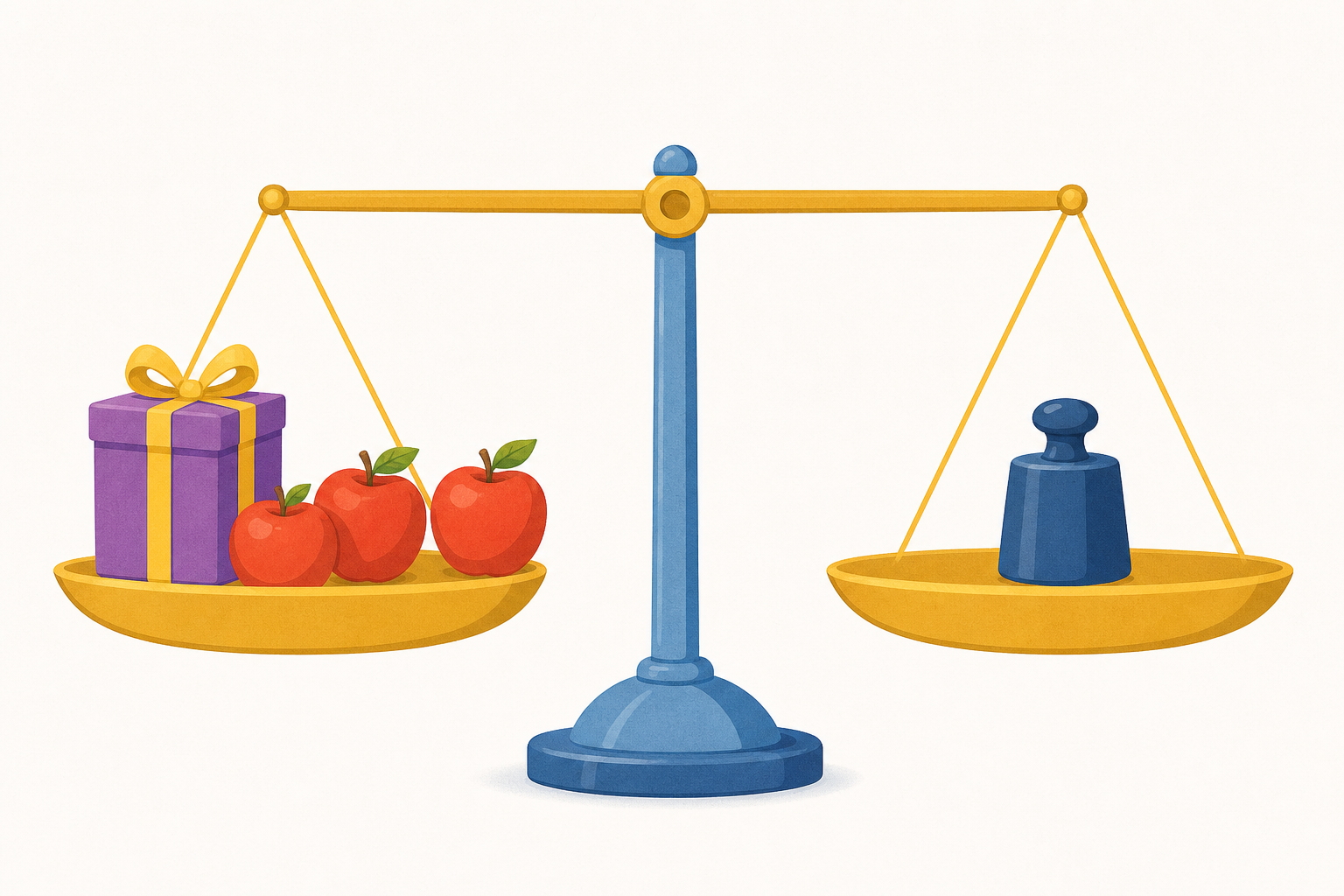
Here is a puzzle: n + 3 = 7.
The letter n is standing in for a number we cannot see yet. What number could n be, so that when you add 3 you land on 7?
Give five seconds of quiet think-time, then take two or three hands-up answers. Do not confirm yet — hold the value of n until Watch and Notice, where the balance makes it visible.
Each balance below shows an equation. One pan holds a letter that stands for a hidden number; the other holds a known amount, and when the beam sits level the letter has found its value. Watch the interactive work through five balances — look for where the letter's value comes from each time.
n + 3 = 7: confirm the opener — the letter just held the place of 4.
x − 5 = 12: the take-away catches people. Put the 5 taken off back beside the 12, so the x pan balances 12 and 5; ask what that comes to — x = 17.
y + y = 8: two of the same letter balance 8, so one is half — y = 4. Both blocks hold the same value; note y + y can be written 2y.
2k + 1 = 11: build in two beams. First beam is the equation as it stands. Second beam takes the 1 off both sides, leaving two k blocks balancing 10; halve, so k = 5.
Pause after each balance to confirm the value with the class before moving on. This reasoning returns in the practice round and the covered-card clues.
Today we work these out together on the board, and the beam tells us when the letter is right. Remember the take-away trick from before: put the number we took off back beside the answer, so the letter's pan balances both together. We'll do:
Slide the letter until the beam sits level, then read off its value.
Talk this one through together — pupils take turns at the board and the class agrees or corrects out loud.
For each equation, ask the class to predict the value before a pupil slides the letter. For x − 4 = 9, remind the class of the take-away trick: the x pan balances 9 and 4 together, which comes to 13. On the story equation, agree together that 's' is the number of sweets Aoife started with, so it must be 7. Revoice: the letter is just holding the place of a number we haven't found yet.
In your maths copy, write each of the lesson's equations on its own line and put the value of the letter underneath, like this:
Circle the letter on each line so you can see where the hidden number was.
Walk the room glancing at the circled letters and the values — this is whole-class copybook practice, not marking.
Now the practice round. Find the hidden number for each equation.
Predict the value before you slide the letter, then use Check to confirm.
This is the practice round — pupils take turns at the board, check each answer, and the class confirms before moving on. Keep the board work brisk rather than over-explaining.
The practice set rises in difficulty: single-step adds, then a take-away, then a doubling, then the two-step 2k + 1 = 11. On the last one, point back to the two beams we built in Watch and Notice: take the 1 off both sides first, then halve.
You're previewing this lesson. Get full access to this lesson and hundreds more — each one ready to teach, with interactive activities, printable resources and pupil progress tracking built in.