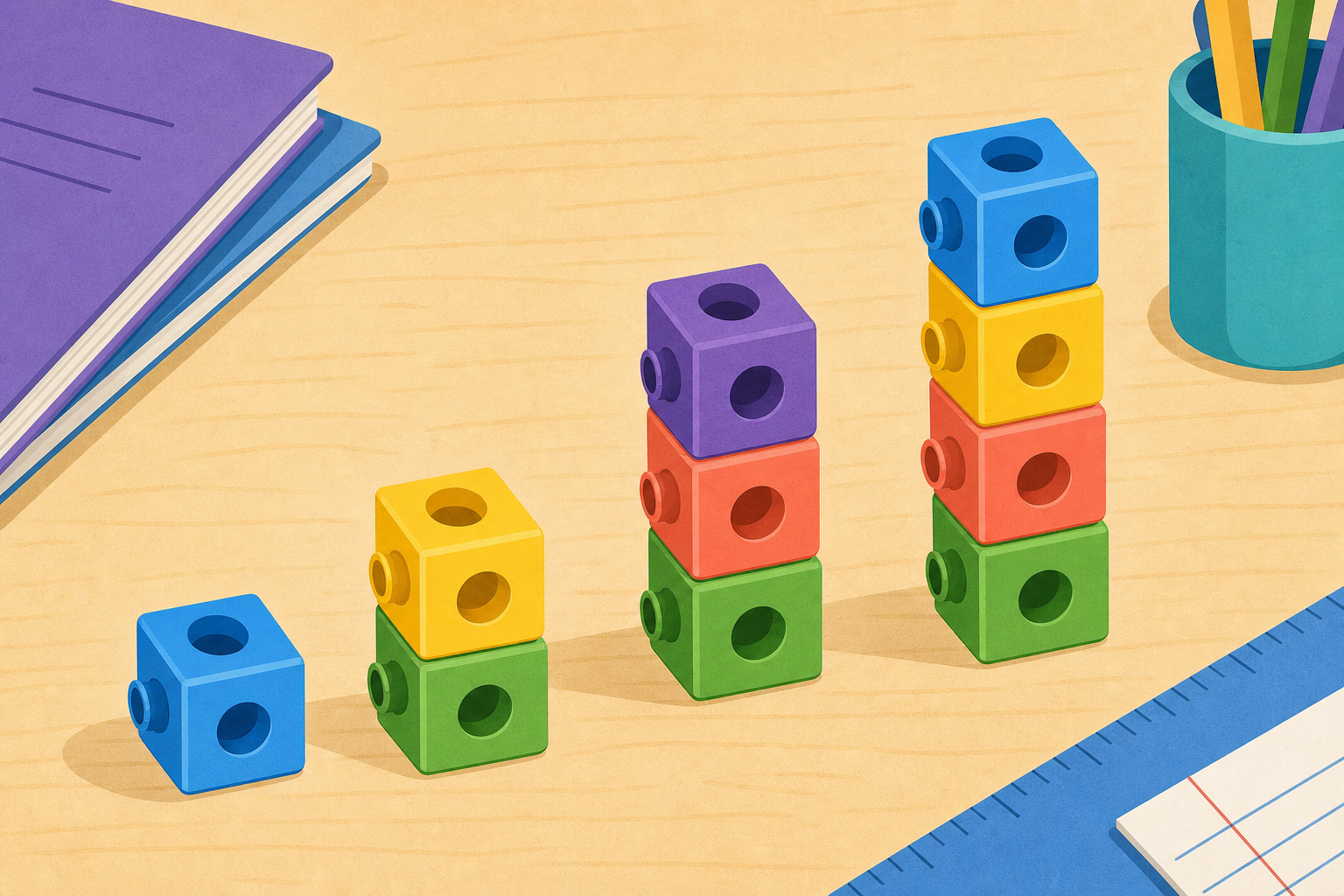
Here is a staircase built from cubes. Look at how many cubes each size needs:

Roughly how many cubes do you think the size-5 staircase needs, before we work it out?
Take three estimates, not open call-outs. Do not confirm or correct any yet — the whole lesson is about testing which guess holds up.
Resist the urge to give the rule now. Let pupils sit with the four cube counts (1, 3, 6, 10) and make a genuine estimate for the fifth.
The staircase grows in a special way. Let's look at the counts side by side and work out what gets added each time.
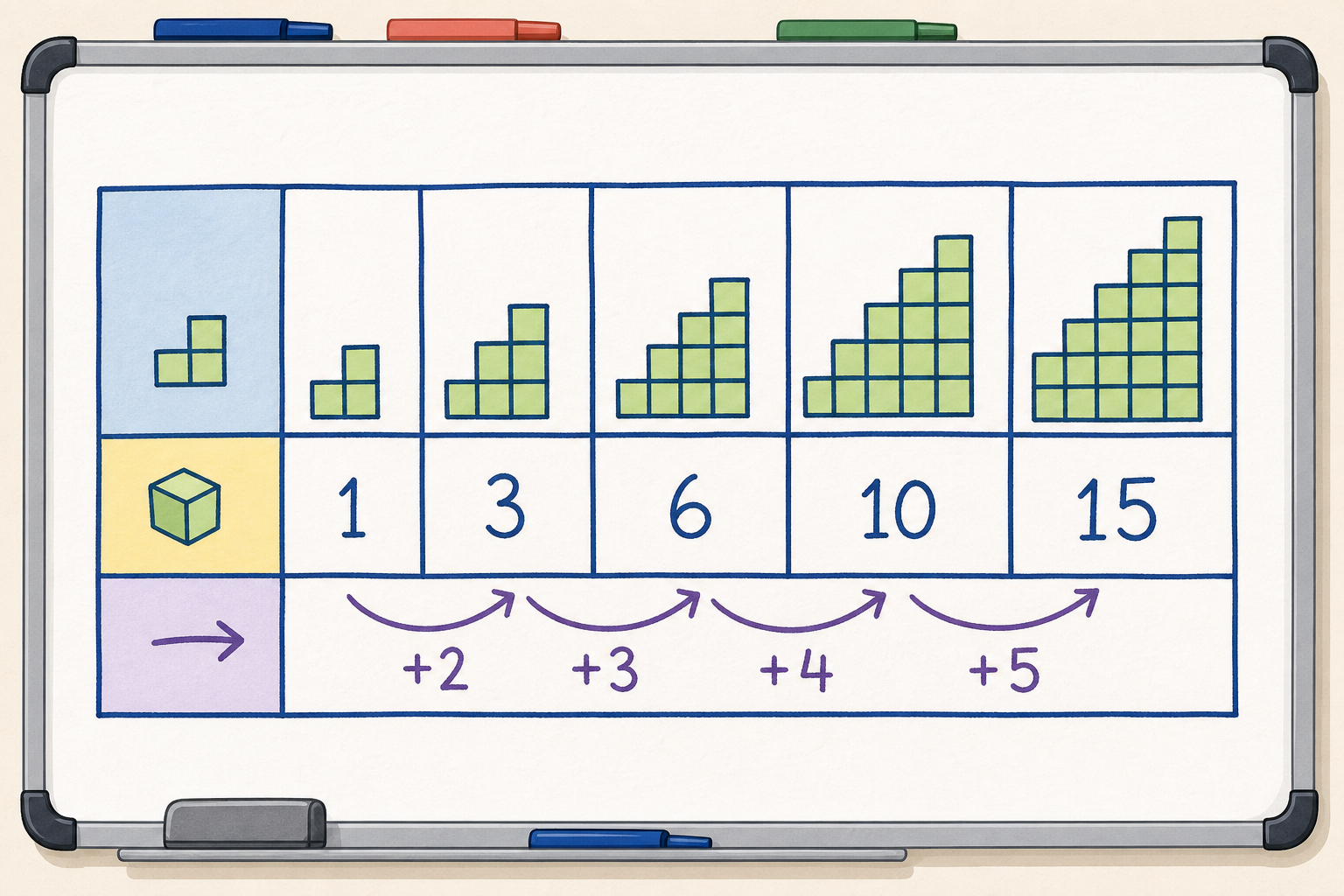
Look at the jumps between the counts. What gets added each time, and how do the jumps change? What do you think we add to a size-4 staircase to reach the next size?
Build this as a running table on the board: write 1, 3, 6, 10 in a row and draw the jumps between them, saying each one aloud — +2, then +3, then +4. Hold out for the growing step, not just "it goes up".
In your maths copy, sketch staircases of size 1, 2, 3 and 4 and write the cube count underneath each one:
Underline the pattern you see in the four counts, then write in words the rule that gives the next staircase.
Walk the room glancing at the counts written under each sketch — this is whole-class copybook practice, not marking. Look for pupils writing a rule that names the growing step ("add the next counting number") rather than just "it gets bigger".
Now we extend the staircase table together on the board. We already have 1, 3, 6, 10 and 15. Predict the count for size 7, then size 8, then size 10, each time, add the next counting number and write the new total in the table before we agree on it.
Check size 7 with your hands: at your desk, build seven columns with cubes from the tub, then count. If your group has no cubes, sketch the seven columns on squared paper and count the squares.
Talk this one through together — pupils take turns coming to the board to add the next row of the running table, and the class agrees or corrects out loud.
Before each new total, ask the class to predict using the rule from the copybook step: size 4 was 10, so size 5 adds +5 → 15; then +6 → 21; +7 → 28. When jumping to size 8, 10 or 12, remind pupils to write out the running steps (+6, +7, +8…) so they track which number to add rather than guessing. Correct totals: size 5 = 15, size 7 = 28, size 8 = 36, size 10 = 55.
To keep the timing, trim the desk check to adding columns onto the existing size-4 build rather than a fresh size-7 build. If a group's count disagrees with the table, that is the maths-talk moment — count the columns together (1+2+3+4+5+6+7 = 28).
First, predict the cube count for a staircase of size 12 using the rule, add the next counting number each time. Write out the running steps from a size you already know so size 12 is easy to reach.
Then we play a target round. We use the staircase numbers 1, 3, 6, 10, 15 and 21 as our starter chips and combine them to hit each target.
This is the practice round — pupils take turns at the board, check each answer, and the class confirms before moving on. Keep the board work brisk rather than over-explaining.
The investigation prediction comes first (paper, in the copy): 10, 15, 36, 55, 78 for sizes 4, 5, 8, 10, 12. Remind pupils to write out the running steps (+5, +6, +7, +8…) so sizes 8, 10 and 12 do not need a mental leap. Then run the target-number bank on the board so pupils flex the same operations with the staircase numbers. The last target is the stretch — expect more than one route.
You're previewing this lesson. Get full access to this lesson and hundreds more — each one ready to teach, with interactive activities, printable resources and pupil progress tracking built in.