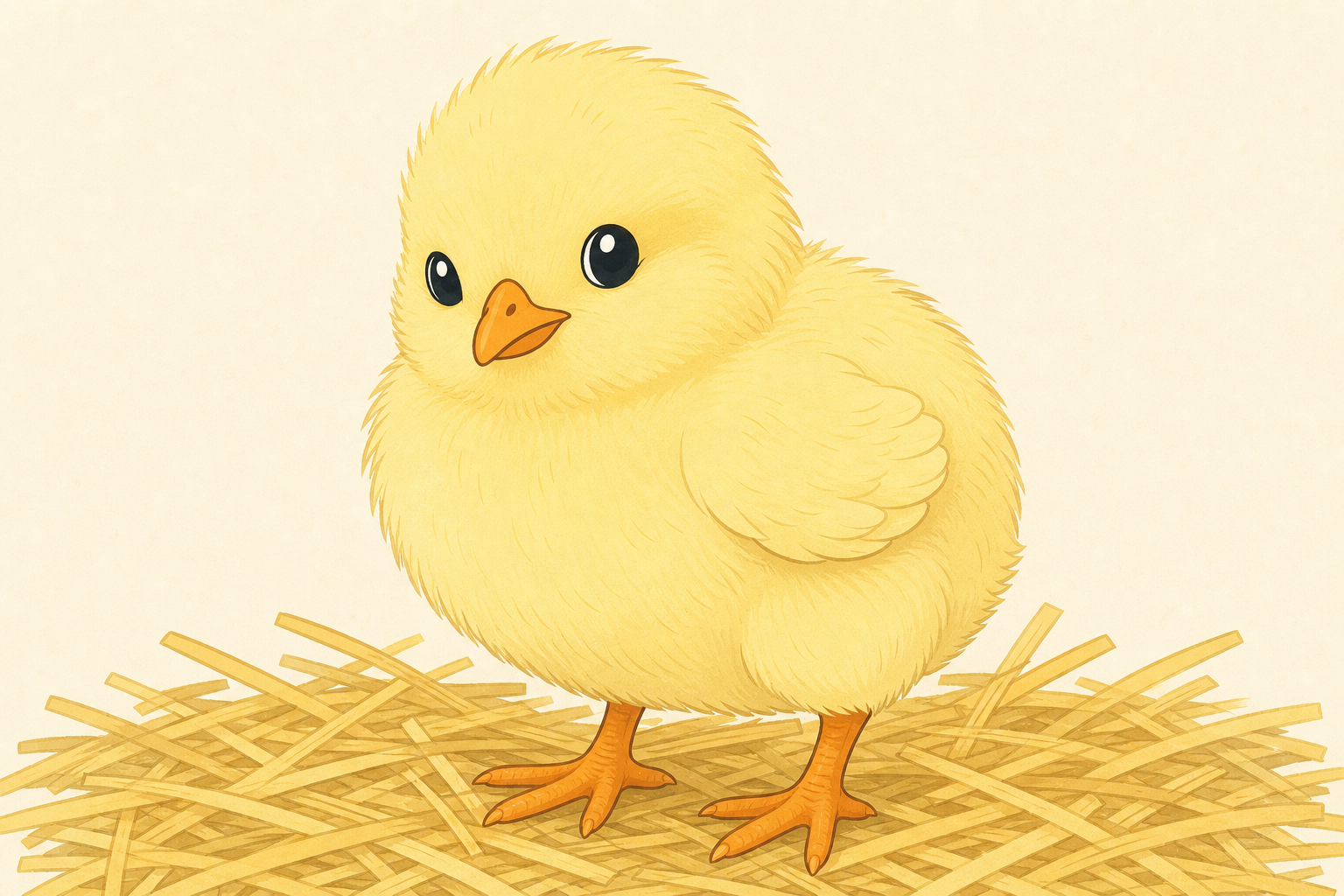
Look at this baby animal. What do you think it will look like when it is all grown up?
Hands up: who has seen a chick, a lamb, or a tadpole before?
Show one clear photo or card of a familiar baby only (chick, lamb or tadpole) with no adult in the frame. Keep the hook light: one question and a quick show of hands. Do not hand out the life-stage sets yet.
Key question: How do you think this baby will change as it gets older?
Link gently to pets and farm animals children already know (a puppy growing into a dog, a kitten into a cat). No death or predation talk.
Do baby animals stay the same forever? No. They grow and change.
How do you think a chick changes as it grows up?
| Concept | Why it matters | Example |
|---|---|---|
| Life cycle — the order of stages an animal goes through as it grows from young to adult, and then new young can start the story again | Putting stages in order helps us see how a baby becomes the adult we know | Frog: egg (frog spawn) → tadpole → froglet → adult frog |
| Grow and change — living animals get bigger and can look different over time | We notice pets and farm animals changing as weeks and months pass | A fluffy chick grows bigger, gets smooth adult feathers, and becomes a hen or a cockerel; a lamb grows a thicker coat |
| Young and adult — young means the baby stage; adult means the grown-up stage | We can tell which card is first and which is last when we order a set | Lamb is young; sheep is adult. Chick is young; hen is adult |
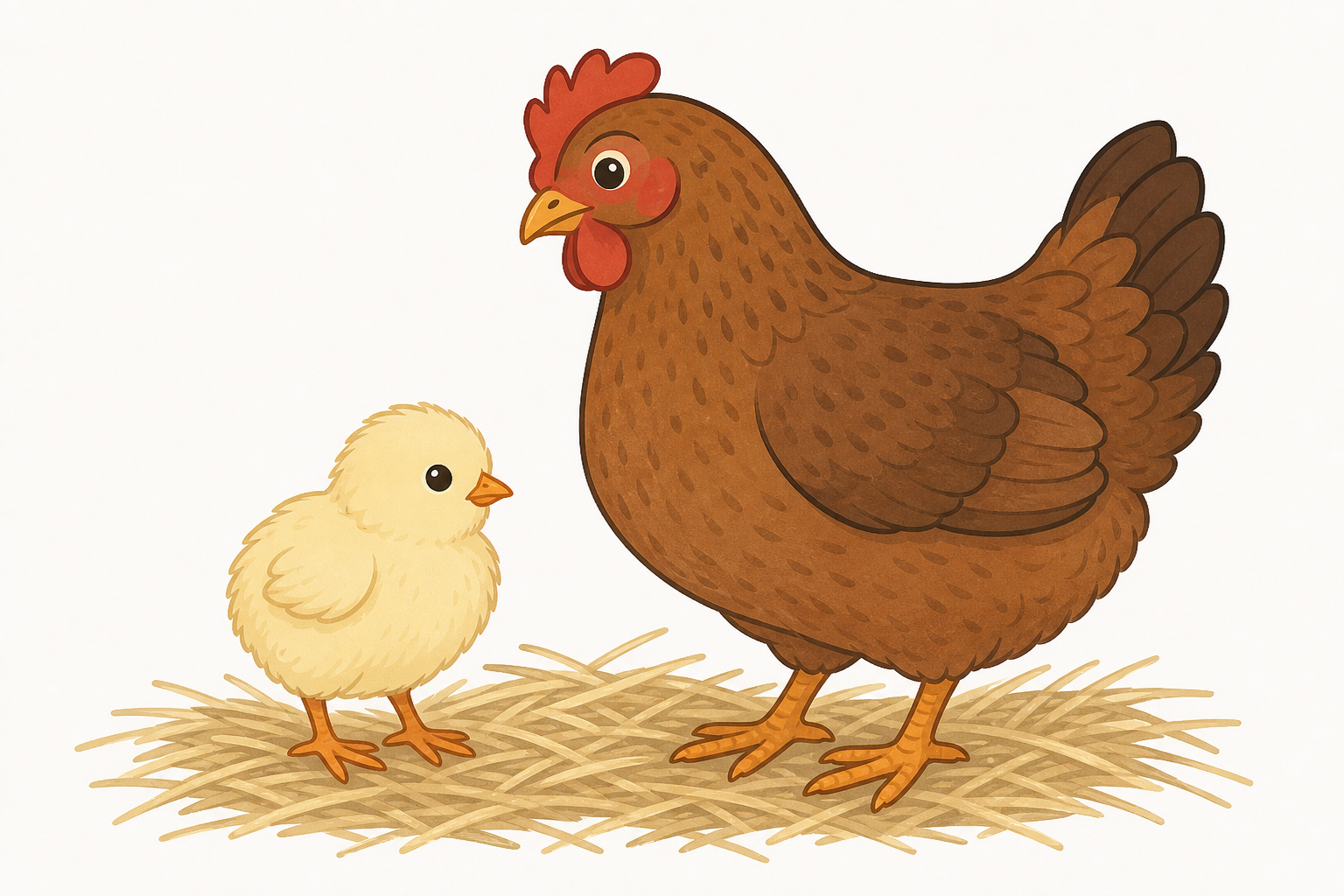
Prep cue: Have the hen card strip in hand for this step (egg, chick, young hen, adult hen). Use it only for spoken modelling, then set it aside before frog groups begin in the next step.
Modelled talk (say aloud while showing hen cards against the pictures): Look at this egg. This fluffy chick is the young. This grown-up hen is the adult. Baby animals grow and change. I wonder how a chick changes as it grows up.
Introduce young and adult aloud against the hen pictures only. Hold the phrase life cycle until groups have ordered cards or the frog cycle is on the board, so the word has something to stick to. Keep the IWB light: grow and change, plus the chick question. Do not put a three-term vocabulary block on the board.
Misconception to head off: children may think the fluffy chick is a different animal from the hen. Same animal, different stage.
Keep language gentle. No talk of animals dying to complete a cycle.
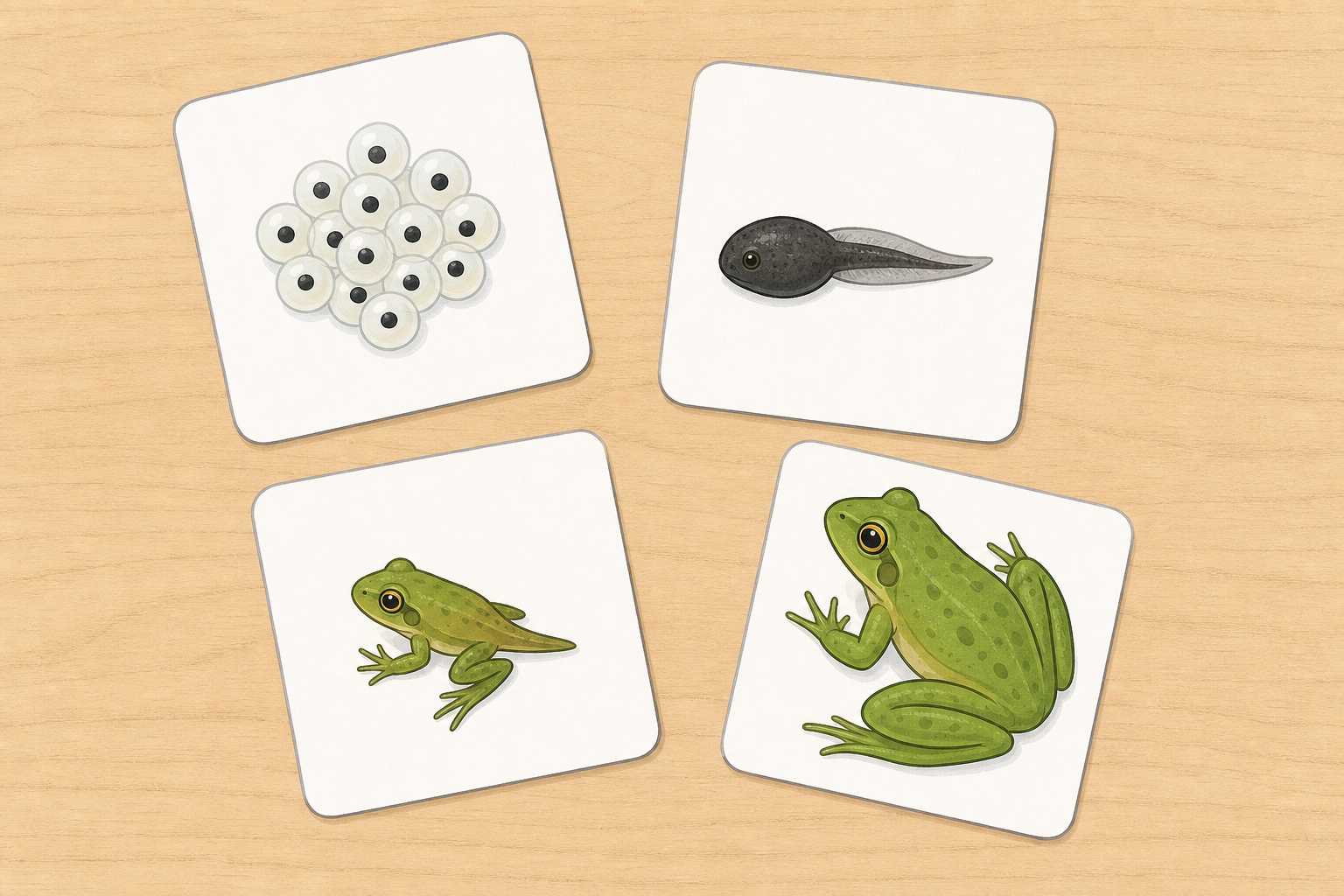
In your group, put the frog picture cards in order from youngest to adult.
Point to the youngest. Point to the adult. Tell your group one thing that changed.
A froglet is a little frog with legs (and often still a small tail).
Print the provided life-stage picture cards (one frog set per group to start). Each frog set has four cards in a mixed pile:
Prep check for card art: before printing, confirm hen and sheep intermediate stages are clearly different (size bar, coat thickness, fluff versus feathers, body proportions), not four near-identical photos. If cards look too similar, use only egg → chick → hen and newborn lamb → adult sheep for support groups. Treat a second mammal set as extension only when the cards are unambiguous.
Give each group a sorting strip or a clear table space marked start → finish. Start every group on the frog set. Circulate and ask: Which card comes first? How can you tell? Read froglet aloud as needed: froglet means a little frog with legs, and it often still has a small tail.
When a group has a clear order, name it lightly: That order of stages is called a life cycle. Do not stop the whole class for a definition; the word sticks once cards are in a line.
Look-fors: cards left to right from young to adult; children using words like egg, baby, bigger, grown-up, young, adult.
Differentiation: stay with the frog set for groups who need a clearer story; challenge confident groups to order the hen or sheep set without help only if those cards show strong stage differences.
Sequence note: this is discovery first. Do not demonstrate the full correct order before groups try. Whole-class consolidation of the frog cycle comes next on the board.
Watch the board. We will put the frog cards in order. This order is called a life cycle.
Where does the story start? Why does the arrow loop back to the start?
Drive the flow-builder interactive on the IWB in explore mode with layout cycle. Four cards appear: frog spawn (egg), tadpole, froglet, adult frog. Invite pupils to call out the order while you drag (or a confident pupil taps with you). This step consolidates what groups discovered with the cards; it is not a first model before they try.
Say the sequence aloud: spawn grows into tadpole, tadpole grows into froglet, froglet grows into adult frog. Leave the loop as a genuine class question first. After children attempt an answer, revoice: A new frog can lay eggs and the cycle can begin again. It is not the same frog turning back into an egg. Keep that misconception guard in your voice, not as a long because/not-because sentence on the board.
If the interactive is unavailable, lay the four frog cards in a circle on the board with arrows drawn between them.
What good looks like: class agrees the order; at least two children can say one change (e.g. the tadpole grows legs); after revoicing, children can say a new egg starts the story again.
First we act the frog growing up. Curl up small like an egg. Wriggle like a tadpole. Hop a little like a froglet. Then a big frog hop.
Now open your Investigation Journal page. Draw the frog stages from the board in a line from young to adult. Two or three pictures is enough. Make one stage look bigger or different so we can see a change.
Clear a small space. Lead the whole class through the frog sequence once, quickly and playfully. Keep it strictly short so drawing time is protected. Invite a small group to lead the words only if time allows, then move straight to drawing.
Board sequence: show the act-out lines first. After the body movements, switch the board to the short draw brief before journals open, so pupils are not holding both instruction sets at once.
Pupils use the Investigation Journal page. Default task: draw the frog sequence still on the board (two or three stages from young to adult) and make one stage look bigger or different to show a change. Four stages is an extension for fast finishers only.
Hen or sheep: only offer that choice if the group actually ordered that set and it is still visible on their table as a reference. Do not let the whole class invent hen or sheep stages from memory when only the frog cycle was consolidated on the board.
Say what to record: the stages in order and one change they notice. Do not invent page layout boxes or column names.
Support: children may copy the order from the frog cards still on display. Scribes can label stages with a word bank: egg, baby, bigger, adult.
STEM eyes: whisper-prompt while they draw: Which pet or farm animal have you seen grow and change?
You're previewing this lesson. Get full access to this lesson and hundreds more — each one ready to teach, with interactive activities, printable resources and pupil progress tracking built in.