1 - Getting Started ~3 mins
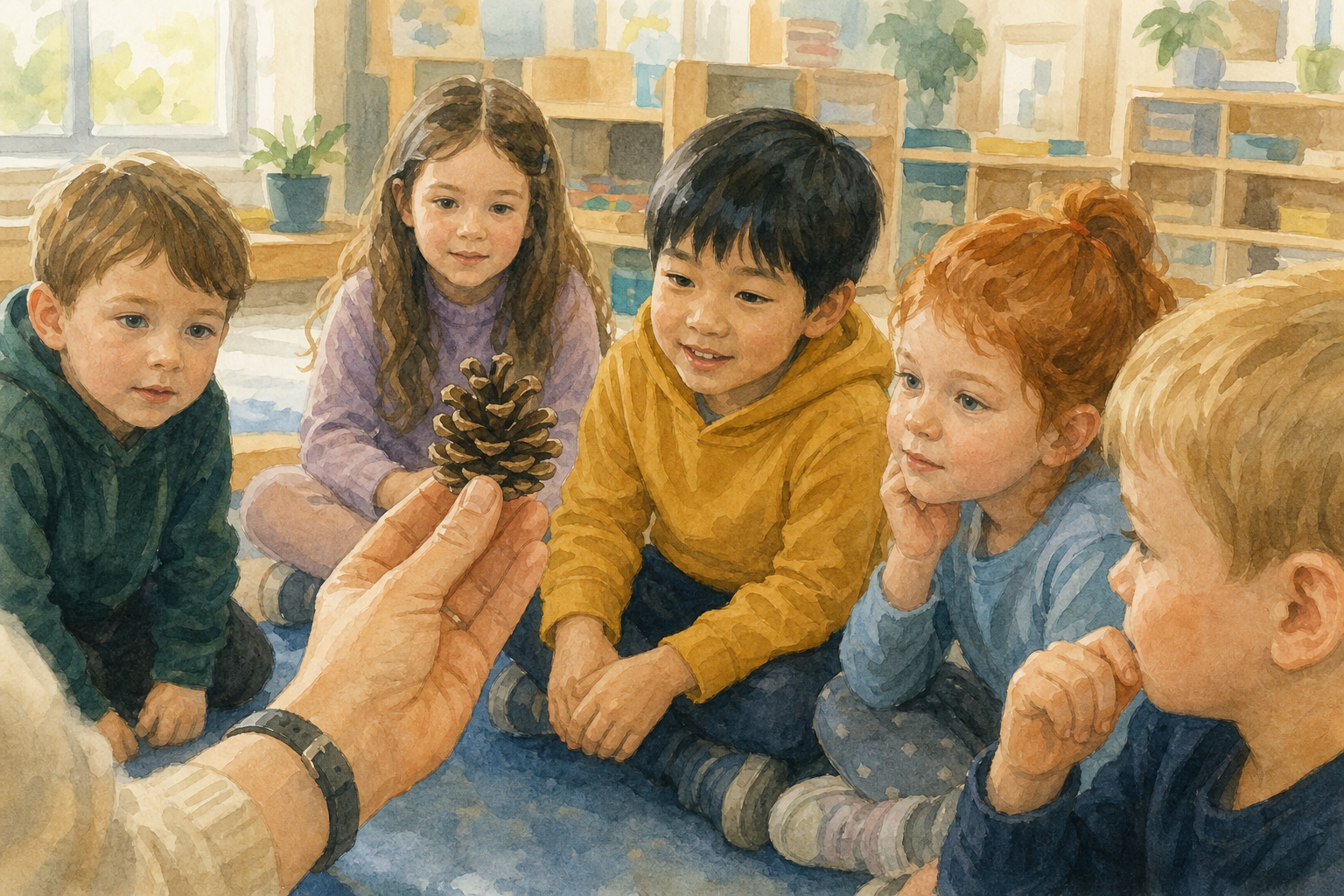 Look at this ordinary thing. What do you see when you really stop and look?
Today we are going to wonder together. Wondering means we stop, look closely, and say what we notice.
Hold up one ordinary classroom object (a leaf from the yard, a shiny spoon, a pine cone, or a pebble). Do not name it yet. Pause and look at it yourself for a moment so the class sees you noticing.
Model once, out loud, in a warm voice: I notice it is smooth. I notice a little brown spot. I wonder how it got there.
Keep the hook light. Do not hand out paper, explain the walk route, or introduce the wonder wall yet. The only job here is curiosity.
Before the lesson: choose a short, safe wonder-walk route. Prefer the classroom and a short loop of the yard or garden path when weather and a second adult allow it. Have a full indoor-only route ready as the equal plan (window sill, nature table, book corner, coat pegs, door mat). Clear a small space on an existing wall or noticeboard and call it the wonder wall when you get there later. Have crayons and one sheet of drawing paper ready per child for after the walk, not before.
2 - What Does Wondering Mean? ~3 mins
Wondering means we stop, look closely, and say what we notice.
We start with the words I notice…
A doctor looks carefully to help us stay well. We can look carefully too.
Keep the board short. Read the two ideas once, then ask the class to practise the sentence stem together: I notice…
| Concept | Why it matters | Example |
|---|---|---|
| Wondering — stopping to look closely, saying what you notice, and being curious about it | Wondering is how we start finding things out about our world | Stopping by a puddle and saying, I notice little circles. I wonder what made them |
| I notice — the words we use when we tell others what our eyes have found | Saying I notice helps our friends see what we saw | I notice a robin on the wall. I notice the leaves are shiny and wet |
Worked model (say this cycle aloud once before the walk):
- I wonder what I will find if I look very carefully by the door.
- I think I might notice something tiny I walk past every day.
- I look (pause, point slowly at a real detail in the room).
- I notice the coat hooks are shiny and the coats are all different colours.
- I wonder who hung the red coat there first.
- I think wondering helps me see more than when I rush.
Who helps us (one concrete line only): name the doctor example from the board, or swap for one real helper the class knows, for example a gardener who notices when a plant needs water. Keep it to one sentence. Do not open a long who-else brainstorm on the carpet.
Misconception to head off gently: children may think wondering means knowing the answer. Praise any honest notice. Guesses and notices are never wrong at this age; they are the start of the fun.
3 - Our Wonder Walk ~12 mins
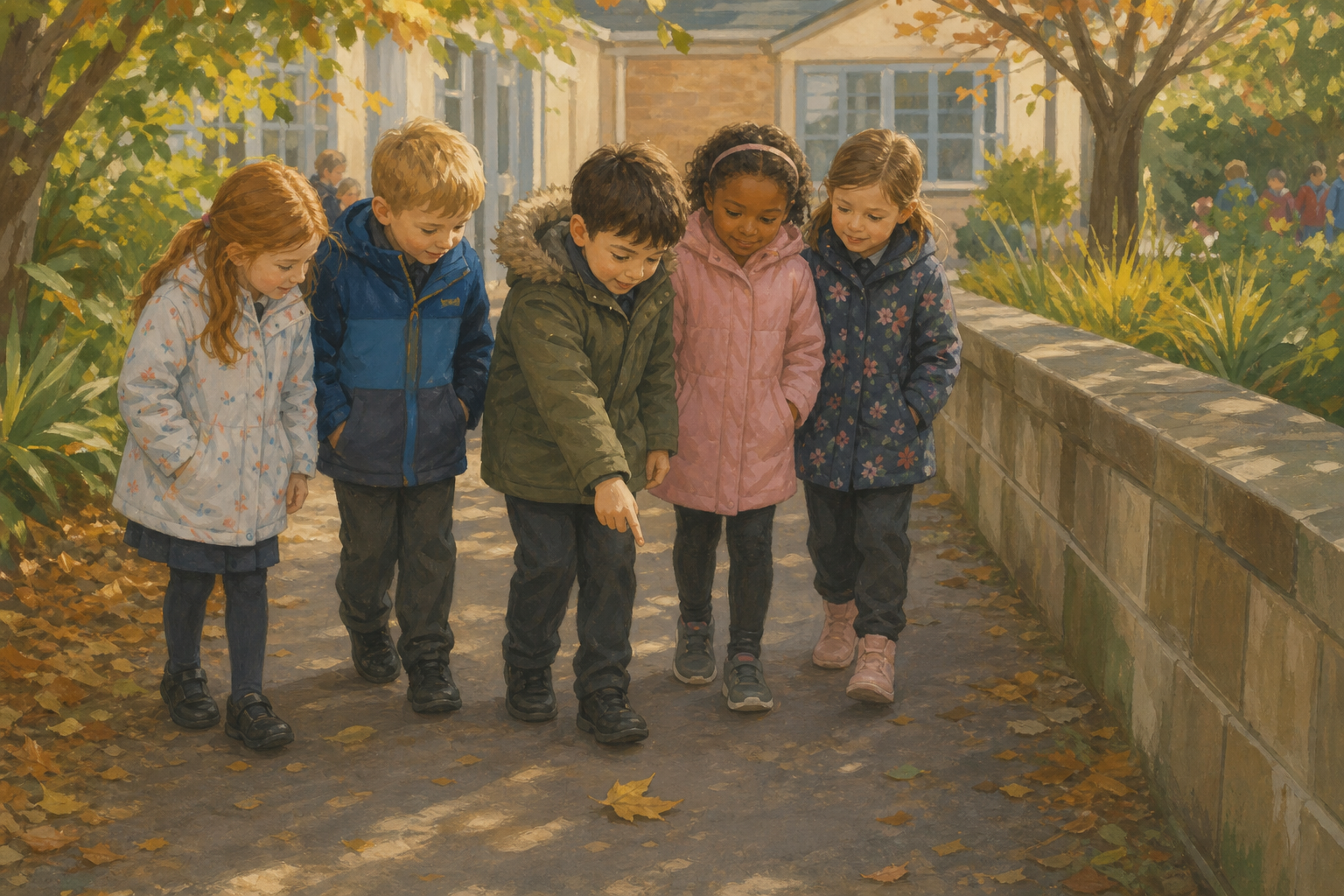 We are going on a wonder walk. We will walk slowly and stop to look.
When we stop, look with your eyes. Point to one thing. Say I notice… and tell us what you see.
Choose your route (full equivalents)
Outdoor option (classroom then short yard or garden path): only when weather is safe and a second adult can cover the outdoor stretch with you. Stay with the class at all times outdoors.
Indoor-only option (equal plan, no second adult needed): stay inside and stop at three or four classroom spots (window sill, nature table or book corner, coat pegs, door mat or sink area). Same noticing job. Use this route for rain, ice, staffing, or when the yard is not free. The lesson still hits every objective.
Before you leave the carpet
Line up calmly. Remind the class: we stay together, we walk slowly, we use pointing fingers not hands that grab, and we do not pick or taste anything.
How to run the walk (about 12 minutes in short bursts)
- Burst 1 (~4 min): stop at two places. At each stop, invite two or three children to point and say I notice… Revoice their words so the whole class hears a clear notice.
- Burst 2 (~5 min): stop at two more places (yard spots if outdoors; coat pegs and door mat if indoors). Same pattern: look, point, say I notice.
- Burst 3 (return and regroup, ~3 min): back on the carpet, ask three children to share one thing they noticed.
Do not try for a long circuit. Two or three rich stops beat a rushed loop. If coats or doors eat time, drop one stop and keep the oral noticing strong.
Key questions: What colour do you notice? What shape? Is it rough or smooth? What is moving? What is still?
Differentiation: some children may only point. Accept the point and supply the stem for them: You are pointing at the wet leaf. You notice the shiny leaf. Confident talkers can add one more detail.
Safety: stay with the class at all times outdoors; clear boundaries; no picking plants or tasting; watch for slippy ground after Irish rain. Wash hands on return if children touched soil, walls or plants.
4 - Draw What You Noticed ~5 mins
Think of one thing you noticed on our walk. Draw that one thing on your paper.
Use your crayons. Make your picture big so your friends can see it.
Hand out one sheet of drawing paper and crayons now (not before the walk). Children draw one thing they noticed. There is no Investigation Journal page for this lesson; the drawing on plain paper is the record, and it will be pinned to the class wonder wall in the next step.
Support: circulate and ask each child, What did you notice? Scribe a short label under the drawing only if the child wants one and you have time (for example: wet leaf, robin, shiny handle). Do not insist on writing from the child.
If a child says they noticed nothing: offer two real choices from the walk you shared: Was it the puddle or the tree bark? Indoors: Was it the window sill or the coat pegs?
Timing: keep this to about five minutes. A simple, bold drawing is enough. Fast drawers can add one more detail to the same picture rather than starting a second sheet.
Observation focus: listen for the stem I notice… as children talk about their drawing. Gently revoice if they only name the object: You noticed the yellow flower by the wall.
5 - Our Wonder Wall ~5 mins
Come to the carpet with your picture. This clear space is our wonder wall.
We will share what we noticed and pin our pictures up. Listen to your friends. What did they notice that you did not see?
The wonder wall is simply a clear space on the existing classroom wall or noticeboard. Children do not need a special sheet prepared in advance. You (or a helper) blu-tack each drawing up as children share. Name the space out loud now so children can see it: This is our wonder wall.
Sharing pattern (teacher-paced, keep it short): invite four to six children only to hold up their picture and say one sentence with the stem I notice… or I noticed…. Pin as you go. The rest of the class look and listen. Fold watchers in with one quick question: Did anyone else notice something like that? Do not try to hear every child live; pin remaining pictures quietly while the group watches, or after the close line.
Make-sense talk to close (one line): revoice two notices and land the big idea: Today we stopped and wondered. Scientists are people who stop and wonder, just like us.
Who helps us thread: one gentle line only, for example: A doctor looks carefully to help us stay well. We looked carefully too.
Display-only and oral. No typing. No extra worksheet. If time is tight, pin first, hear three voices, then the scientists line.
6 - Time to Tidy ~2 mins
We wondered, we noticed, and we drew. Look at our wonder wall. It shows the things our class noticed today.
Crayons away, hands ready. Well done, wonderers.
Quick pack-away: crayons into pots, spare paper stacked, coats hung if used outdoors. Leave the wonder-wall pictures up so children can revisit them later in the week.
Success look-fors for this lesson:
- Child stopped and looked (even briefly) on the walk
- Child pointed to or named one thing they noticed
- Child made a drawing of one noticed thing
- Child heard or used the stem I notice…
Optional tiny home noticing (oral only, not homework online): ask families at the door, if you wish: Tonight, notice one thing on your way home and tell someone I notice…
Unlock the full learning experience
You're previewing this lesson. Get full access to this lesson and hundreds more — each one ready to teach, with interactive activities, printable resources and pupil progress tracking built in.
This lesson is copyright of Coding Ireland 2017 - 2025. Unauthorised use, copying or distribution is not allowed.