Look at these three: 3/8, 0.375 and 37.5%. Are they the same amount, or three different ones? And if they are the same, which one did you recognise fastest? Hands up when you have decided.
Take three hands-up answers, not open call-outs. Give five seconds of quiet think-time first. Do not confirm yet — let the disagreement sit; the model step settles it.
Listen for the pupil who spots that 37.5% is the trickiest to read at a glance because of the half-percent — flag that this lesson is about reading all three at speed.
Watch the first battery. Three eighths of the way up, and the same amount reads as 0.375 and 37.5%. To get the decimal, we divide three by eight, which gives 0.375. To get the percentage, we use the fact that percent means 'out of 100': we multiply the decimal by 100. So 0.375 × 100 = 37.5, and we add a per-cent sign to get 37.5%. Multiplying by 100 slides the digits two places, which is why the decimal point ends up two places to the right. Notice this is our first amount that runs to a third digit after the point, the thousandths place.
Here is a tidier one. Two fifths fills the battery to 0.4 and 40%. Again, 0.4 × 100 = 40, so 0.4 = 40%. This one stops cleanly after one decimal place, much friendlier than three eighths. Before the next battery, predict: will seven eighths give us a tidy decimal or a long one?
Seven divided by eight gives 0.875, and 0.875 × 100 = 87.5, so 7/8 = 0.875 = 87.5%. Notice it is the mirror of three eighths, sitting high up the battery instead of low, but with the same half-percent tail.
Now the surprise. One third divided out is 0.333, but the threes never stop. A decimal whose digits repeat forever like this is called a recurring decimal. As a percentage it is 33.3…% , the threes running on forever there too.
Here is how we write it, not just read it. Worked example on the board with 1/3:
Both writings mean the same amount. This is the one that does not fit neatly, and that is exactly why it is worth knowing how to write it.
Walk each battery aloud, one at a time. Point at each of the four labels as you say it, the percentage, the fraction, the decimal, the words.
Worked write-up (LO4), board, one example only:
Slip to watch: pupils putting the dot above every digit, or writing 0.3̇3̇3̇, or treating 0.33 as exact. Cue: one dot above the digit that repeats, or write a few threes and and so on.
Today we work through these fifths and quarters together, one after another: 1/5, then 2/5, then 3/5, and finally 3/4. Each time, one of us sets the battery to the fraction and the rest of the class reads off the decimal and the percentage before we check. The jump from fifths to that last quarter is where it gets interesting, so watch for it.
This round is for talking it through together — pupils take turns at the board and the class agrees or corrects out loud.
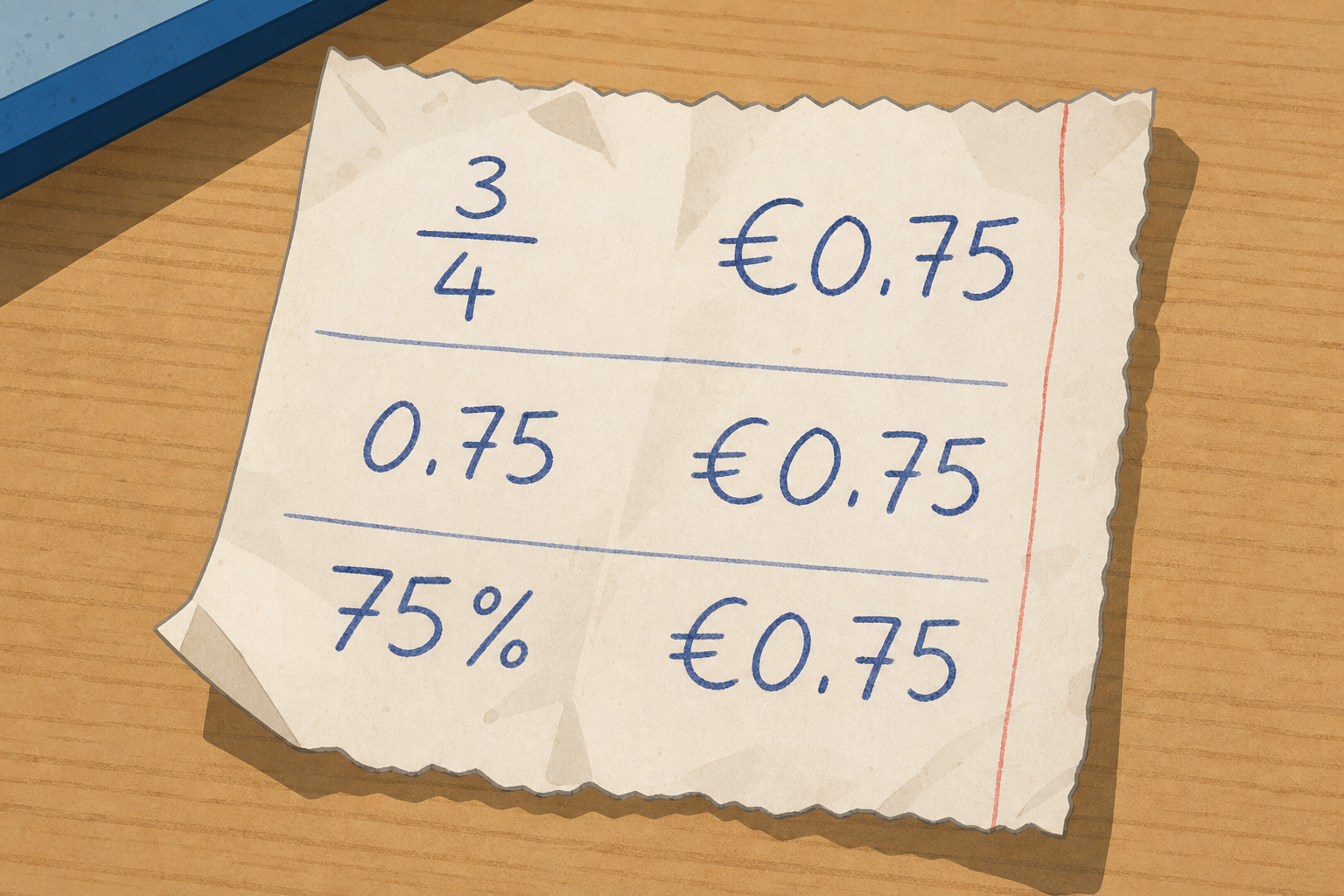
Work them in order: 1/5 (0.2, 20%), 2/5 (0.4, 40%), 3/5 (0.6, 60%), 3/4 (0.75, 75%).
Pacing lever for the watching class: before each pupil sets the battery, ask the whole class to predict the decimal and the percentage with hands up, then let the pupil set it and the class checks. After each round, revoice one pupil's reasoning aloud (so you knew two fifths is 0.4 because you doubled 0.2). This keeps the ~25 pupils not at the board thinking through all four conversions.
The pause is 3/4: it breaks the fifths pattern and lands between 3/5 and a whole. Ask why doesn't three quarters fit the twenty-percent steps? before checking.
In your maths copy, draw a three-column table headed Fraction, Decimal and Percentage. Each row gives you one form and you fill in the missing two. Underline the simplest fraction on each completed row.
Walk the room glancing at the rows — this is whole-class copybook practice, not marking. Watch for pupils who write 0.6 for 60% but forget to simplify it back to a fraction. No individual correcting; note common slips for the wrap.
Today's challenge builds up: match the battery to 25%, then 0.8, then 3/8, and finally the recurring stretch 1/3.
Each target is given in a different form, so first work out where the battery needs to sit, then set it and check. The battery reads to the nearest whole percent, so round when the exact value does not land on a whole percent. Predict the level before each pupil sets it.
These are the practice questions — pupils take turns at the board, check each answer, and the class confirms before moving on. Keep the board work brisk rather than over-explaining.
Each target is stated in a different form on purpose — the work is the conversion into a battery level, not the setting. Have the class say the other two forms aloud before the pupil presses Check.
The recurring 1/3 stretch is the key one. Be explicit with the class: the battery can only get close to a recurring value — a green Check on 33% does not mean 1/3 equals 33% exactly. Say we settled for the nearest whole percent because the threes never end, and use it to revisit why this one never lands neatly.
You're previewing this lesson. Get full access to this lesson and hundreds more — each one ready to teach, with interactive activities, printable resources and pupil progress tracking built in.