1 - Getting Started ~5 mins
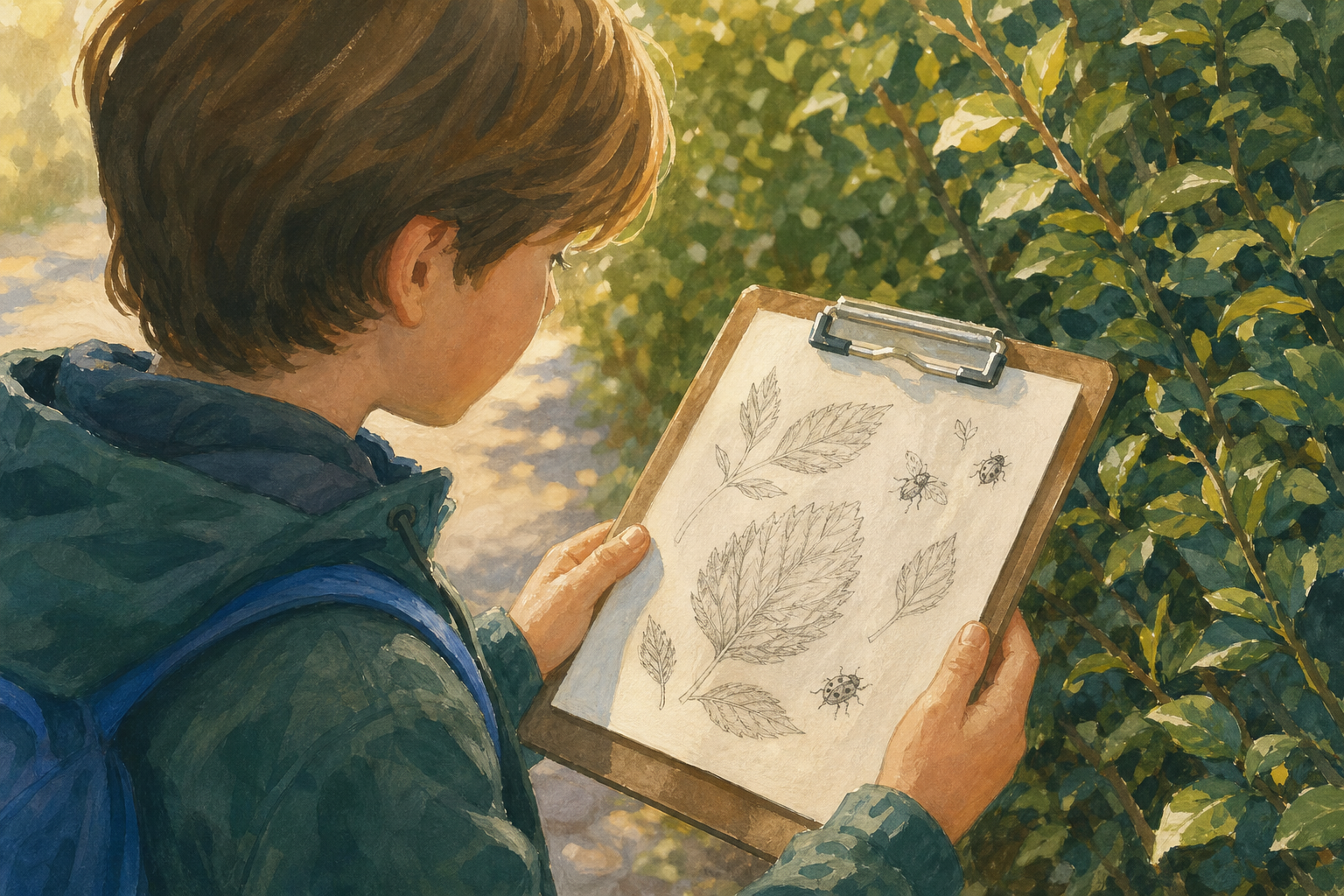 Open your survey notes from earlier in this project. Name one living thing you found and one thing it seemed to need or eat. Today we join those finds into food chains and a web.
Have each group's survey notes ready from Part 1 of this project (Investigation Journal pages or clipboards). A quick round: two or three groups name one find and what it seemed to eat or need. Keep this light; do not build chains yet.
Key question: If the aphids vanished from our patch, who else might feel it?
Before the lesson: print the provided species cards and arrow cards (one set per group); cut them apart; open the flow-builder interactive on the IWB for Step 4 only. Keep a small teacher set of cards ready for the desk model in Step 3. String is optional and teacher-only for a rare extra join.
2 - Energy on the Move ~6 mins
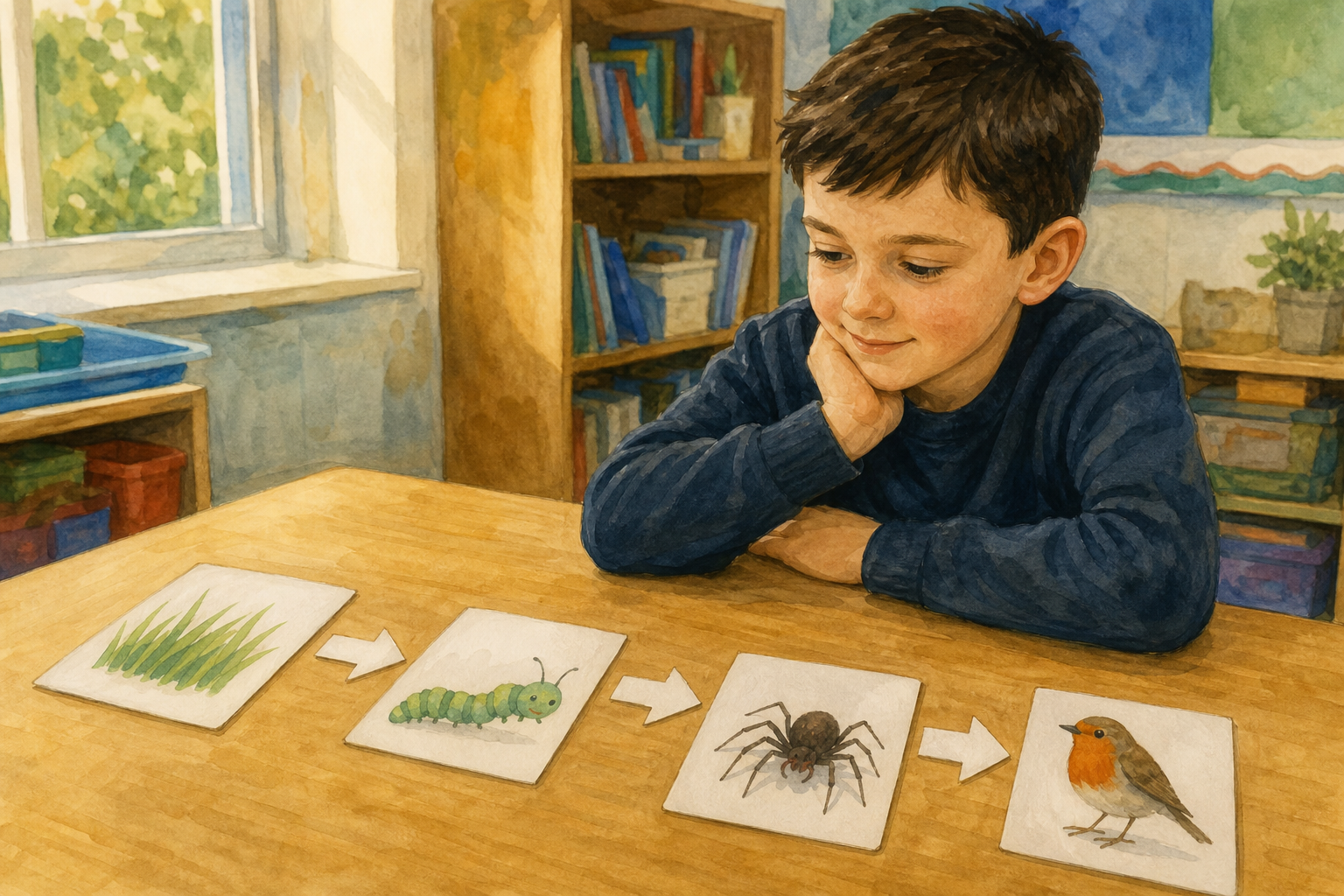 That line of who-eats-whom is how energy from the sun travels across our school hedge.
Grass is eaten by a caterpillar, the caterpillar by a spider, the spider by a robin. That line is a food chain.
A plant that makes its own food from sunlight is called a producer. Every chain starts there. The arrow shows energy moving from the food to the eater (the energy began as sunlight trapped by the plant).
Keep this short and concrete. Name food chain and producer only on the board now. Keep web and interdependence in everyday language until groups have joined their own chains (food web) and felt a remove-a-link knock-on (interdependence).
| Concept | Why it matters | Example |
|---|---|---|
| Food chain — a line that shows who eats whom, starting with a plant that makes its own food | It shows how energy from the sun, trapped by plants, moves to animals we see in the school grounds | Grass → caterpillar → spider → robin (energy moves along each arrow to the eater) |
| Producer — a plant that makes its own food using sunlight | Every school-grounds chain starts with a producer | Grass, daisy, nettle, oak |
| Food web — several food chains joined because many living things eat more than one kind of food (attach the formal name once groups can point at their own joined chains) | Real habitats are webs, not single lines, so a change to one species can ripple out | A thrush may eat both snails and earthworms, linking two chains |
| Interdependence — living things depending on one another for food, shelter or other needs (say first: living things need each other; name the formal word after remove-a-link) | Protecting one species often protects others that rely on it | Fewer flowering plants can mean fewer bees, then fewer fruits for birds |
Misconception to head off: children often draw the arrow pointing at the food ("the robin points to the worm"). Model the arrow as energy moving to the eater: plant first, then what eats it.
Oak aside (if it comes up): the oak is the producer; the leaf is the part a caterpillar eats.
Nature of STEM: ecologists map chains and webs before deciding how to protect a habitat; the same idea helps when Irish hedgerows and pollinators are under pressure.
3 - A Finished Chain on the Desk ~5 mins
Look at the finished food chain on the desk at the front. Read it left to right. The plant at the start is a producer. Where does the energy start? Where does each arrow point?
Now watch one more short chain join on. When two chains share a living thing, they join up. That joined picture is what you will build next from your own survey.
Run this step as a fully physical desk model with printed species cards and arrow cards on a front table. Do not open the flow-builder yet — that interactive is for Step 4 so the class still has a chain to work out on the IWB.
Chain 1 (energy and arrows): lay out grass → caterpillar → spider → robin with arrow cards labelled eaten by.
Ask: Which living thing makes its own food? Who eats the grass? Who eats the spider? Stress that the arrow shows energy moving to the eater, and that the energy began as sunlight in the plant.
Chain 2 (shared-card web preview, about one minute): lay a second short chain that reuses one animal already on the desk so both chains touch a single shared card. Use a defensible living-plant link, for example daisy → caterpillar → robin, with the robin card sitting once so both chains meet there (caterpillar may also be shared if you place it once). Say in plain words only: When two chains share a living thing, they join up. Scientists call that joined picture a food web — you will make one with your survey cards next.
Alternative shared-card pair: nettle → aphid → ladybird and daisy → aphid → spider, with one aphid card touching both chains.
Do not use grass → earthworm as the board model (earthworms mainly feed on dead plant material, not living grass). Do not name interdependence yet; hold that formal word until groups have felt a remove-a-link knock-on.
Do not ask pupils to drag digital cards yet; that comes next.
4 - Build the Chain Together ~4 mins
Help put the cards in order on the board. Call out which card must come first and which way each arrow points. Quick check only: plant first, arrows to the eater. Then name one other school-grounds plant that could start a different chain.
Build the food chain
Now open the flow-builder in explore mode. The four cards appear unset: grass, caterpillar, spider, robin. Keep this to a short check, not a full rebuild of the desk demo. Pupils call out plant-first order and arrow direction; you drag the cards on the IWB.
Fold the class in: Are they right? What would go wrong if we started with the robin? Then ask one or two pupils to name a different starter plant from the school grounds (daisy, nettle, oak) so attention turns toward their own survey cards next.
Worked model (say aloud before groups work): I wonder which chain lives in a grassy hedge. I predict grass is eaten by caterpillars, caterpillars by spiders, spiders by a robin. I test by lining the cards with arrows toward each eater. I observed the plant had to come first or the chain made no sense. I think energy starts as sunlight in the plant and moves along each arrow.
5 - Chains and a Web from Our Survey ~18 mins
Use your survey notes and the cards. We will take one job at a time — only do the job showing on the board right now.
Evidence rule: Only species from your survey notes. If you did not see the eating, write likely beside that arrow on your journal page.
When I call freeze, stop and leave your cards where they are.
Before groups start
Give each group: their survey notes, one set of species cards, arrow cards, and their Investigation Journal. Do not hand out string as standard kit. Hold string back as a teacher-only prop for a rare extra join you model if needed.
Whole-class shared-card model (about one minute, before groups start or at the first freeze): on a desk at the front, show two short chains meeting at one shared card (e.g. grass → caterpillar → spider → robin and daisy → caterpillar → robin, with robin placed once so both chains touch it). Say: One animal, one card, both chains meet there. That joined picture is a food web. String is only a rare extra join you will show if a group needs a second cross-link; do not lead with string.
Evidence rule (say aloud; keep as one short IWB line)
Only species from your survey notes. If you did not see the eating, write likely beside that arrow on your journal page. Do not invent species that were never found.
How the shared-card web works
Prefer one shared card for a species that sits in both chains (place it once so both chains touch that card). Only use string if you, the teacher, show a rare extra join. Keep the rule simple: one animal, one card, both chains meet there.
IWB progressive reveal (required — one job on screen at a time)
Do not project the full job list. Reveal each line below only when that beat starts:
- Job 1: Underline the plants (producers) on your survey notes.
- Job 2: Build chain 1 — plant first, then what eats it, arrows pointing to each eater (3–4 links if evidence allows).
- Freeze (about 7 minutes in): One group holds up chain 1; class checks plant-first order and arrow direction. Re-show the shared-card model if needed.
- Job 3: Build chain 2 from different survey finds.
- Job 4: If the same living thing is in both chains, use one card for it and let both chains touch that card. Attach the formal name: That joined picture is a food web.
- Stop-build freeze: Leave the card layout in place ready to draw and for remove-a-link. Every group should have at least one stable plant-first chain still laid out.
Printable species cards (cut apart; one set per group)
grass · daisy · nettle · oak · dandelion · moss · aphid · caterpillar · snail · slug · earthworm · woodlouse · beetle · ladybird · spider · ant · bee · robin · blackbird · thrush · wren · (blank) · (blank)
Oak aside: the oak is the producer; leaves are the part some animals eat. Caption on the card may still show oak leaves.
Arrow cards
Print 8–10 small cards per group each showing a simple arrow and the words eaten by.
Look-fors
- Every chain starts with a plant.
- Arrows point toward eaters (energy flow).
- Species come from the survey; feeding links can be explained (mark likely on the journal when inferred).
- A shared species shows web thinking (one card touching both chains).
- Earthworm, woodlouse or slug links are fine if framed as feeding on dead leaves or plant bits from the patch; mark living-leaf → earthworm as likely/simplified if used.
Differentiation: support groups with a two-link chain first (plant → eater). Stretch: a four-link chain or two cross-links in the web. Floor for thin surveys: one full survey chain plus one justified "likely" school-grounds link marked on the journal page.
If the survey was thin: allow one plausible school-grounds link the group can explain ("we saw thrushes on the grass; thrushes often eat earthworms"), and mark it as "likely" on the journal page.
Unlock the full learning experience
You're previewing this lesson. Get full access to this lesson and hundreds more — each one ready to teach, with interactive activities, printable resources and pupil progress tracking built in.
This lesson is copyright of Coding Ireland 2017 - 2025. Unauthorised use, copying or distribution is not allowed.