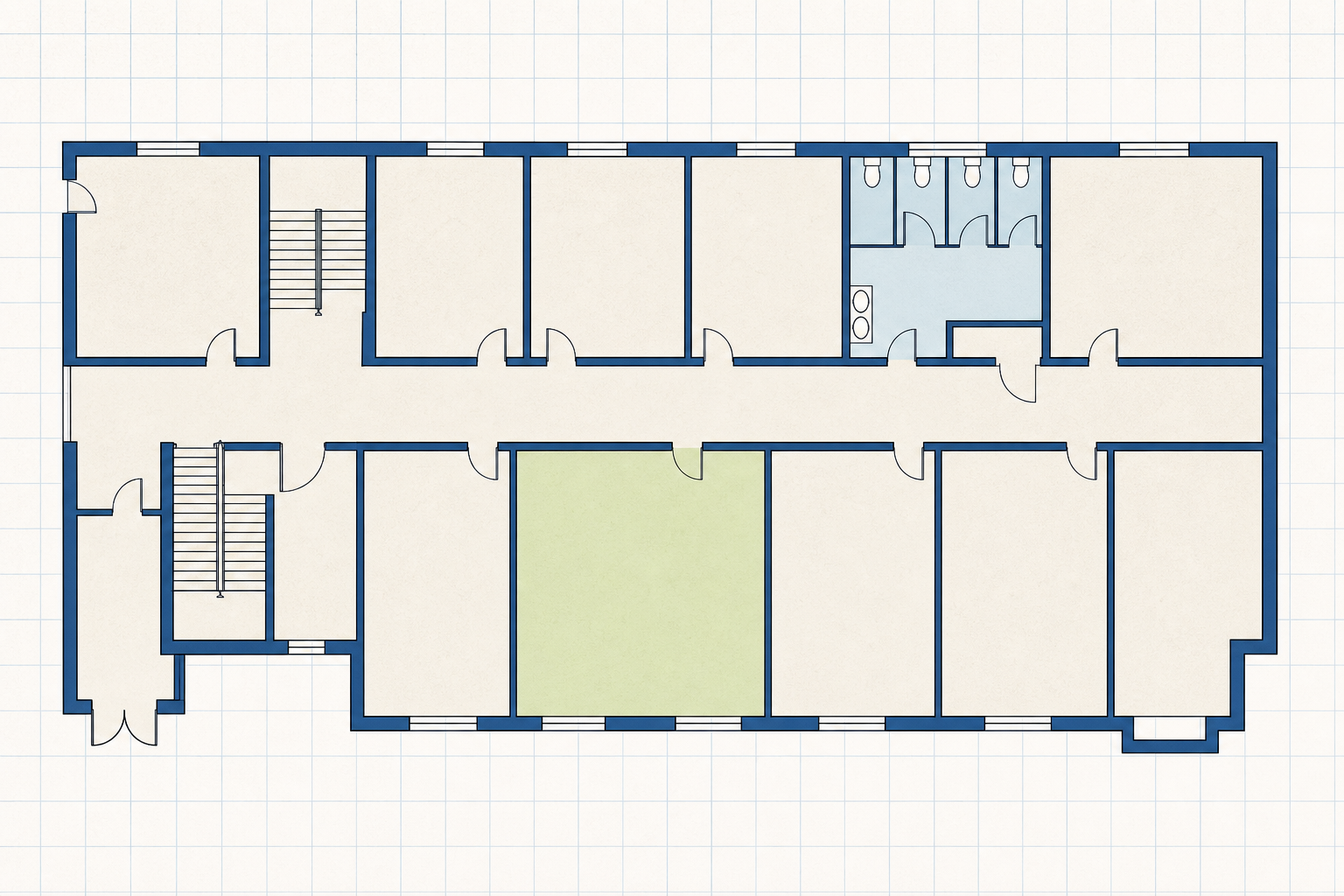
Here is a plan of our school with a grid drawn over it. One room is shaded to stand out.
How would you tell someone exactly which square the shaded room is in, if all they had was this plan and could not point at it?
Take two or three hands-up answers, not open call-outs. Listen for anyone who reaches for two numbers or an 'across then up' idea; that is exactly where we are going. Do not correct or name co-ordinates yet, just gather the guesses.
Every point on the grid has a name made of two numbers in brackets, like (x, y): the first tells you how far across, the second how far up, always starting from the corner at (0, 0). We will look at three points on the interactive. Look hard at the two points that use the same numbers in a different order, and later at the two points sitting on the axes.
Origin is (0, 0); trace right-then-up with a finger for each point, do not let them read the label before you count.
Grid 1 points: A (3, 4), B (1, 6), C (6, 1). Hold on B and C — same numbers, very different spots. Ask what changed. Keep repeating: first across, then up.
Grid 2 points: D (5, 0) sits on the bottom line, 0 up; E (0, 5) sits on the side line, 0 across. Draw out the swapped first/second numbers with a question, don't announce it.
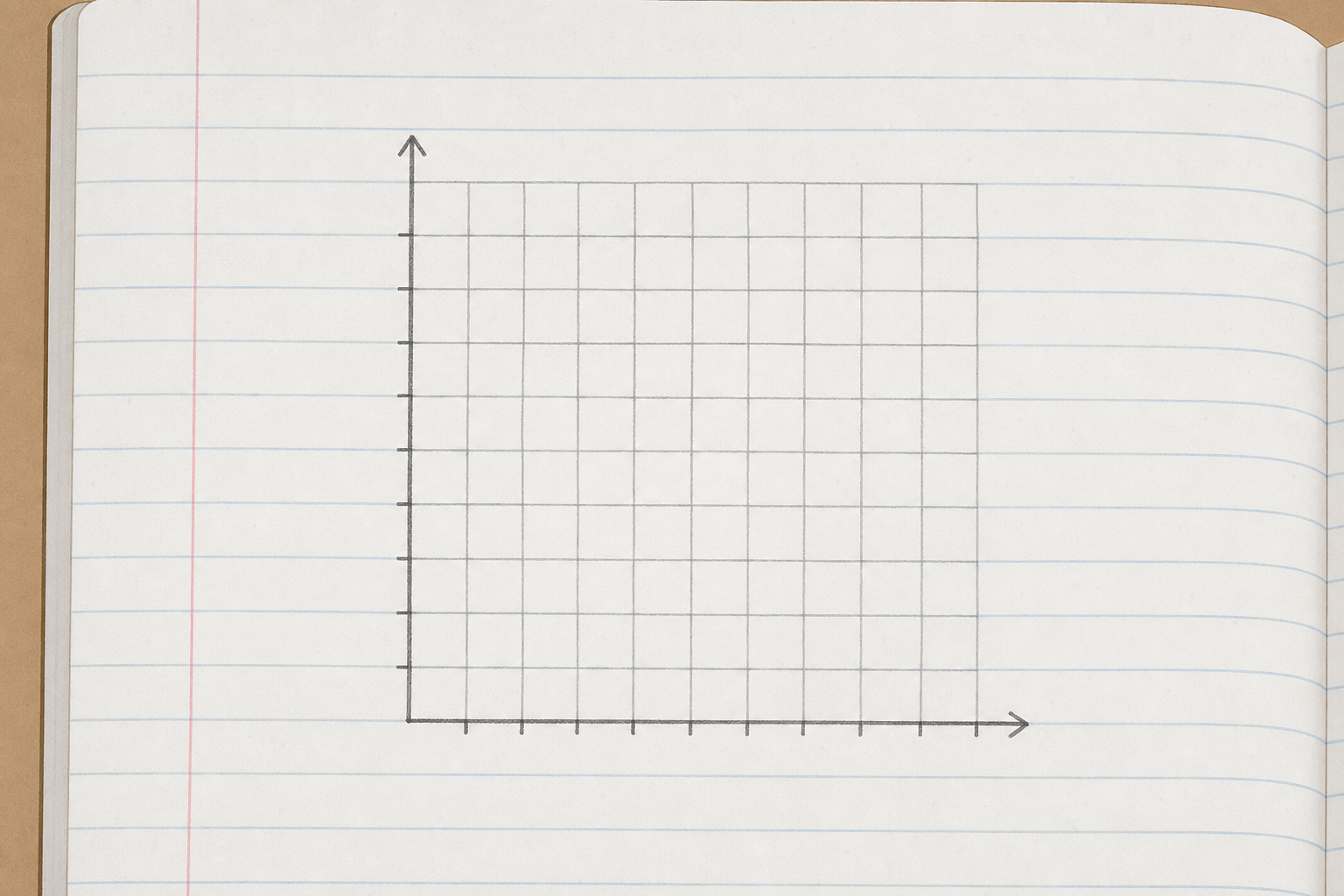
In your maths copy, sketch a first-quadrant grid with the numbers 0 to 6 along the line across the bottom and 0 to 6 up the side.
Then plot each of these points and label each one with its co-ordinate pair beside the dot:
Walk the room glancing for the right-then-up order and for a clearly ruled origin at (0, 0). No individual marking — this is whole-class copybook practice, not assessment. Watch for anyone plotting (1, 6) and (6, 1) on the same spot.
Today we work through these points together on the board, one at a time: (2, 5), then (5, 2), then (4, 0), then (0, 3), and finally (6, 6) up in the far corner.
Before each point is plotted, say out loud where it should land. Watch (2, 5) and (5, 2) closely — the same two numbers, but they will not go to the same place.
Talk this one through together — pupils take turns at the board and the class agrees or corrects out loud.
Call each pair, get a prediction from the class before a pupil plots it, then check. Revoice a strong answer: so we went 2 across and 5 up, not 5 across and 2 up. (6, 6) has both numbers the same, so it lands the same distance across as up — a nice check on the rule. Keep the board work brisk; rotate four or five pupils through the turns.
Today we take on a set of plotting challenges on the board, getting a little trickier each time. First plot (4, 3). Then plot (3, 4). Next find the point sitting on the x-axis at (6, 0). Then find the point on the y-axis at (0, 7). The last challenge asks for the point that swaps the two numbers of (2, 7).
Before each point is plotted, everyone predicts aloud where it will land. Then the pupil at the board presses Check so the whole class can confirm together.
This is the practice round — pupils take turns at the board, press Check on each answer, and the class confirms before moving on. Keep the board work brisk rather than over-explaining.
You're previewing this lesson. Get full access to this lesson and hundreds more — each one ready to teach, with interactive activities, printable resources and pupil progress tracking built in.