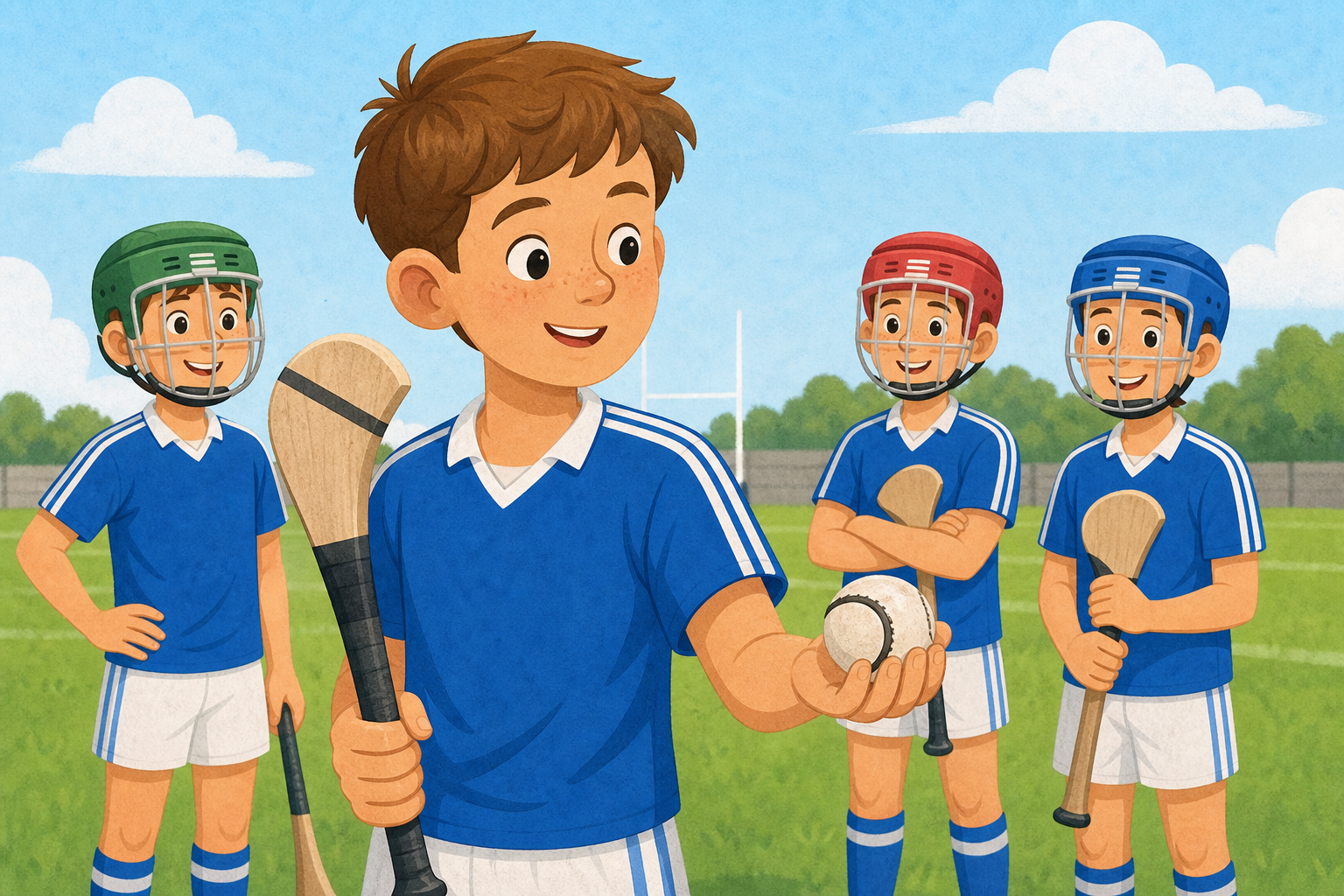
Imagine your team has 12 sliotars to share out fairly. If three players share them equally, how many does each player get? And here is the tricky question: what fraction of all the sliotars does one player end up holding?
Take three hands-up answers, not open call-outs. Give five seconds of quiet think-time first.
Listen for a pupil linking one player's share to one third — that link between sharing and the fraction is the whole point of the lesson. If nobody makes it, don't hand it over; hold it for Watch and Notice.
Watch the counters get shared into equal groups. The bottom number of the fraction tells us how many groups to make. Predict how many land in each group before it reveals.
One half of 8: shares into 2 groups, 4 in each. Draw out that the bottom number, 2, tells how many groups to make. This unlocks every later example.
One quarter of 12: 4 groups, 3 in each. Take one hands-up prediction before the reveal.
One third of 9: 3 groups, 3 in each. Pause here. Same answer 3 as one quarter of 12, but different fraction and different whole. Revoice a pupil who notices this.
One half of 10: 2 groups, 5 in each. Confirm sharing into 2 groups is the same as dividing by 2.
Throughout, head off the muddle between the bottom number (how many groups) and the answer (how many in one group).
Today we work through these together on the equal-groups tool: one half of 6, one third of 12, one quarter of 8, and one fifth of 10. Each time we share the whole set into the number of equal groups the bottom of the fraction asks for, then read off how many are in one group.
This round is for talking it through together — pupils take turns at the board and the class agrees or corrects out loud.
Call the fraction and the whole; the pupil at the board sets the group count to match the bottom number, then deals the counters. The class predicts how many will be in each group before the dealing finishes.
The order builds: one half of 6 (small, 3 each) → one third of 12 (4 each) → one quarter of 8 (2 each, more groups) → one fifth of 10 (2 each again, but five groups — the key one where pupils see the bottom number is the group count, not the answer). Revoice: the bottom number is how many groups, not how many in each.
In your maths copy, draw 8 counters and ring them into 2 equal groups. Write underneath: one half of 8 = 4. Then draw 6 counters, ring them into 3 equal groups, and write one third of 6 = 2.
Walk the room glancing at whether the rings hold equal amounts and the equation is written out fully. No marking — this is whole-class copybook practice, not assessment.
Today we work through these numbers together: one half of 14, one quarter of 16, one third of 15, and one fifth of 20. For each one, share the whole set into equal groups, read one group, and record it as "fraction of number = answer".
Pupils take turns at the board, check each answer, and the class confirms before moving on. Keep the board work brisk rather than over-explaining.
The practice set steps up: one half of 14 (7) uses odd tens, one quarter of 16 (4) adds a group, one third of 15 (5) is a familiar split, and one fifth of 20 (4) is the ceiling — five groups from twenty. Watch pupils who set the group count to the top number instead of the bottom.
You're previewing this lesson. Get full access to this lesson and hundreds more — each one ready to teach, with interactive activities, printable resources and pupil progress tracking built in.