1 - Getting Started ~5 mins
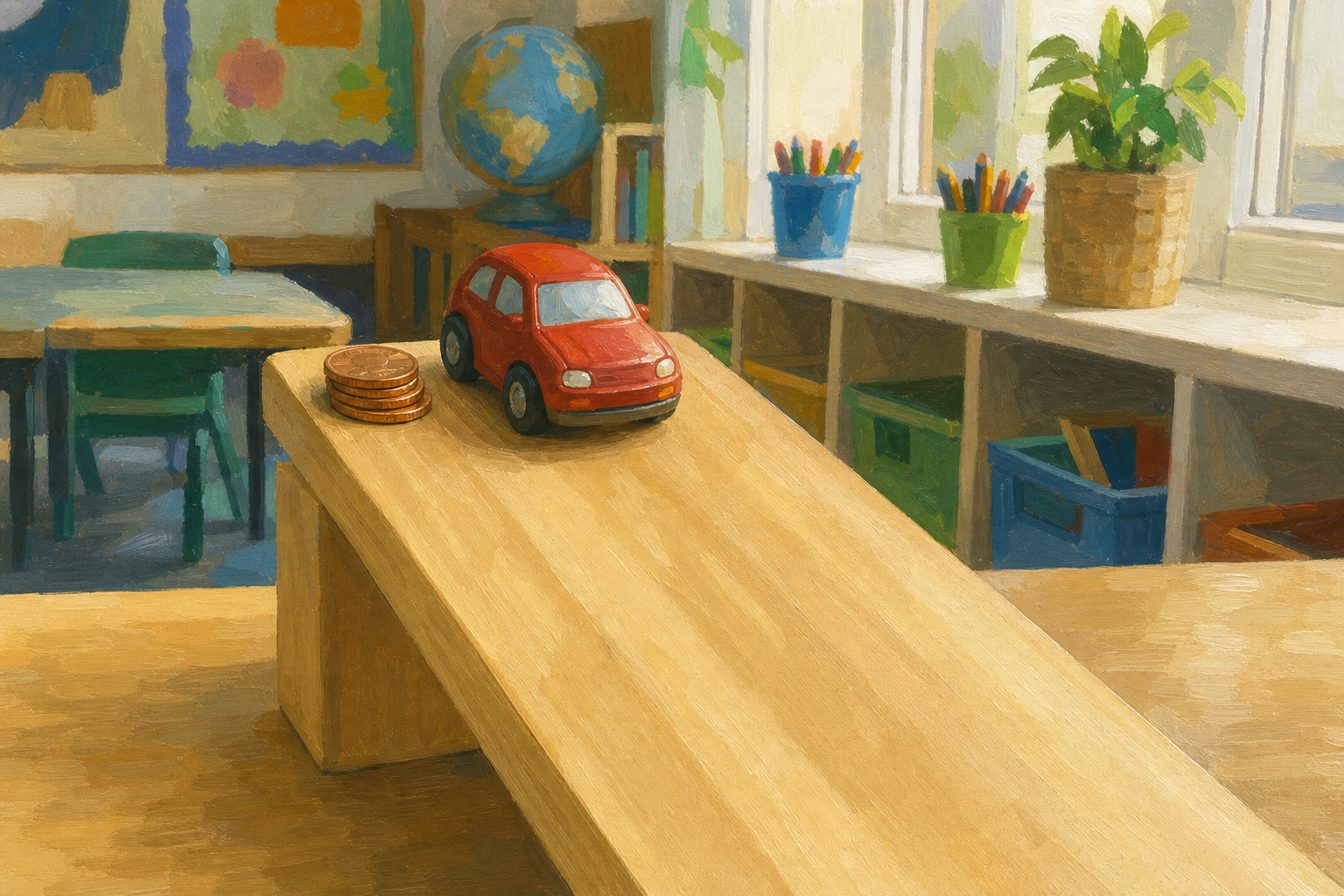 A playground slide that is too steep sends children flying. A slide that is too gentle leaves them stuck halfway. How do engineers decide what is safe?
Today each group will pick its own force question about rolling cars and plan a careful test to answer it, changing only one thing at a time. What would you like to find out?
Hold up a toy car and a short board ramp. Do not set up the full stations yet. Ask: If a playground designer wanted to know whether a steeper slide makes you go faster, what would they need to keep the same every time?
Collect two or three quick ideas. Link to Irish life: engineers who design playgrounds, roads and ramps use careful, repeated tests so decisions are based on evidence, not guesses. That is why we trust the slope of a school slide or a wheelchair ramp.
If a child asks why a steeper slope might go further, keep it light here: On a steeper slope more of the pull is along the ramp, so the car can speed up more before it leaves. Save deeper force talk for the evidence discussion.
Keep the hook light — no apparatus layout, no variable list, no full vocabulary yet. Save the exact phrase fair test for the next step. The ramps come out in the plan and experiment steps.
2 - What Makes a Force Test Fair? ~5 mins
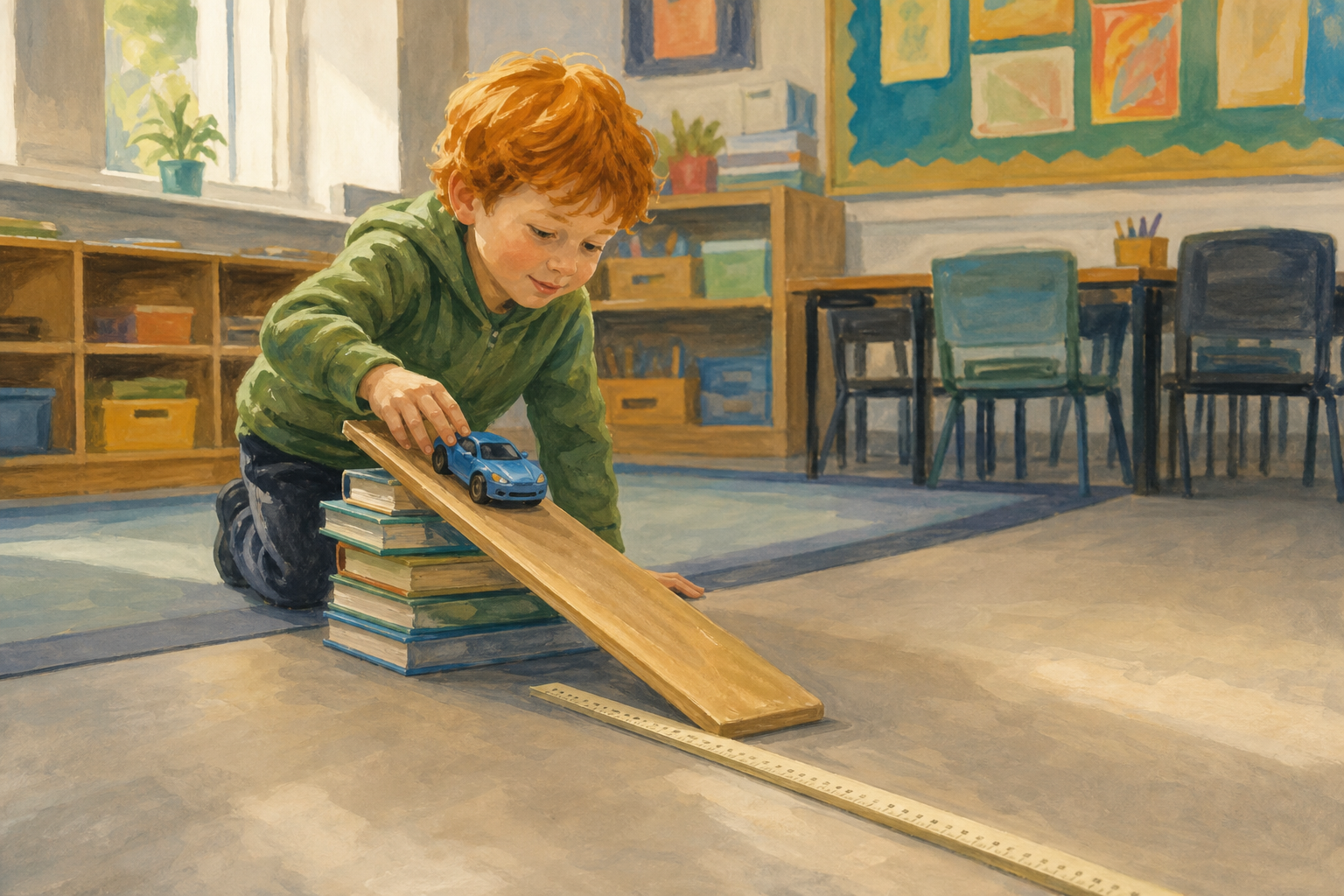 If two groups get different answers, what might have made their tests unfair?
Fair test: change only one thing. Measure one thing. Keep everything else the same.
As we model with the ramp, watch for Change: the one thing we change on purpose (for example, ramp height). We will meet Measure and Average as each part of the model happens.
| Concept | Why it matters | Example |
|---|---|---|
| Fair test — a test that changes only one thing, measures one thing, and keeps everything else the same | Unfair tests mislead engineers; a safe playground or road needs evidence you can trust | Same car, same start line, same floor — only the ramp height changes |
| What we change — the single thing the group decides to change | If you change two things at once, you cannot tell which one caused the result | Adding coins to make the car heavier, or raising the ramp steeper |
| What we measure — the result you record each trial | Careful measuring turns a feeling into evidence you can compare | Distance on the floor from the bottom edge of the ramp to the front of the car (cm) |
| Average — a single typical number from several trial results (add the trials, then divide by how many there were) | One odd roll can mislead; three trials and an average make the answer more trustworthy | 80 + 84 + 76 = 240; 240 ÷ 3 = 80 cm |
Board and live model (fit the five minutes): put the unfair-test question first so pupils have a reason to care. Keep the fair-test sentence on screen from the start. Reveal labels one at a time as you act each beat — do not dump Change, Measure and Average together before any doing.
Non-negotiable in these five minutes (protect this even if time is tight): one clear roll at the low height, one clear roll at the high height, and the board average micro-script left visible. Steps 5 and 6 rely on that average model. Do not skip it. Extra force talk belongs in the step 1 hook or the step 7 evidence discussion.
Short live demo (teacher performs — do not read aloud as a script):
I wonder whether a steeper ramp makes the car roll further. I predict the steeper ramp will send it further. Reveal Change: only the ramp height (two books, then four books). I keep these the same: the car, the start line, the floor, and how I release it. Reveal Measure: do one clear roll at the low height and one clear roll at the high height, calling out the distances (for example about 45 cm then about 90 cm). Each time, measure from the bottom edge of the ramp to the front of the car on the floor. Reveal Average with a 20-second board micro-script using tidy numbers, not six live rolls: If three trials were 80 cm, 84 cm and 76 cm: 80 + 84 + 76 = 240; 240 ÷ 3 = 80 cm. Leave that worked example visible. I think steeper ramps make the car roll further when everything else is fair. Full multi-trial practice belongs to the pupil experiment, not this step.
Misconception to head off: children often change the car and the ramp together, or push the car instead of releasing it. Fair means one change only, and the same gentle release every time.
What to expect later: steeper usually means further. Heavier cars sometimes roll a similar distance, and sometimes a little further or less — friction and how the extra weight is stuck on both matter. Treat whatever the averages show as the evidence; that is why repeats matter.
3 - Choose Your Force Question ~5 mins
In your group, pick one force question you can really test with a car and a ramp. Turn it into a clear question, then say what you predict and why.
Ideas to choose from: Does a heavier car roll further? Does a steeper ramp make it go further? Does a smooth floor let it roll further than carpet?
Agency: the theme is forces that change how a car moves. Each group chooses its own testable question within that theme. Do not assign the same question to every group unless a group is stuck.
Visit groups quickly. Push vague ideas into testable ones: "Which is better?" becomes "Does adding three coins change how far the car rolls?"
Predictions are never wrong — they are the start of the science. Ask every group to say why, using a force idea (push, pull, gravity, friction) in plain words.
If two groups pick the same question, that is fine; their results can be compared later.
4 - Plan Your Fair Test ~10 mins
On the board we will sort the cards for one force question together. Five cards appear: weight of the car, distance rolled, ramp height, starting point and floor surface.
Which card goes in Change? Which goes in Measure? Which three must stay the same? Then complete your own FairTestPlanner page for the question your group chose.
Does a heavier car roll further?
Before the Lesson
- Print the FairTestPlanner Investigation Journal page (one per pupil or pair).
- Have the toy cars, ramps, coins or modelling clay, metre sticks and surface samples ready to hand out after planning — not before.
Driving the interactive
Open the fair-test-planner on the IWB in explore mode. The question on screen is: Does a heavier car roll further down the same ramp? The five cards are weight of the car, distance rolled, ramp height, starting point and floor surface.
Invite pupils to call out placements. Target sort for the model: Change = weight of the car; Measure = distance rolled; Keep the same = ramp height, starting point, floor surface. If the class puts a card wrong, ask If we changed that as well, could we still trust the answer?
Optional one-line aside on "weight": We say weight here meaning how heavy the car is — the coins add mass (stuff) so it feels heavier. No need to rename the card for 4th Class.
Then each group fills its own paper FairTestPlanner for their question — they decide what to change, what to measure and what to keep the same. That group-level design choice is where this inquiry is open-ended.
Look-fors on the planner: only one thing in Change; a measurable result; at least three sensible Keep-the-same items; a release method that does not include a push.
5 - Run and Repeat Your Force Test ~20 mins
You are about to find out whether your force idea holds up: the averages will settle the argument.
Set up the test your group planned. Change only the one thing on your planner. Release the car the same way every time — no pushing.
Run at least three trials for each version you try (for example 0 coins and 3 coins, or low ramp and high ramp). Measure from the bottom edge of the ramp to the front of the car on the floor, in centimetres. Write every reading on your DataTable page as you go.
To find each average, add the three trial distances and divide by three. Board example: 80 + 84 + 76 = 240, and 240 ÷ 3 = 80 cm.
Room layout
Arrange stations around the edge of the room so each group has a clear floor run-out of about 1–2 metres that does not cross another group's path. Push chairs fully under desks before anyone starts. Hand out apparatus only when stations and paths are clear.
Tight-space wave model (use when a full set of run-outs will not fit)
Do not silently halve the hands-on time. Split the 20 minutes so both waves still get a full trial-and-measure block:
- Minutes 0–2: all groups finalise planners and agree release and measure point; hand out apparatus to Wave A only.
- Minutes 2–11 (about 9 min): Wave A runs two versions × three trials, measures and records. Wave B stays at desks: whisper-checks release method against the board model, double-checks Change / Measure / Keep-the-same on their planner, and watches one Wave A release to coach fairness (no separate make-work sheet).
- Minutes 11–13: swap. Wave A clears the run-out; Wave B sets up.
- Minutes 13–20 (about 7 min): Wave B runs the same two-version, three-trial block. Wave A finishes any missing averages using the board example and packs spare kit to the side.
Keep the two-version cap for most groups in either layout so set-up, six trials, measuring and recording fit.
Setup
One station per group: a board or stiff card ramp on books, one toy car, a metre stick or tape along the floor, chalk or tape for a start line (release point), and the extras their question needs (coins or clay for weight; a second ramp height; a scrap of carpet or card for surface).
Class measure rule (state once before trials)
Everyone measures the same way: from the bottom edge of the ramp to the front of the car on the floor (cm). The start line is only for a fair release. Keep the ramp board length the same when height is the variable being changed.
Average method on the board before trials start
Before anyone rolls, point back to the worked example from step 2 (or rewrite it large): 80 + 84 + 76 = 240; 240 ÷ 3 = 80 cm. Say once: Add your three trial distances, then share that total into three equal parts — that is the average for that version. This is the only calculation needed. Groups then finish averages on the paper DataTable during or straight after their trials so step 6 is call-out and chart reading, not first teaching of mean.
During the experiment
- Check each group is changing only one thing. If they raise the ramp and add weight, stop them and ask which question they are really answering.
- Model a fair release once more if needed: fingers off, car free at the start line.
- Three trials minimum per version. If a car hits a chair leg, that trial does not count — rerun it.
- First-time or less confident groups should test only two versions of their variable (for example 0 coins and 3 coins, or low ramp and high ramp). Confident groups with full floor space can add a third version or refine how they judge the stop point.
- Pupils who should not crouch or chase cars can be the official measurers and recorders.
Differentiation: less confident groups can use the modelled question (heavier car) with two versions only. Confident groups (full room layout) can add a third version (for example 0, 3 and 6 coins) or refine how they judge the stop point.
Safety: roll cars away from feet and faces; keep the run-out clear; no standing on chairs to make taller ramps — stack books on the floor or desk only.
Unlock the full learning experience
You're previewing this lesson. Get full access to this lesson and hundreds more — each one ready to teach, with interactive activities, printable resources and pupil progress tracking built in.
This lesson is copyright of Coding Ireland 2017 - 2025. Unauthorised use, copying or distribution is not allowed.