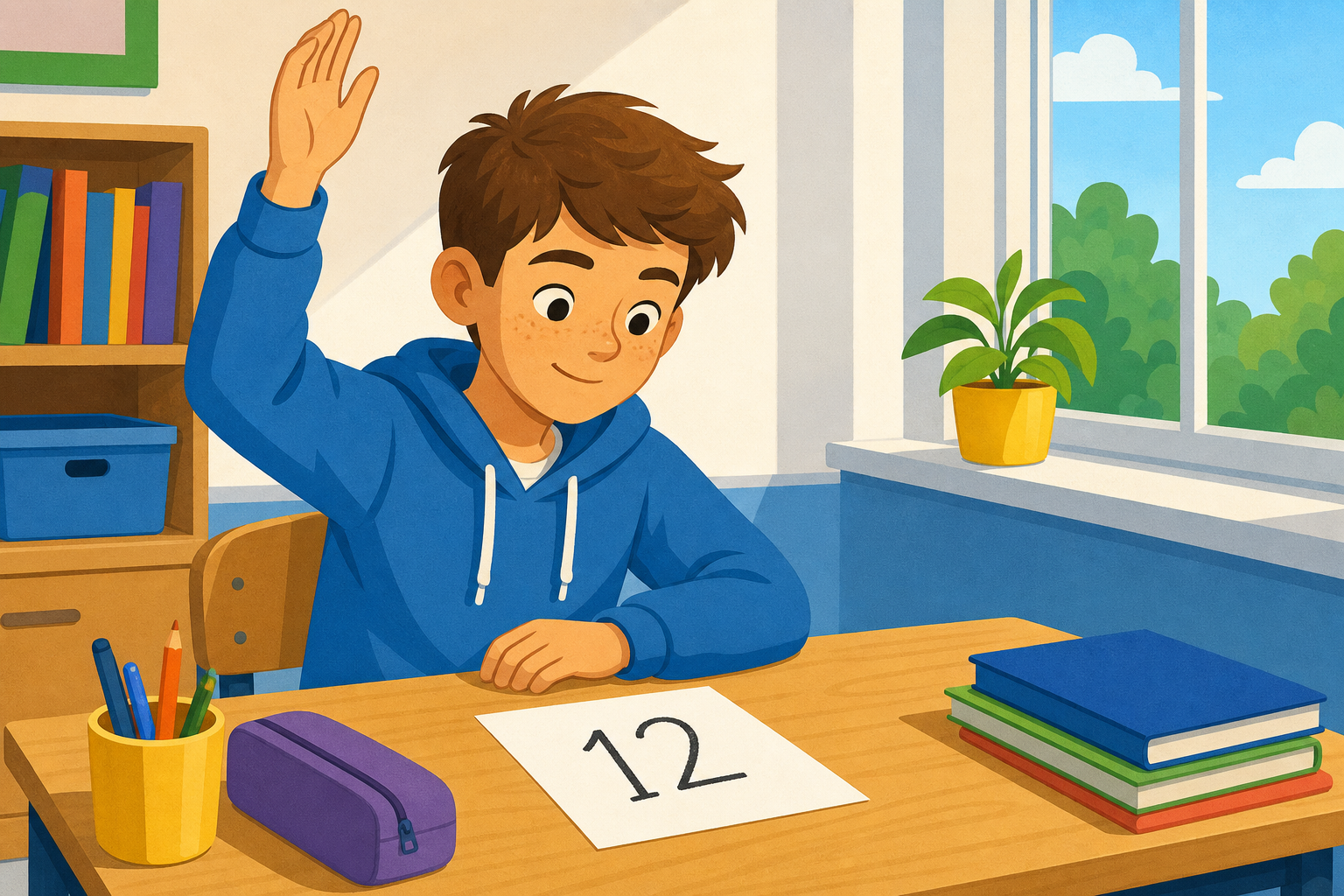
Here is a number to think about: 12. Name every whole number that divides into 12 with nothing left over. Hands up when you have one.
Take three or four hands-up answers, not open call-outs, and collect them on the board (1, 2, 3, 4, 6, 12). Don't confirm they've found them all yet — that's the point of the lesson. If a pupil offers 5 or 8, ask does 12 share evenly into fives? and let the class decide.
The hundred square shows three different shading patterns, one after another. Look at which numbers are shaded in each pattern and look for what the shaded cells have in common.
Factors of 24: shaded are 1, 2, 3, 4, 6, 8, 12, 24. Point to the pairs that multiply to 24 - 1 and 24, 2 and 12, 3 and 8, 4 and 6. Every factor has a partner.
Multiples of 6: 6, 12, 18, 24, 30 and on. Trace how they step across the ten-wide grid in two slanting columns. Ask what comes next after 30 before it shows. Multiples never run out; factors do.
Primes under 30: shaded are 2, 3, 5, 7, 11, 13, 17, 19, 23, 29. Key idea - a prime has exactly two factors, itself and 1. More than two makes it composite, e.g. 9 has 1, 3 and 9. Head off the slip that 1 is prime: 1 has only one factor, so neither prime nor composite. Note after 2 none shaded is even, and they spread out through the twenties.
Today we work on one grid at the front of the class together: shade all the multiples of 4, then all the multiples of 8. What do you notice about where the two patterns overlap? Then we'll shade the factors of 36 and count how many there are.
This round is for talking it through together — no marking yet. It runs on the single whole-class board grid, with pupils taking turns to shade while the rest watch and check aloud.
Start with multiples of 4, then switch to multiples of 8 on a fresh grid, and ask why is every multiple of 8 also a multiple of 4? (because 8 is a multiple of 4). Then set it to factors of 36 and count them together (1, 2, 3, 4, 6, 9, 12, 18, 36 — nine factors). Rotate three or four pupils to the board. To keep the watching class with each task, turn-and-name a pupil to say where the next shaded cell will land before it appears.
In your maths copy, for each number below write its full factor list, then list its first five multiples. Finally, mark each number as prime or composite.
Walk the room glancing at whether factor lists are complete and paired — no individual marking, this is whole-class copybook practice. Watch for pupils forgetting that 1 and the number itself are always factors, and remind them a prime's factor list has exactly two entries.
Today we work through these together on the board, one at a time: first shade all the multiples of 3, then all the multiples of 7, then all the primes under 30.
Then the stretch. First look at 6 together: its factors are 1, 2, 3 and 6 — that is exactly four factors. Your job is to hunt for every other number on the grid whose factor list has exactly four numbers in it. Count the factors by hand for each number you try.
These are the practice questions — pupils take turns at the board, check each answer, and the class confirms before moving on. Keep the board work brisk rather than over-explaining.
Model the four-factor idea on screen first with 6 (factors 1, 2, 3, 6) so pupils have a method: write the factor list, then count how many there are. Let pupils find the rest by counting factors by hand rather than needing a rule — 6, 8, 10, 14, 15, 21, 22, 26, 27, 33, 34, 35 and so on. If stronger pupils spot the pattern (product of two different primes, or a prime cubed), let them share it, but no pupil needs it to attempt the task. Use the Check button after each of the first three shadings; the class confirms with a yes, that's it. For the stretch, count factors aloud on whatever numbers pupils find and keep the pace moving rather than waiting for a full-grid match.
You're previewing this lesson. Get full access to this lesson and hundreds more — each one ready to teach, with interactive activities, printable resources and pupil progress tracking built in.