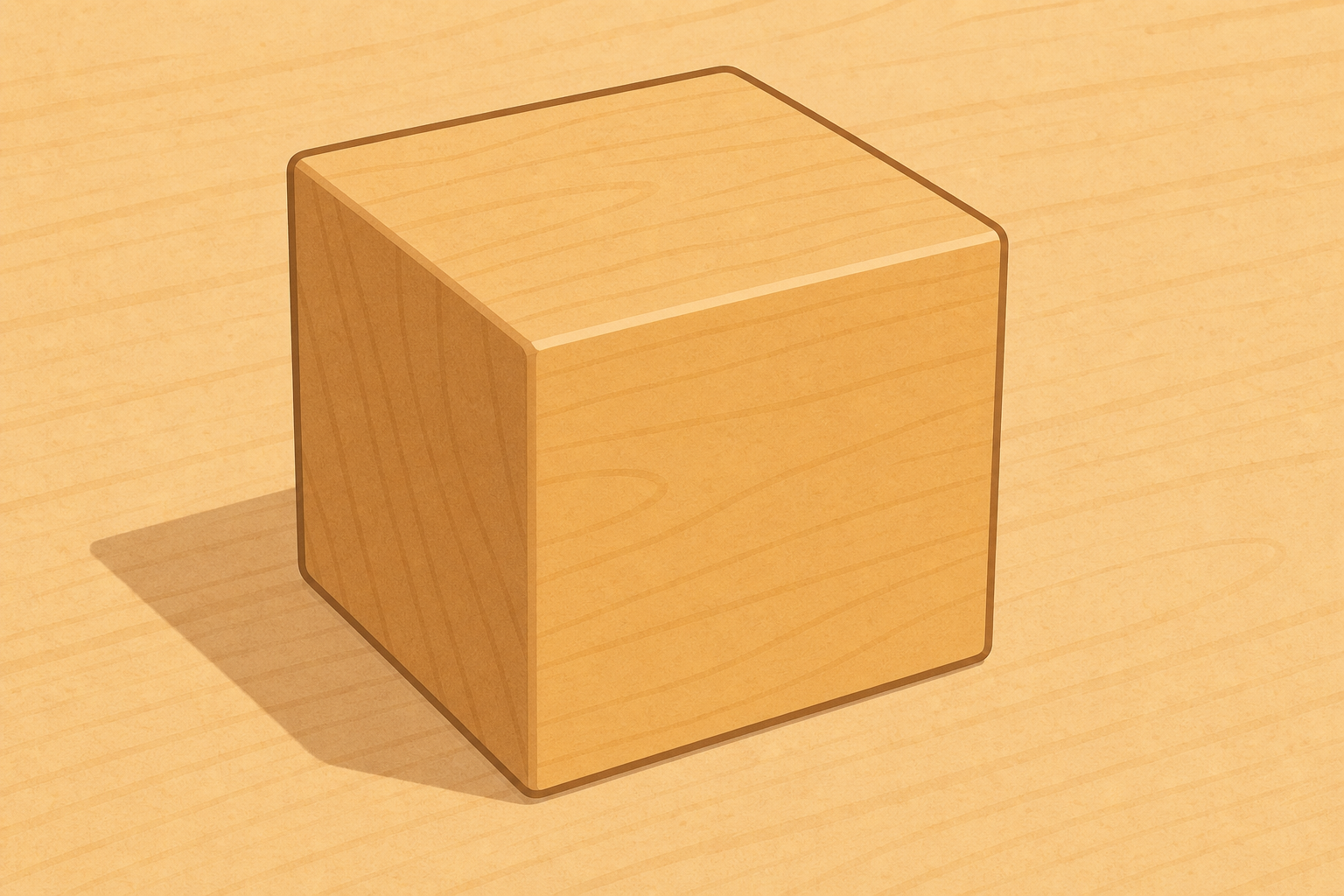
Here is a cube. Without touching it, how many corners do you think it has? Hands up with a number before we count.
Some of the corners are round the back where you cannot see them. That is going to be the tricky part today: counting the parts you cannot see.
Take three hands-up guesses for the corners, don't confirm yet. The point is to surface that pupils forget the hidden ones — most will guess 4 or 6 by counting only what faces them.
Give five seconds of quiet think-time before any hands go up.
Watch along as these four solids turn. This is a watch-along: you do the counting in your head as we count together on the board, so following closely is your job here.
For each solid we count three things: the flat faces, the straight edges where two faces meet, and the corner points, which we call vertices. Some edges and corners hide round the back, so we turn the shape to catch them all. As we count, look for anything the same across the four solids.
Do not point out any pattern in the numbers yet — that is the pupils' job in the next steps.
In your maths copy, rule a table with four columns: Solid, Faces, Edges, Vertices. Write one row for each of the four solids we counted.
Fill in the three counts for each. Then look down your table and write one sentence about any relationship you spot between the three numbers in a row.
Walk the room glancing at column headings and the row counts — no marking, this is whole-class copybook practice. Hold back from naming the F + V − E pattern; some pupils will start to notice their rows behave the same way, and that noticing is the next step's fuel.
If you would rather not have pupils rule the table by hand, a printable four-solid recording sheet (with a spare F + V − E column ready for step 5) can be handed out here instead — it is only a convenience, and the copybook table works just as well.
Today we work through these solids together, turning each one to count the parts we cannot see: first the cube again to warm up, then the cuboid, then the triangular prism, and finally the square pyramid. Each time, one of you comes to the board, turns the solid, and taps each face, edge and vertex once so nothing is counted twice.
Before each new solid, the rest of the class calls out how many faces they expect, then we check the count against the prediction as the board pupil turns it.
Talk this one through together — pupils take turns at the board and the class agrees or corrects out loud.
Use the whole-class prediction between solids as your pacing lever: before each solid, take two hands-up guesses for the face count, then have the class watch the board pupil confirm or correct it. This keeps the back rows in the count across all four solids without any desk task.
Insist that each part is tapped once and only once; the whole skill is a system for not double-counting. The edges on the far side are where the count goes wrong — make the pupil at the board turn the solid fully before they claim a total. Revoice a good move: so we turned it right round to catch the back corners.
Work out F + V − E for each solid and see what you get.
Today's investigation: does the same hidden pattern turn up in every solid? Using F for faces, V for vertices and E for edges, you already have F, E and V for each solid in your copy. Now work out F + V − E for each row and see what you get.
Predict what F + V − E will come to before we check each one, then confirm the counts on the board. The order we work them: cube, then cuboid, then triangular prism, then square pyramid.
This is the practice round — pupils take turns at the board, check each answer, and the class confirms before moving on. Keep the board work brisk rather than over-explaining.
The check here confirms the counts (F, E, V); pupils then work F + V − E in their copy (or on the printable recording sheet if you handed it out earlier) for each. The lesson lands when a pupil says the answer is 2 every time — hold out for a pupil to say it rather than announcing it. For the pyramid: 5 + 5 − 8 = 2. Ask would you bet it works for a solid we haven't tried yet? before the wrap.
You're previewing this lesson. Get full access to this lesson and hundreds more — each one ready to teach, with interactive activities, printable resources and pupil progress tracking built in.